
Why the Purchase Price Is Only the Starting Point
Most buyers enter a dealership focused on one number: the sticker price or the negotiated sale price. That figure is real, but it is far from complete. Research from consumer automotive organizations consistently shows that the purchase price accounts for roughly 40-50% of what the average owner spends over a five-year period. The remainder is distributed across depreciation, fuel, insurance, financing interest, scheduled maintenance, unscheduled repairs, registration fees, and tires.
Understanding this full picture before signing is not just a financial nicety - it is the difference between a vehicle that fits your budget and one that quietly strains it for years. Be aware, too, that widely repeated ownership cost assumptions often don't hold up under scrutiny. See our examination of common ownership cost myths for context before you begin your calculations.
Build a Comparison Spreadsheet
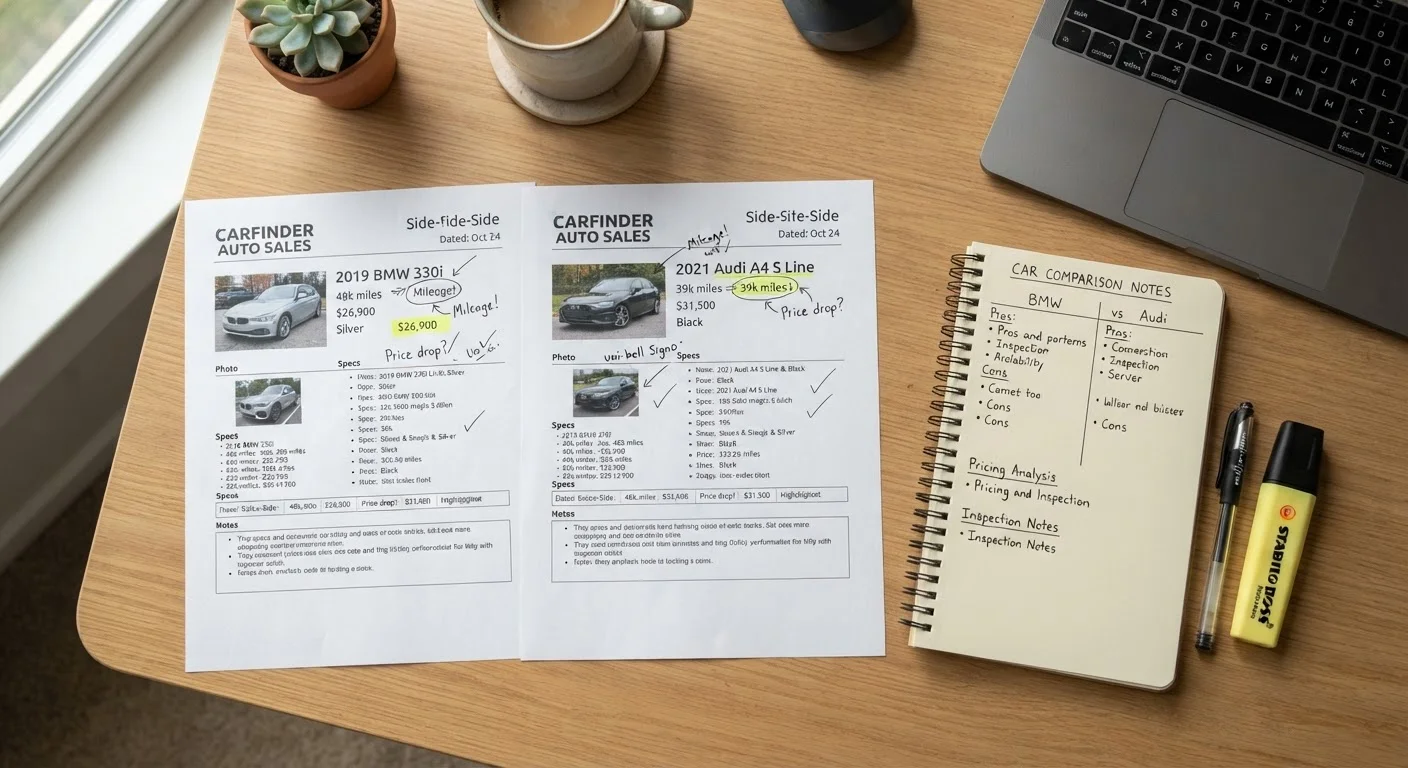
Create one column per vehicle you are seriously considering, then fill in each cost category row by row. The side-by-side view often reveals that a vehicle with a higher sticker price has a lower total ownership cost than a cheaper alternative - particularly when depreciation and fuel costs are factored in.
What You Need Before You Start
Gathering inputs takes most of the time. The calculation itself is straightforward once you have the numbers. Here is what to assemble:
What you will need
Government or insurer fuel economy data
Provides official MPG or MPGe ratings used to calculate annual fuel costs based on your estimated mileage.
Depreciation data from automotive valuation guides
Shows historical residual value percentages for a given make, model, and age so you can estimate value lost over your ownership period.
Insurance quote comparison
Gives a realistic annual insurance premium for the specific vehicle before purchase, which varies significantly by model.
Manufacturer scheduled maintenance guide
Lists the service intervals and typical costs for oil changes, filters, brake fluid, and other scheduled items across 60,000 miles.
Tire cost reference
Estimates how many tire sets you will need and their replacement cost - an expense that <a href="/car-buying-basics/ownership-costs/tyre-costs-over-a-vehicles-life-what-owners-often-underestimate">buyers frequently underestimate</a>.
Loan amortization calculator
Calculates total interest paid over the loan term so you can include financing cost in your ownership total.
The Step-by-Step Estimation Process
Work through each cost category in sequence. Record every figure in a single spreadsheet so you can compare multiple vehicles side by side.
Calculate your depreciation exposure
Depreciation is typically the largest single ownership cost. Look up the expected residual value of the vehicle at the end of your planned ownership period using an automotive valuation guide or market data. Subtract that projected future value from your purchase price. The result is your depreciation cost - the amount of money you will not recover.
Example: A vehicle purchased for $30,000 that retains 45% of its value after five years has a depreciation cost of $16,500.
Project your total financing cost
If you are financing, calculate total interest paid - not just the monthly payment. Use a loan amortization calculator with your purchase price (minus any down payment), your loan term in months, and your interest rate. The total interest figure is a real ownership cost that belongs in your projection. Review how loan terms influence this figure at the rates and terms hub.
Estimate annual fuel costs and multiply by ownership years
Divide your estimated annual mileage by the vehicle's official fuel economy rating (MPG or MPGe) to get annual fuel consumption. Multiply by your local average fuel price to get an annual fuel cost. Multiply that by the number of years you plan to own the vehicle.
Formula: (Annual miles ÷ MPG) × Price per gallon × Years owned = Total fuel cost
Add scheduled maintenance and expected repair costs
Pull the manufacturer's service schedule and price each interval for your planned mileage. Include oil changes, brake fluid, spark plugs, air filters, and any major services (e.g., timing belt or transmission fluid) that fall within your ownership window. For unscheduled repairs, industry data suggests budgeting an additional 10-20% on top of scheduled maintenance, increasing for older or higher-mileage vehicles. Component reference guides like our parts explained hub can help you understand what each service involves and when it typically occurs.
Include insurance, registration fees, and tires
Obtain an actual insurance quote for the specific vehicle before purchase - premiums vary considerably by model, trim level, and safety rating. Multiply the annual premium by your ownership period. Add estimated registration and licensing fees from your state or local authority. Finally, estimate how many tire sets you will need based on expected mileage and typical tire lifespan for that vehicle category, then price a replacement set at current market rates.
Sum all categories and calculate cost per mile
Add every figure together: depreciation + total financing interest + fuel + maintenance and repairs + insurance + registration + tires. This is your total projected ownership cost over the planned period. Divide by total miles driven to get a cost-per-mile figure. Cost per mile is a useful normalizing metric when comparing vehicles with different fuel economies or purchase prices.
Do Not Rely on Dealer Ownership Cost Estimates
Some dealers provide ownership cost summaries, but these may omit categories like depreciation or use optimistic fuel economy and insurance figures. Always build your own projection using independent data sources. The time invested - typically 30-45 minutes per vehicle - is modest relative to the financial commitment you are about to make.
Once you have a total five-year figure, divide by 60 to get a monthly cost of ownership - then compare that number across the vehicles you are evaluating, not just the monthly loan payment. After purchase, revisit your projections using our annual ownership cost audit checklist to track whether actuals are tracking your estimates.
This article provides general financial information for educational purposes only and is not personalised financial or purchasing advice. Costs vary significantly by location, driving patterns, vehicle condition, and individual circumstances. Consult a qualified financial adviser for guidance specific to your situation.