
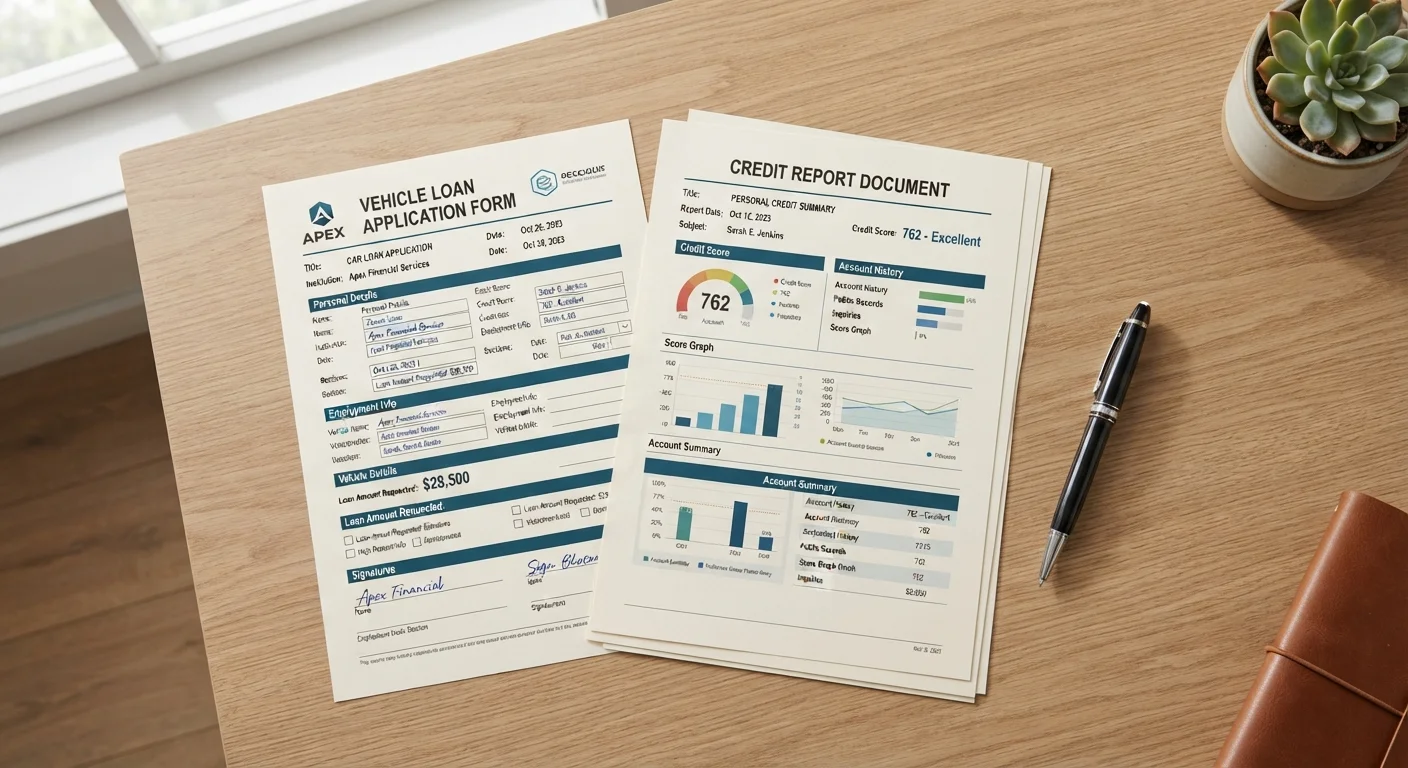
What Each Term Actually Means
The automotive finance industry uses pre-qualification and pre-approval loosely, and dealers sometimes treat them as synonyms. They are not. Each represents a distinct stage in the lending process, with different data inputs, different credit impacts, and different levels of commitment from the lender.
Pre-qualification is a preliminary estimate. A lender reviews self-reported information - income, estimated credit range, desired loan amount - and may run a soft credit inquiry to generate a range of likely loan terms. Because it draws on limited, unverified data, the result is an indication of eligibility, not a binding offer. Critically, a soft inquiry does not appear to other lenders and does not affect your credit score. This makes pre-qualification a useful, risk-free starting point when you're in the early comparison phase. For a deeper look at how inquiry types work, see how hard and soft inquiries differ.
Pre-approval is a conditional loan offer. The lender pulls a full credit report via a hard inquiry, verifies income and employment documentation, and issues a specific loan amount, interest rate (APR), and term. That offer is binding on the lender's side - subject to verification of the actual vehicle - for a defined window, typically 30 to 60 days. This is a meaningfully stronger signal of your borrowing capacity.
| Criterion | Pre-Qualification | Pre-Approval |
|---|---|---|
| Credit inquiry type | Soft inquiry (no score impact) | Hard inquiry (minor, temporary dip) |
| Data reviewed | Self-reported income, estimated credit range | Full credit report, verified income and employment |
| Output | Estimated rate and loan range | Firm loan amount, APR, and term |
| Lender commitment | None - indicative only | Conditional offer, valid 30-60 days typically |
| Negotiating value | Low - no binding figure to present | High - concrete benchmark for dealer comparison |
| Best stage to use | Early research and budgeting | When ready to purchase imminently |
Credit Impact and the Rate-Shopping Window
The credit score implications of each step are one of the most misunderstood aspects of auto financing. Pre-qualification's soft inquiry leaves no footprint on your credit report. Pre-approval's hard inquiry does - but the effect is usually minor (often fewer than five points) and temporary, typically recovering within a few months as long as other credit behaviors remain stable.
Where many buyers miss an advantage: modern credit scoring models, including FICO and VantageScore, include a rate-shopping window. Multiple hard inquiries for auto loans within a compressed period - generally 14 days under older FICO models and up to 45 days under FICO 9 and VantageScore 4.0 - are treated as a single inquiry for scoring purposes. This means you can apply for pre-approval from several lenders without compounding the credit impact, provided you do so within that window.
14-45 days
Auto loan rate-shopping window
FICO scoring models consolidate multiple auto loan hard inquiries into one if submitted within this window, minimizing credit score impact.
~5 points
Typical hard inquiry score impact
FICO data indicates a single hard inquiry generally reduces a credit score by fewer than five points, with recovery expected within months.
Understanding how your credit profile affects approval outcomes before you apply is worth the effort. The credit readiness checklist for car buyers walks through the key factors lenders scrutinize.
Negotiating Power and Practical Strategy
A pre-approval fundamentally shifts the dealership dynamic. When you arrive with a lender-issued offer in hand, you already know your maximum loan amount and your rate benchmark. The conversation with the finance and insurance (F&I) office becomes a comparison exercise: can the dealer's financing beat your pre-approved rate? If it can, you benefit. If it cannot, you already have your fallback. Without pre-approval, you are negotiating vehicle price and financing simultaneously - a position that gives the dealer more variables to work with.
Pre-qualification, while not carrying that same weight, is not without strategic value. It helps you establish a realistic budget ceiling before you fall in love with a vehicle that strains your finances. It also gives you enough information to have an informed conversation with a lender about which factors might be limiting your estimated rate range - credit utilization, derogatory marks, or thin credit history among them. If those issues are present, strengthening your credit before applying may be a more productive use of your time than rushing to formal pre-approval.
A practical sequence for most buyers: start with pre-qualification across two or three lenders to calibrate expectations, address any obvious credit issues, then pursue pre-approval from your preferred lender - or several lenders within the rate-shopping window - once you are genuinely ready to purchase. For broader context on how credit shapes the entire financing process, the guide on auto financing from credit check to repayment covers each stage in detail.
This article is for general informational purposes only and does not constitute personalised financial or legal advice. Consult a qualified financial professional for guidance specific to your circumstances.