
The Core Distinction: Ownership vs. Access
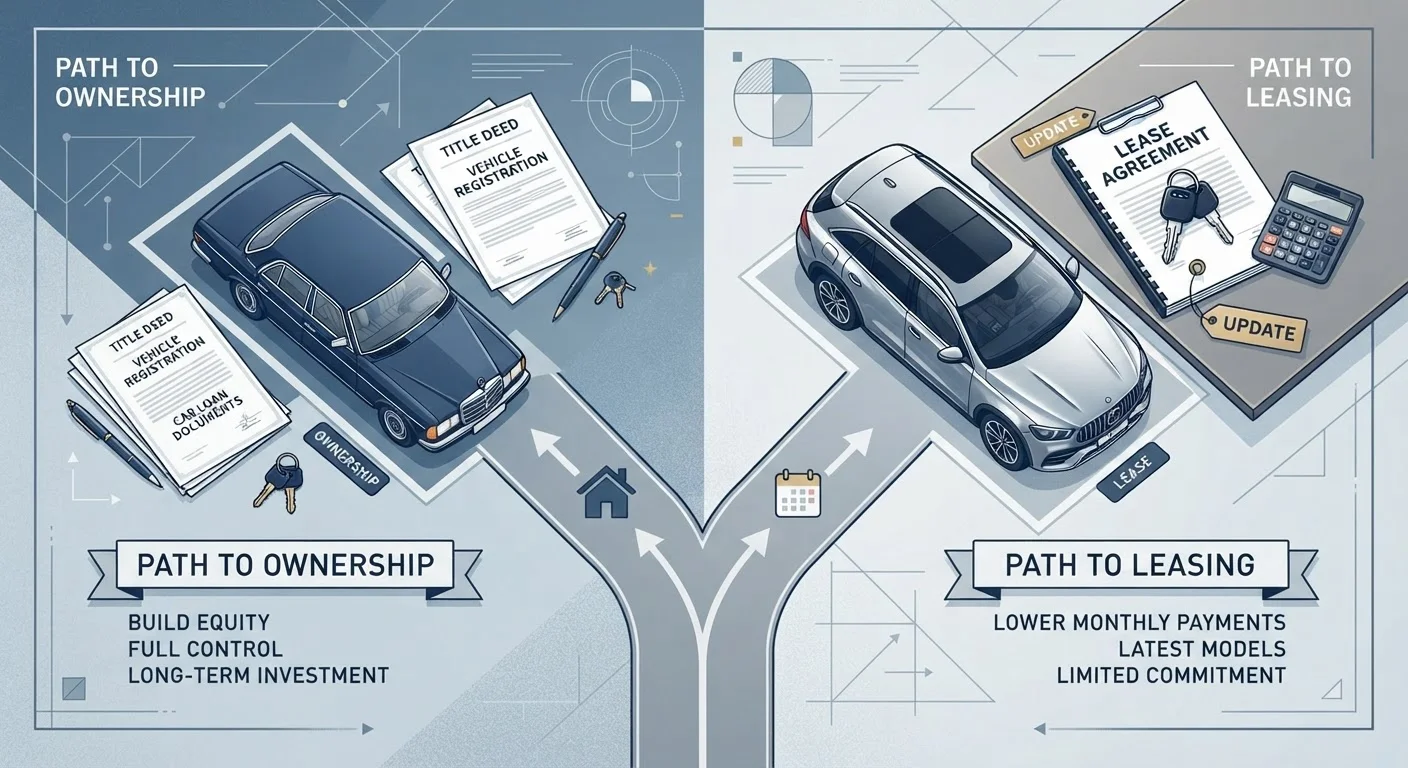
Every practical difference between an auto loan and a lease flows from one foundational question: are you acquiring ownership of the vehicle, or purchasing the right to use it? A loan answers that question with ownership. A lease answers it with access.
When you finance a vehicle with a loan, the lender holds a lien until the balance is paid, but you are the legal owner, responsible for the asset and entitled to its equity. When you lease, the financing company or automaker's captive lender retains ownership throughout the contract term. You are a renter with a structured exit.
This distinction cascades into nearly every other variable: what you can do with the vehicle, what you owe if you exit early, and what the arrangement is worth financially over time. For a detailed numerical comparison, see the side-by-side financial breakdown of loans and leases.
~30%
Share of new vehicle transactions that are leases
Industry analysts have historically estimated that leases account for roughly a quarter to a third of new vehicle retail transactions in the U.S., though this fluctuates with interest rates and incentive cycles.
$0.10-$0.30
Typical per-mile overage charge on a lease
Most lease agreements specify excess mileage fees in this range; the exact figure is disclosed in the lease contract and varies by vehicle segment and lessor.
2-4 years
Standard lease term length
Most consumer leases run 24 to 48 months, with 36-month terms being among the most common in the U.S. market, aligning with manufacturer warranty periods.
How Monthly Payments Are Calculated Differently
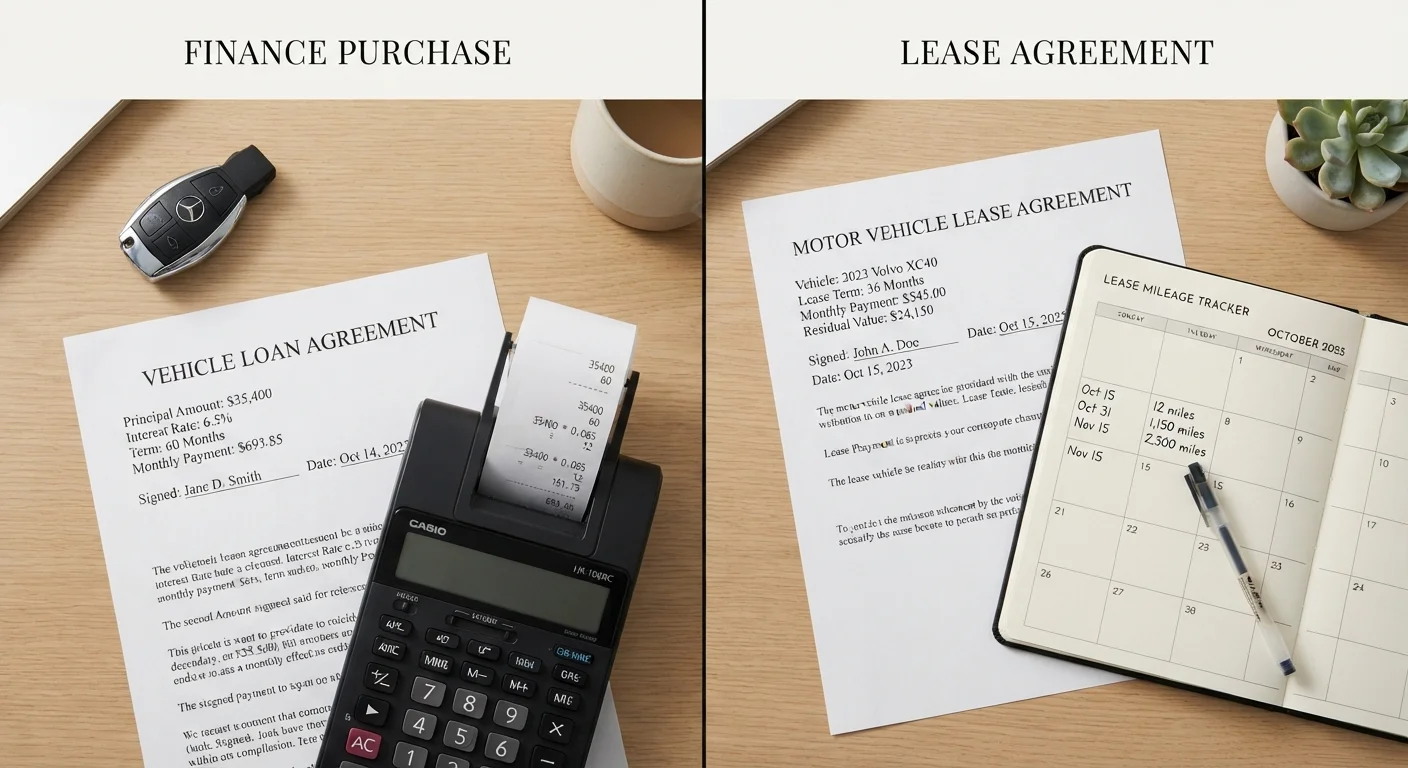
Loan payments are determined by the vehicle's purchase price, your down payment, the loan term, and the APR. You're amortizing the full financed amount plus interest over the loan period. Understanding how APR differs from a simple interest rate is essential - the difference between APR and interest rate can affect what you actually pay across the life of the loan.
Lease payments use a different formula. The key inputs are the capitalized cost (the vehicle's negotiated price), the residual value (the projected value at lease end), and the money factor (the finance charge). Your monthly payment covers the depreciation - the gap between cap cost and residual - plus the money factor charge applied to the sum of both values.
Because you're financing depreciation rather than the full vehicle price, lease payments on an equivalent vehicle tend to be lower. However, a low monthly payment isn't the same as a low total cost. Over multiple lease cycles, cumulative payments can exceed what an outright purchase would have cost - particularly if the vehicle would have retained strong resale value.
Convert the Money Factor Before Comparing
When evaluating a lease offer, always convert the money factor to an approximate APR by multiplying it by 2,400. This lets you compare the lease finance charge directly against loan APR offers on the same vehicle. A money factor of 0.00125, for example, equates to roughly 3% APR - a number that's far easier to benchmark against prevailing loan rates.
Mileage, Wear, and Flexibility Constraints
Loans impose no usage restrictions. Drive as many miles as you choose, modify the vehicle as you see fit (within legal limits), and sell or trade it at any time. The vehicle is your asset to manage.
Leases introduce structured boundaries that don't exist in loan agreements:
- Annual mileage caps - typically 10,000 to 15,000 miles per year. Overage fees at lease-end can be substantial.
- Wear-and-tear standards - lessors define acceptable condition at return. Damage beyond normal use triggers charges.
- Modification restrictions - alterations must usually be reversed before return or result in penalties.
- Early termination costs - exiting a lease before its end is significantly more expensive and complex than paying off a loan ahead of schedule.
These constraints make leasing less practical for high-mileage drivers, those who use vehicles for commercial purposes, or anyone who wants to customize their vehicle. Structured questions about your usage and budget can help you assess whether these constraints align with your actual habits.
Long-Term Financial Picture
The loan-vs-lease decision has compounding financial consequences that extend well beyond the monthly payment. A loan, once paid off, leaves you with an asset - a vehicle you can drive payment-free, sell, or trade. Every mile driven after payoff reduces your effective per-mile cost of ownership.
A lease provides access to a newer vehicle more frequently, often with warranty coverage throughout the term, but no residual asset. When one lease ends, another begins, and the payment cycle continues indefinitely unless you choose to purchase.
Depreciation - the rate at which a vehicle loses value - sits at the center of both calculations. For loan borrowers, rapid depreciation means the vehicle may be worth less than the loan balance early in the term (often called being "underwater"). For lessees, the same depreciation dynamic determines payment levels; a vehicle that depreciates quickly may actually lease at a comparatively favorable rate because the residual is lower and the math works differently.
For a broader view of how these costs compound over time, the true long-term costs of vehicle ownership are worth understanding before committing to either path. Readers weighing specific circumstances - driving patterns, vehicle preference cycles, and budget structure - may also find it useful to explore when leasing makes more financial sense than buying.
This article provides general financial education about auto loan and lease structures. It is not personalized financial advice. Readers should consult a qualified financial professional before making decisions based on their individual circumstances.