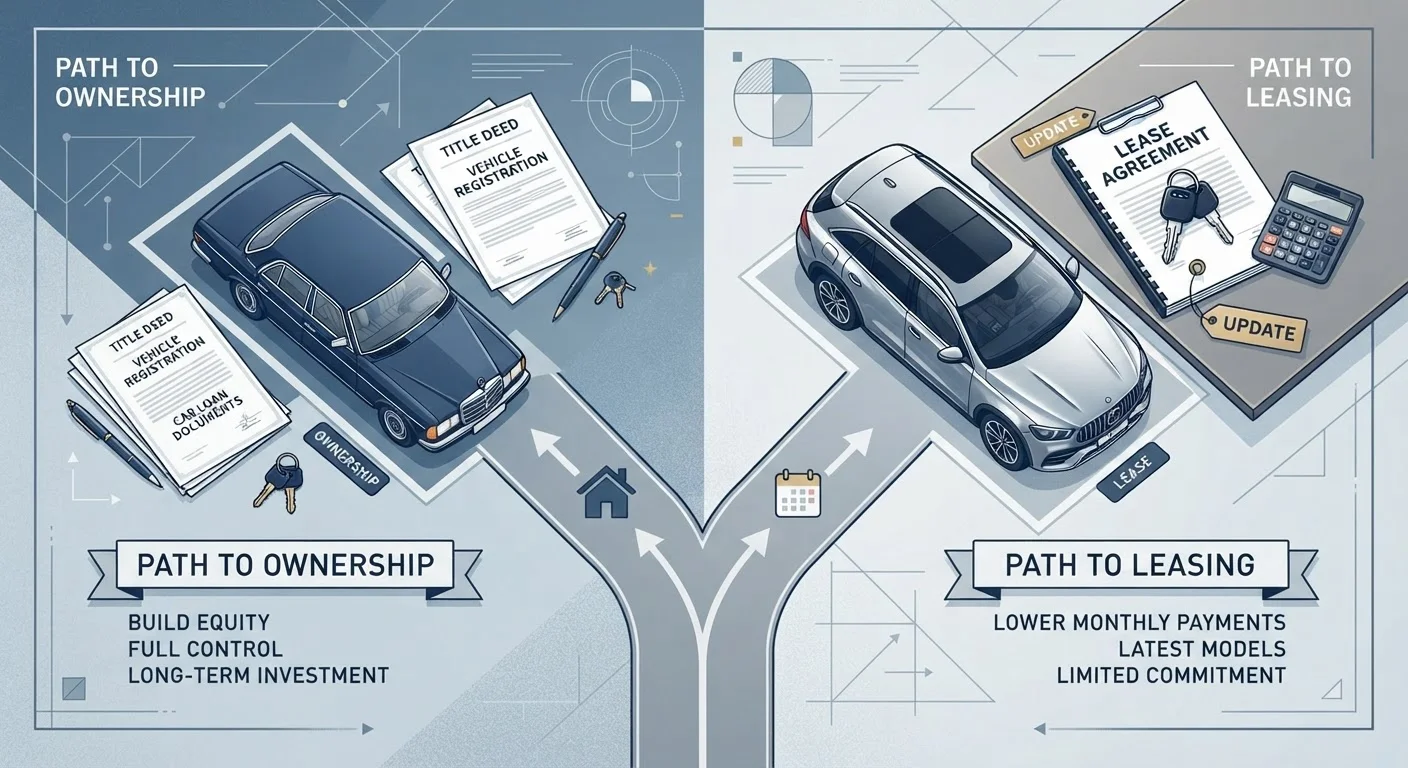

How Each Financing Structure Works
An auto loan is a secured installment credit product: a lender advances the purchase price (minus any down payment), and you repay principal plus interest over a fixed term - commonly 36 to 72 months. Title transfers to you at origination or payoff depending on lender structure, and you build equity as the balance declines. For a detailed look at how loan components interact, see our guide to auto loan structure.
A lease is a long-term rental agreement. You pay for the vehicle's depreciation during your contract term - typically 24 to 39 months - plus a finance charge (expressed as a money factor) and fees. At term end, the vehicle is returned to the lessor unless you exercise a purchase option at a pre-agreed residual value. No equity accumulates during the lease.
The distinction is foundational: one is a purchase mechanism, the other is a usage arrangement. That single difference cascades into every financial variable discussed below.
| Criterion | Auto Loan | Vehicle Lease |
|---|---|---|
| Ownership | Title transfers to buyer | Lessor retains title |
| Monthly Payment | Higher (full vehicle value) | Lower (depreciation only) |
| Mileage Limits | None | Typically 10,000-15,000 mi/yr |
| Equity Built | Yes, as balance decreases | None |
| Modifications Allowed | Yes, unrestricted | Generally prohibited |
| Early Exit Cost | Low to none (check terms) | Significant termination fees |
| End-of-Term Options | Keep, sell, or trade vehicle | Return or buy at residual |
| Typical Term Length | 36-72 months | 24-39 months |
Cost Comparison: Monthly Payments and Total Outlay
Lease payments are calculated on depreciation - the difference between the vehicle's capitalized cost and its residual value - rather than its full purchase price. This is why a lease on a $45,000 vehicle typically carries a lower monthly payment than a loan on the same vehicle, even when rates are comparable.
However, monthly payment is a misleading metric in isolation. A 60-month loan on a $40,000 vehicle at a 6% APR produces roughly $773 per month and approximately $46,400 in total payments. A 36-month lease on the same vehicle, then a second 36-month lease, results in 72 months of continuous payments with no asset at the end. Over a decade, a buyer who loans and holds will generally pay significantly less in total than someone who serially leases. Total ownership cost analysis is essential context for any honest comparison.
~$150-$200
Typical monthly payment difference (lease vs. loan)
Industry data consistently shows lease payments running lower than loan payments on equivalent vehicles, primarily because payments cover depreciation rather than total vehicle cost.
$0.15-$0.30
Per-mile overage fee range on leases
Excess mileage charges on consumer leases typically fall within this range per mile, making high-mileage driving considerably more expensive under a lease structure.
36-72 mo
Standard auto loan term range in the US
According to Experian's automotive finance data, the most common loan terms in the US consumer market span 36 to 72 months, with longer terms growing in share.
Down payment dynamics also differ. Lease contracts often call for a "capitalized cost reduction" (an upfront payment that lowers monthly costs), but consumer advocates frequently caution against large upfront lease payments - if the vehicle is totaled early in the term, that prepaid amount may not be recoverable.
Ownership Rights, Flexibility, and Exit Costs
With a loan, you own the vehicle outright once paid off and hold all attendant rights: sell it, modify it, use it as collateral, or drive it into the ground. Early loan payoff typically incurs no penalty (confirm with your lender), and selling the vehicle at any point is entirely within your rights.
Leases impose contractual restrictions. Mileage caps - standardly 10,000 to 15,000 miles per year - carry overage charges typically ranging from $0.10 to $0.30 per excess mile. Permanent modifications are generally prohibited, and early termination is costly: early lease termination fees can equal several months of remaining payments. For a structured look at which factors make one path more suitable than the other, consult our article on factors that decide whether a loan or lease fits your situation.
Lease Termination Is Rarely Cheap
Walking away from a lease early is one of the costlier decisions in consumer auto finance. Most contracts require the lessee to pay all remaining monthly payments, a termination fee, and sometimes a disposition fee. Unlike selling a financed vehicle where proceeds can offset the loan balance, there is no asset to liquidate when exiting a lease early. Review termination provisions carefully before signing any lease contract.
Gap coverage - which protects you if the vehicle is totaled and the insurance payout is less than the outstanding balance or residual - matters under both structures but is especially relevant for leases, where the lessor typically requires it.
Which Path Fits Your Financial Profile?
Credit profile matters in both scenarios, but differently. Lenders price auto loan APRs heavily on credit score and debt-to-income ratio. Lease approvals similarly depend on creditworthiness, with money factor (the lease equivalent of interest rate) tightening for lower-tier applicants. Lessors also consider residual risk, so they may be more selective. Those with credit challenges may find subprime auto loan trade-offs worth reviewing.
For rate structure within the loan context, it's also worth understanding fixed versus variable auto loan rates, as that choice affects your total cost exposure independently of the loan-vs-lease decision.
Ultimately, neither option is universally superior. The right choice depends on how long you intend to hold the vehicle, your annual mileage, your tolerance for payment certainty versus flexibility, and your broader financial goals. Our pre-decision checklist can help structure that analysis before you sign.
This article provides general financial information for educational purposes and does not constitute personalized financial, tax, or legal advice. Consult a qualified financial professional before making financing decisions specific to your circumstances.