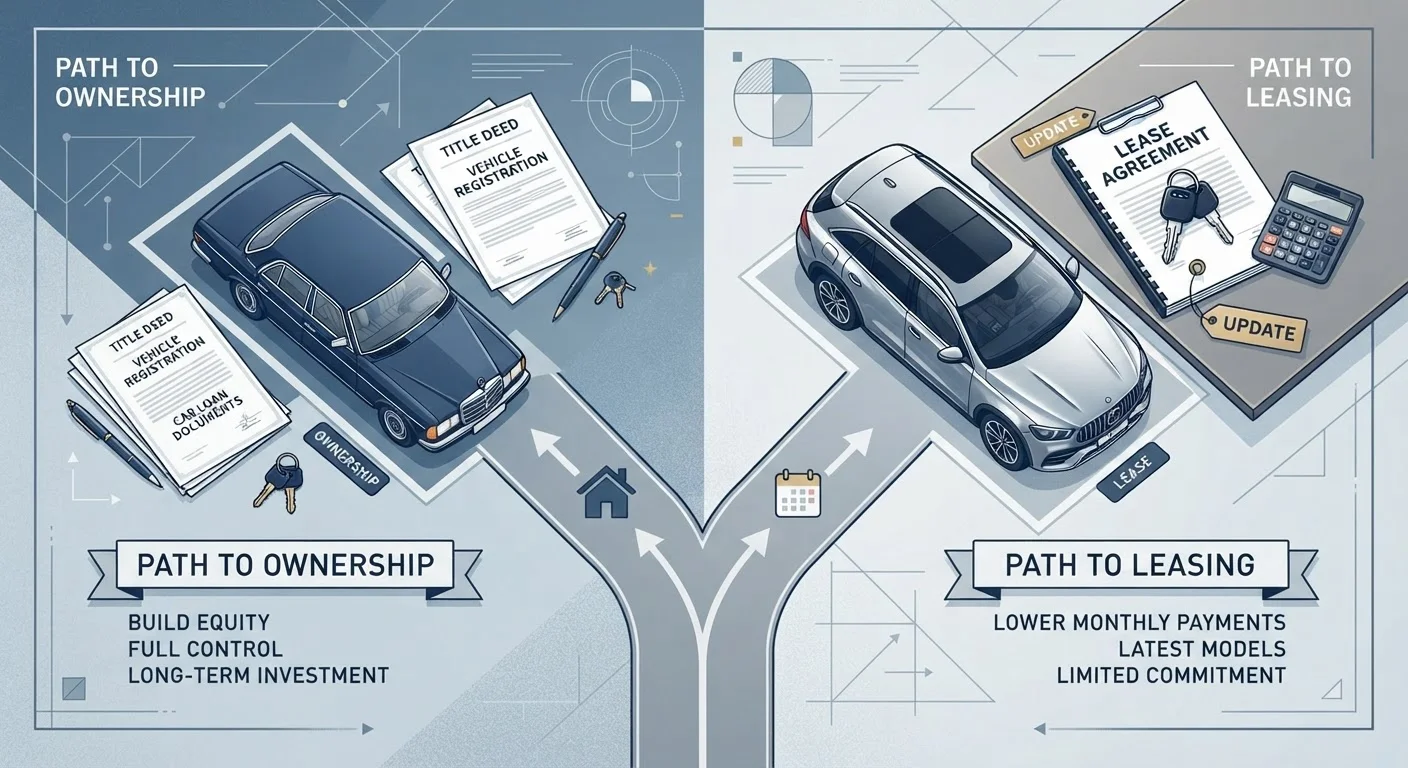

Loans vs. Leases: The Core Distinction
Every vehicle financing arrangement falls into one of two broad categories: a loan or a lease. Understanding the structural difference between them is the most important step for any new buyer.
When you finance a purchase with a loan, a lender pays the dealer on your behalf and you repay that amount - plus interest - over a set term, typically 24 to 84 months. At the end of the term, you hold the title outright. You can keep the vehicle, sell it, or trade it in whenever you choose.
A lease functions differently. You're paying for the vehicle's depreciation during a fixed contract period, not its full value. Monthly payments are usually lower than on a comparable purchase loan, but you return the vehicle at the end of the contract and have no accumulated equity. Leases also come with mileage limits - typically 10,000 to 15,000 miles per year - and excess wear charges that can add up at turn-in.
Lease vs. Loan: A Quick Decision Prompt
Before choosing between a lease and a loan, ask yourself three questions: How many miles do I drive annually? Do I want to customize the vehicle? Would I prefer to own an asset at the end of the contract? If you answered high mileage, yes to modifications, or yes to ownership, a purchase loan is likely the more suitable structure.
For buyers who drive high annual mileage, plan to customize their vehicle, or prefer long-term cost predictability, a purchase loan generally makes more financial sense than a lease.
How Credit Shapes Your Financing Options
Lenders use your credit profile to assess risk and set the interest rate on your loan. A higher credit score signals lower default risk, which typically translates into a lower APR offer. Even a difference of two or three percentage points in APR can meaningfully change the total cost of a loan over a multi-year term.
Your credit profile includes your score (most lenders use a FICO-based model), payment history, total debt load, and the length of your credit history. Before applying for any auto financing, it's worth pulling your own credit report to identify errors or accounts that may be dragging your score down.
For a deeper look at how credit history shapes every stage of the financing process, see this comprehensive credit and approval guide.
APR
Annual Percentage Rate - the yearly cost of borrowing expressed as a percentage, including the interest rate and certain fees. It is a more complete cost measure than the interest rate alone.
Loan term
The agreed repayment period for a loan, stated in months. A longer term reduces your monthly payment but increases the total interest you pay over time.
Principal
The base amount you borrow - typically the vehicle price minus any down payment or trade-in credit applied at purchase.
Residual value
In a lease, the projected value of the vehicle at the end of the contract. A higher residual value generally results in lower monthly lease payments.
Negative equity
A situation where you owe more on your loan than the vehicle is currently worth. Often called being 'underwater' on a loan.
Pre-approval
A conditional commitment from a lender stating the loan amount and rate you qualify for before you've selected a vehicle. It gives buyers a baseline for comparison when evaluating dealer financing offers.
Key Terms Every Buyer Should Know
Dealership finance offices use specific terminology that can feel opaque without context. A working familiarity with the core concepts keeps you from being caught off guard.
- Principal: The amount you borrow - the vehicle price minus any down payment or trade-in credit.
- APR: The annualized cost of borrowing, including the interest rate and certain fees. Always compare APRs, not just rates.
- Loan term: The repayment period in months. Longer terms mean lower monthly payments but more total interest paid.
- Residual value (lease): The estimated value of the vehicle at lease end, which partly determines your monthly payment.
- Money factor (lease): The lease equivalent of an interest rate. Multiply it by 2,400 to get an approximate APR equivalent.
For a full reference covering every term you'll encounter on a financing agreement, the auto loan terminology glossary is a useful companion. You can also explore how these terms interact in the rates and terms field guide.
Money Factor and APR Are Not the Same
A lease money factor is expressed as a very small decimal (e.g., 0.00125) rather than as a percentage. To approximate the APR equivalent, multiply the money factor by 2,400. This conversion is approximate and useful for comparison, but the two calculations are not structurally identical - factors such as residual value also influence the effective cost of a lease.
Choosing a Lender and Structuring a Deal
Auto financing is available from several source types: banks, credit unions, online lenders, and dealer-arranged financing (typically through captive finance arms or third-party lenders the dealer has relationships with). Each has trade-offs.
Credit unions frequently offer competitive rates for members, and their nonprofit structure often means lower fees. Banks can be convenient if you already have a relationship there. Dealer financing may include manufacturer-subsidized rates on certain models but sometimes bundles in less favorable terms elsewhere. Online lenders tend to provide fast pre-approval decisions and are easy to comparison-shop.
The most effective approach for most buyers is to obtain at least one pre-approval from an independent lender before entering the dealership. This gives you a concrete rate to benchmark against whatever the dealer proposes. It also separates the vehicle price negotiation from the financing conversation - two discussions that dealers often prefer to blend together.
Loan structure matters beyond the rate. A down payment of 10-20% of the purchase price reduces your principal, improves your loan-to-value ratio, and can help you avoid negative equity - a position where you owe more than the vehicle is worth. Keeping your loan term as short as your budget allows also limits total interest cost substantially.
To go deeper on how rates and terms interact across the life of a loan, visit the Rates & Terms hub, or explore the Credit & Approval hub to understand how lenders evaluate your application.
This article is for general informational and educational purposes only. It does not constitute personalized financial, legal, or investment advice. Readers should consult a qualified financial professional for guidance specific to their individual circumstances.