
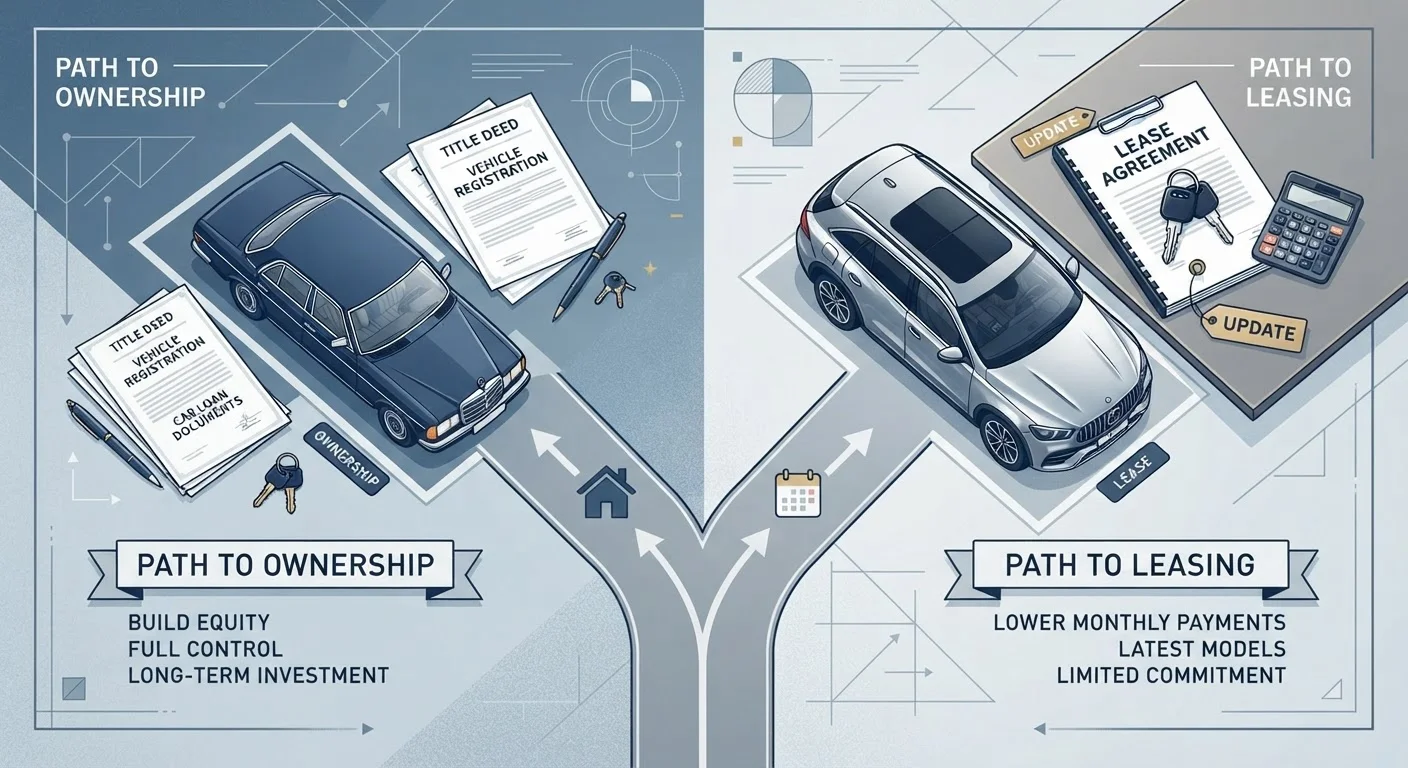
Why the Right Answer Depends on Your Specific Circumstances
There is no universal winner between a loan and a lease. Both are legitimate financing structures - each designed to serve a different profile of driver, budget, and ownership goal. The problem is that many vehicle shoppers evaluate these options by comparing monthly payment figures alone, which reveals only a fraction of the financial picture.
For a fuller analysis of the structural differences between these two paths, see what actually separates auto loans from leases. The eight factors below go further - they help you map those structural differences onto your own situation so the choice becomes clear rather than arbitrary.
Annual Mileage
Lease contracts set a mileage cap - typically 10,000 to 15,000 miles per year - and charge per-mile penalties, often $0.15 to $0.25 per mile, for anything beyond that threshold. Drivers who regularly exceed 15,000 miles annually will often find that overage charges erode any monthly payment advantage a lease initially appeared to offer. Loans carry no mileage restrictions, making them structurally better suited to high-mileage drivers. Low-mileage drivers, by contrast, rarely trigger penalties and can exploit lease pricing more effectively.
Mileage overages can quietly eliminate every dollar of monthly savings a lease seemed to offer.
Intended Holding Period
Leases are engineered for two- to four-year cycles. If you prefer driving a current-model vehicle and have no strong attachment to long-term ownership, a lease aligns naturally with that pattern. If you plan to keep a vehicle for seven or more years, a loan almost always produces a lower total cost - especially once you reach the point of owning the vehicle outright. Exiting a lease early typically involves substantial termination fees, so committing to a lease when your plans are uncertain carries real financial risk. See when leasing makes more financial sense than buying for a fuller picture of holding-period dynamics.
Early lease termination fees can be steep - uncertainty about your timeline favors a loan.
Credit Profile
Both loans and leases are credit-dependent, but lessors generally apply tighter approval thresholds. Many captive finance arms - the financing subsidiaries operated by automakers - reserve their most attractive lease programs for borrowers with prime or super-prime credit scores, broadly defined as 700 and above. Borrowers with lower scores may find that the advertised lease terms are unavailable to them, and the adjusted terms may be less favorable than a conventional loan. Understanding how your credit score shapes your options is foundational; credit and approval dynamics covers the mechanics in depth.
Captive finance lease promotions are typically reserved for borrowers with prime credit scores.
Customization and Modification Plans
Lessees return the vehicle at the end of the term, and leases require the vehicle to be returned in original or near-original condition. Aftermarket modifications - lifted suspensions, custom wheels, performance tunes, or even certain audio upgrades - must typically be reversed before return, or the lessee faces charges. Drivers who intend to personalize their vehicle are better served by a loan, since ownership transfers fully at payoff and no contractual restrictions govern what you do to your own property.
Any modification that can't be reversed at lease-end becomes a financial liability on a leased vehicle.
Tolerance for Wear and Tear Charges
Lease agreements define "normal" wear and tear, and anything beyond that standard triggers end-of-term charges. Families with children, dog owners, contractors who haul materials, or anyone whose lifestyle produces interior or exterior wear above what a dealer considers acceptable will face deductions from their security deposit or additional invoices at turn-in. Loans eliminate this exposure entirely - the condition of your own vehicle at any given time is your concern, not a contractual liability.
Lifestyle factors that cause above-normal wear can generate unexpected charges at lease return.
Equity and Long-Term Asset Building
Loan payments build equity incrementally - each payment reduces the outstanding principal and increases your ownership stake. At payoff, you hold a tangible asset that can be sold, traded, or used as a down payment. Lease payments, by contrast, cover depreciation and financing costs but build no equity. For drivers who view their vehicle as part of a longer-term financial plan - particularly as a trade-in asset - loan financing preserves that option. How mileage, age, and condition affect resale value is worth understanding if equity recovery matters to you.
Loan payments build equity; lease payments do not - a meaningful distinction for long-term planning.
Business or Tax Considerations
For self-employed individuals and business owners, the tax treatment of vehicle expenses is a material variable. Lease payments on a vehicle used for business are generally deductible as an operating expense (subject to IRS limitations and the actual business-use percentage). Loan financing on a business vehicle allows for depreciation deductions, including potential Section 179 expensing, but the mechanics differ significantly. Neither treatment is universally superior - it depends on income level, vehicle cost, and usage. A qualified tax professional should evaluate which structure produces a better outcome in your specific situation.
Business vehicle tax treatment differs substantially between leases and loans - professional advice is warranted.
Rate Environment and Total Cost Sensitivity
The attractiveness of either option shifts with prevailing interest rates and any manufacturer incentives in the market. Lease pricing is driven by the money factor (a financing rate expressed in lease terminology) and the residual value set by the lessor. Loan pricing depends on APR, term length, and lender competition. In periods of elevated interest rates, lease money factors may be subsidized by manufacturers seeking to move inventory, making leases temporarily more competitive. In other environments, loan APRs may be more favorable. For a framework on evaluating whether a rate offer is genuinely competitive, see factors that determine whether a rate offer holds up. Term-length trade-offs for loans are explored in how loan term length shapes total cost.
Manufacturer lease subsidies can temporarily make leasing more cost-effective even in high-rate environments.
Using These Factors to Reach a Confident Decision
No single factor here is a definitive tiebreaker on its own. The value of this framework is in the aggregate: when five or six of these factors point in the same direction, your financing path becomes much easier to justify. When they split evenly, that signals a need for deeper analysis - particularly around total cost of ownership over your expected holding period.
Evaluate Total Cost, Not Just Monthly Payment
Monthly payment comparisons are a starting point, not a conclusion. Calculate total out-of-pocket cost over your expected holding period for each option - including down payment, fees, insurance differentials, mileage overages, and residual purchase price if applicable. That number, not the monthly figure, is the true basis for comparison. For help structuring that analysis, strategies for getting the most from either arrangement offers actionable guidance.
For a structured comparison of total cost, monthly obligations, and flexibility under each path, the side-by-side financial breakdown provides a useful complement to this checklist. And before you sign anything, working through the key questions to ask before choosing can catch blind spots that pure number-crunching misses.
This article is for general informational and educational purposes only. It does not constitute personalized financial, legal, or tax advice. Consult a qualified financial adviser, tax professional, or attorney before making financing decisions based on your individual circumstances.