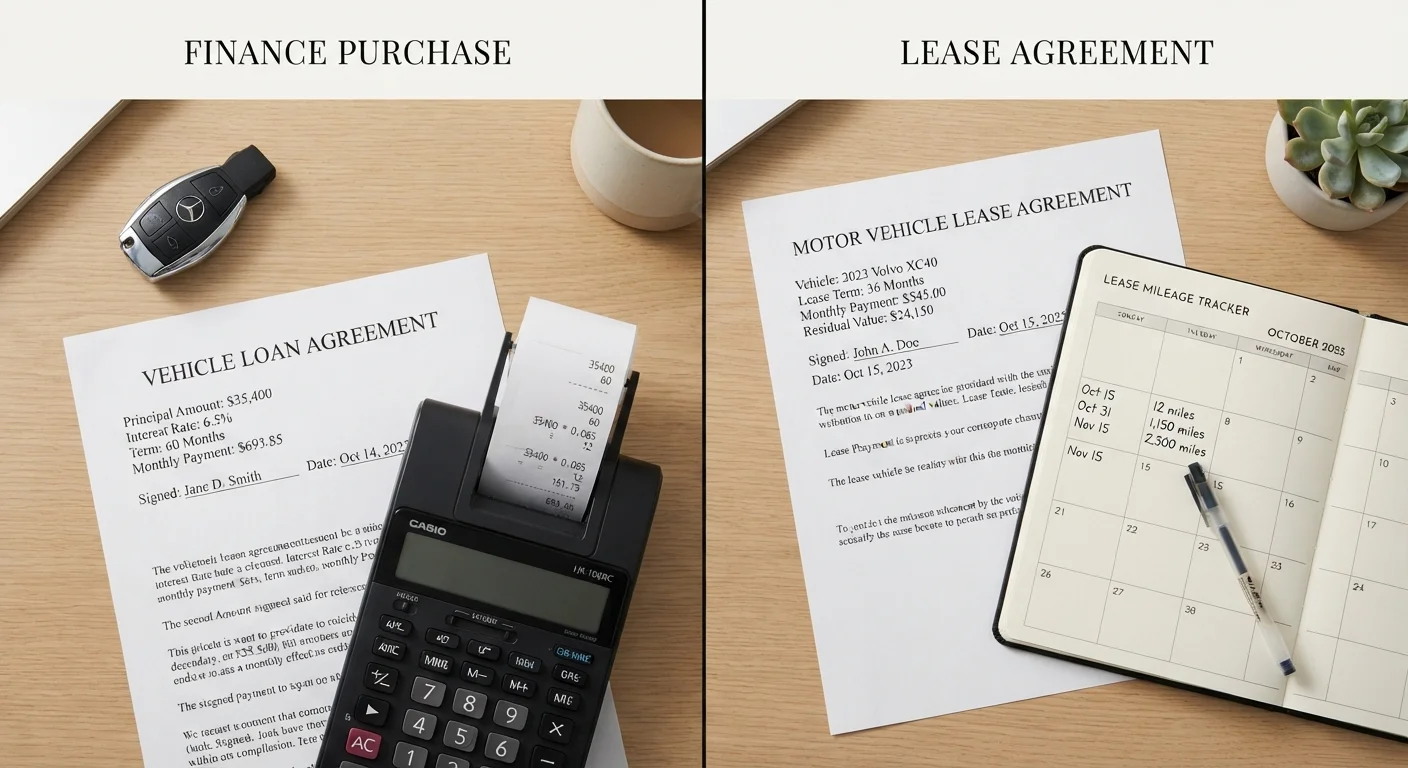

What a Vehicle Lease Actually Is
A vehicle lease is a contractual arrangement in which you pay to use a vehicle for a set period - typically 24 to 48 months - without acquiring ownership. The lessor (usually a manufacturer's captive finance arm or a bank) retains the title throughout. At the end of the term, you return the vehicle, purchase it at a pre-agreed residual price, or roll into a new lease.
This structure differs fundamentally from an auto loan, where each payment builds equity toward full ownership. With a lease, you are financing the portion of the vehicle's value you consume - its depreciation - plus a finance charge. That distinction shapes everything from monthly payment calculations to your obligations when the contract ends.
For many drivers, the appeal is straightforward: lower monthly outlays, access to newer vehicles more frequently, and reduced exposure to long-term mechanical risk while the vehicle remains under warranty. For others, the restrictions embedded in the contract outweigh those benefits. Understanding the mechanics is the only way to judge which camp applies to you. See the structured checklist of questions worth resolving before committing to either path.
Key Lease Terms Decoded
Lease contracts carry a vocabulary that differs from standard loan agreements. Misreading even one figure can alter the total cost by thousands of dollars.
55-65%
Typical 36-month residual value range
Industry data suggest most mainstream vehicles retain between 55% and 65% of MSRP after 36 months, directly driving monthly payment calculations.
$0.15-$0.30
Common per-mile excess mileage charge
Lessor contracts frequently specify this range; on a 36-month lease, consistent annual overages can accumulate to several thousand dollars at return.
2,400×
Multiplier to convert money factor to APR
Multiplying the money factor by 2,400 yields an approximate annual percentage rate, enabling direct comparison with conventional loan offers.
- Capitalized Cost (Cap Cost)
- The agreed purchase price of the vehicle, which forms the starting point for calculating your payments. Negotiating cap cost down has the same effect as negotiating a sale price - it directly reduces what you owe.
- Residual Value
- The projected value of the vehicle at lease-end, expressed as a percentage of MSRP. A higher residual reduces your monthly payment because you are financing less depreciation. Residuals are set by the lessor and are generally non-negotiable.
- Money Factor
- The lease equivalent of an interest rate. Multiply it by 2,400 to convert it to an approximate annual percentage rate (APR) for comparison purposes. A money factor of 0.00150 corresponds to roughly 3.6% APR.
- Acquisition Fee
- An administrative charge - often $400-$1,000 - collected by the lessor at lease inception. It may be rolled into the cap cost or paid upfront.
- Disposition Fee
- A charge assessed at lease-end if you return the vehicle and do not purchase it or lease another from the same manufacturer. Amounts typically range from $300 to $500.
Always ask the dealer to disclose the money factor in writing before discussing monthly payment figures. Some dealers substitute a higher-than-current money factor without disclosure, inflating your finance charge.
The money factor is a primary driver of lease cost and is not always visible on standard deal sheets; obtaining it explicitly protects against silent markups.
If your projected annual mileage is near or above the lease cap, negotiate a higher allowance at signing rather than planning to pay the per-mile overage charge at return.
Pre-purchased mileage blocks are routinely priced lower than the excess rate applied at lease-end, making upfront negotiation the more cost-efficient path.
Lease vs. Loan: The Core Financial Trade-offs
The monthly payment on a lease is structurally lower than on a loan for the same vehicle because you are financing only the depreciation portion of the value rather than the full purchase price. On a vehicle with a 55% residual over 36 months, you finance roughly 45% of the cap cost (plus fees and finance charges), whereas a loan finances 100%.
That payment advantage does not represent savings in a net-cost sense. At the end of a loan, you own an asset. At the end of a lease, you own nothing unless you exercise the purchase option. Over multiple back-to-back lease cycles, a driver who always leases will consistently carry a monthly payment - a dynamic that differs materially from a driver who pays off a loan and holds the vehicle.
“The monthly payment is the least important number in a lease. The total cost - including fees, excess charges, and what you walk away owning - is what matters.”
— Consumer Financial Protection Bureau, U.S. federal consumer finance regulatory agency
Total cost of occupancy - not monthly payment alone - is the more useful metric. Factor in the down payment (called a cap cost reduction in a lease), all fees, the cost of gap insurance, and any projected end-of-lease charges. Then compare that sum against the all-in cost of financing and eventually owning the same or similar vehicle. The true long-term costs of owning and operating a vehicle are broader than most shoppers initially model.
What the Fine Print Actually Means
Lease contracts contain several provisions that generate unexpected costs for drivers who skim rather than read carefully.
Down Payments on Leases Carry a Unique Risk
A substantial cap cost reduction (upfront payment) reduces monthly payments but does not reduce end-of-lease obligations or what you owe if the vehicle is totaled early in the term. Unlike a loan down payment, a large lease cap cost reduction provides no additional protection against early-loss scenarios. If the vehicle is written off in month three, the insurer pays market value - your upfront cash does not factor into that recovery.
Mileage Allowances
Most leases set an annual mileage cap - commonly 10,000, 12,000, or 15,000 miles. Excess mileage is charged at a per-mile rate, typically $0.15 to $0.30, assessed at lease-end. On a 36-month lease with a 12,000-mile annual allowance, driving 16,000 miles per year would generate a $4,320 overage charge at $0.30/mile. If your driving patterns suggest you will exceed the cap, negotiating a higher mileage allowance at signing is almost always cheaper than paying the excess rate later.
Wear and Use Standards
Lessors define acceptable wear differently. Minor scratches, small chips, and light interior wear typically fall within tolerance. Curb-rash on wheels, tears in upholstery, or windshield cracks often do not. Review the lessor's wear guide - most publish one - before the inspection at lease-end, not after.
Gap Coverage
If the vehicle is totaled or stolen, standard auto insurance pays the vehicle's current market value. If that amount is less than the outstanding lease balance (a common situation in the early months of a lease, when depreciation is steepest), you remain liable for the difference. Gap coverage - whether bundled into the lease or purchased separately - addresses this exposure. Confirm whether it is included or must be added.
Early Termination
Exiting a lease before its natural end is expensive. Early termination clauses typically require payment of all remaining monthly installments plus a termination fee, less a credit for the vehicle's current value. Some lessors permit lease transfers to a qualified third party as a lower-cost exit, though transfer fees and approval requirements vary.
For a parallel examination of what to scrutinize in any financing agreement, the practical checklist for reading a loan offer covers the overlapping disclosure points relevant to both structures. Refer also to the rates and terms hub for broader context on how finance charges affect total cost.
Questions to Ask Before You Commit
Before signing a lease agreement, work through the following due-diligence points. They are not exhaustive of every reader's situation - a qualified financial professional can help map them to your specific circumstances - but they address the most consequential variables.
Request the Lessor's Wear Guide Early
Most manufacturer finance arms publish a written wear and use standard that defines exactly what is and is not acceptable at vehicle return. Request this document before signing, not at the end-of-lease inspection. Reviewing it early gives you the option to address issues proactively - often at lower cost than the charges assessed by a third-party inspector at return.
- What is the negotiated cap cost, and how does it compare to the vehicle's market value? Cap cost is negotiable, and a higher starting price inflates every payment.
- What is the money factor, and how does it convert to an APR? Multiply by 2,400 and compare it to current market rates for auto financing.
- What annual mileage do I realistically drive? Underestimating generates the most common and avoidable end-of-lease charge.
- Does the lease include gap coverage, or must I obtain it separately? If separately, factor that premium into your true monthly cost.
- What are the wear standards, and do they align with how I typically use a vehicle? Drivers with children, pets, or rough commutes face elevated end-of-lease exposure.
- What does early termination cost, and is a lease transfer permitted? Life circumstances change; understanding your exit options before entering is prudent.
Approaching a lease with these questions answered positions you to evaluate the agreement on its financial merits rather than reacting to the monthly payment figure in isolation. The approaches to negotiating terms and managing financing - whether you borrow or lease - are worth reviewing as you finalize your decision.
This article provides general financial education about vehicle lease structures and is not personalized financial, legal, or tax advice. Consult a qualified financial professional for guidance tailored to your individual situation.