Why Organization Is the Foundation of Comfortable RV Living
Space in an RV is finite - and unforgiving. Whether you're in a compact Class B van or a full-length Class A motorhome, the gap between a comfortable, functional interior and a chaotic one often comes down to how deliberately you've organized what you own and where it lives. For full-timers especially, poor organization doesn't just create inconvenience; it creates daily friction that compounds over weeks and months on the road.
The good news is that RV organization is largely a solvable problem. It rewards intentional thinking over expensive gear, and the strategies that work are consistent across most rig types. The principles behind effective RV storage can guide your approach before you start buying bins and brackets.
The ideas below reflect the organizational approaches experienced full-timers and RV owners return to most consistently - practical, adaptable, and effective across a range of layouts.
Claim Every Inch of Vertical Wall Space
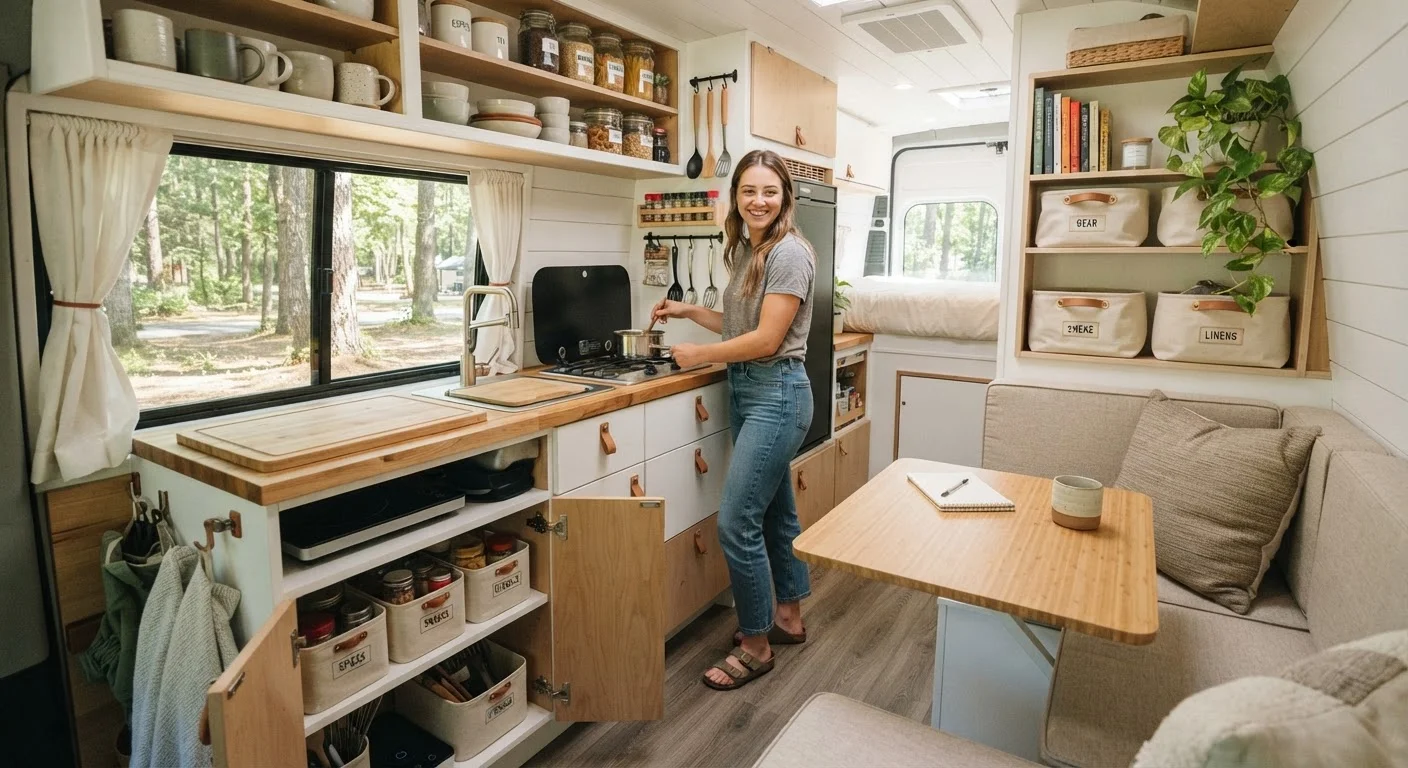
Most RV owners focus on horizontal surfaces - countertops, shelves, floor space - while walls go largely unused. Adhesive hooks, magnetic strips, pegboards, and slim wall-mounted organizers can carry a surprising load without eating into floor or counter real estate. Inside cabinet doors are particularly valuable: a mounted spice rack, a small mesh pocket for cleaning supplies, or a thin organizer for foil and wrap frees up the shelf space behind it.
In galley kitchens especially, a magnetic knife strip or a rail system with hanging hooks can move frequently used utensils off the counter entirely. The goal is to keep work surfaces clear during travel, reducing the chance of items shifting or breaking in transit.
Walls and cabinet doors are the most consistently wasted storage surfaces in any RV kitchen.
Treat Under-Bed Storage as a Primary Closet
The space beneath a fixed bed - common in Class A motorhomes and many fifth wheels - is one of the largest single storage zones in any rig. Most rigs include a pass-through or lift-access compartment here, but that space is easy to mismanage. Using shallow rolling bins or labeled fabric cubes keeps contents accessible and prevents the common problem of items shifting into an unorganized pile that requires full excavation to search.
Categorize what goes under the bed deliberately: seasonal clothing in one zone, tools and maintenance supplies in another, rarely-used gear in a third. A simple inventory list taped inside the access panel eliminates guesswork. For rigs where the bed doesn't lift, vacuum storage bags can compress bulky items like extra bedding significantly.
A labeled inventory list inside the access panel eliminates the guesswork of under-bed storage entirely.
Zone Your Galley Kitchen by Use Frequency
In a standard home kitchen, the logic of proximity to the stove or sink often develops organically. In a 10-foot galley, every placement decision needs to be intentional. The most effective approach is zoning by frequency of use: items touched daily (coffee supplies, a single skillet, everyday utensils) stay at arm's reach in accessible drawers and lower cabinets; items used weekly or less get stored in overhead cabinets or deeper compartments.
Drawer organizers - particularly expandable dividers designed for narrow spaces - prevent the constant shifting that happens in transit. A small tension rod across the inside of a cabinet creates a second tier for storing pan lids vertically rather than stacked, which is both space-efficient and far less likely to cascade when the rig is moving.
Zone your galley by use frequency - daily items at arm's reach, occasional items stored deeper or higher.
Invest in Collapsible and Multi-Use Items
Every item in an RV occupies space whether it's in use or not. Collapsible colanders, nesting measuring cups, flat-pack cutting boards, and stackable pots address this directly - they serve their full function when deployed and take up a fraction of the space when stowed. The same principle applies to furniture: folding camp chairs that stow in a single bag replace bulky fixed seating in outdoor areas, and ottomans with interior storage replace decorative-only pieces.
For full-timers, this often means reconsidering items carried out of habit rather than genuine need. The transition to full-time RV life is a natural forcing function for this audit - but even part-timers benefit from applying the multi-use standard to every item they load.
Every item that collapses or serves two purposes earns its place twice over in a limited-footprint rig.
Build a Consistent Labeling and Return System
The best organizational system degrades quickly without a consistent return-to-place habit. Labeling bins, baskets, and cabinet zones isn't just helpful for memory - it creates accountability when multiple people share the space and makes it easier to maintain organization during high-activity travel periods when the temptation to set things down temporarily is highest.
Label makers, chalkboard labels, and simple printed tags all work. What matters more than the medium is the specificity: "Medications" is less useful than "Medications - Daily" and "Medications - First Aid" in separate containers. The same principle applies to electrical adapters, tools, and paperwork. A small filing system for vehicle documents, campground records, and maintenance logs prevents the paper scatter that tends to colonize dashboards and dinette tables.
Specific labels outperform general ones - 'Daily Medications' beats 'Medications' every time.
Use the Bathroom as a Model for Compact Efficiency
RV bathrooms are tight by design, which means they're also a useful testing ground for organization logic that can be applied elsewhere. Over-the-toilet shelf units, slim over-door organizers, and suction-mounted shower caddies all add usable storage without requiring drilling or permanent modification - important for renters or those who may resell. Keeping a strict limit on personal care items (a single set of travel-size containers rather than full bottles) has an outsized effect in a 30-square-foot wet bath.
The same edit-first principle applies across the rig. Before adding more storage infrastructure, experienced full-timers typically recommend a complete inventory pass - removing anything unused in the past 30 days and reassessing whether it belongs on the road at all.
Edit before you organize - removing unused items is more effective than adding more storage solutions.
Building a System That Travels Well
The most effective RV interiors aren't just tidy - they're systematic. Items have defined zones, every drawer has a purpose, and nothing is stored ambiguously. That clarity pays dividends when you're navigating a dark galley at 6 a.m. or trying to locate a specific tool at a campsite.
Start With a Full Inventory Before Adding Storage Gear
Before purchasing bins, hooks, or organizers, do a complete walkthrough of everything currently in your rig and remove anything unused in the past month. Adding storage infrastructure on top of unedited clutter only moves the problem - it doesn't solve it. A leaner inventory makes every organizational system more effective and easier to maintain during travel.
If you're still evaluating the broader lifestyle trade-offs of full-timing, understanding the constraints before you downsize is a practical next step. And if you're already committed, a grounded look at daily RV life on the road can help set realistic expectations for how your organizational systems will be stress-tested over time.
This article is for informational purposes only. Individual RV layouts vary significantly; adapt any organizational approach to fit your specific rig, travel style, and storage constraints.