
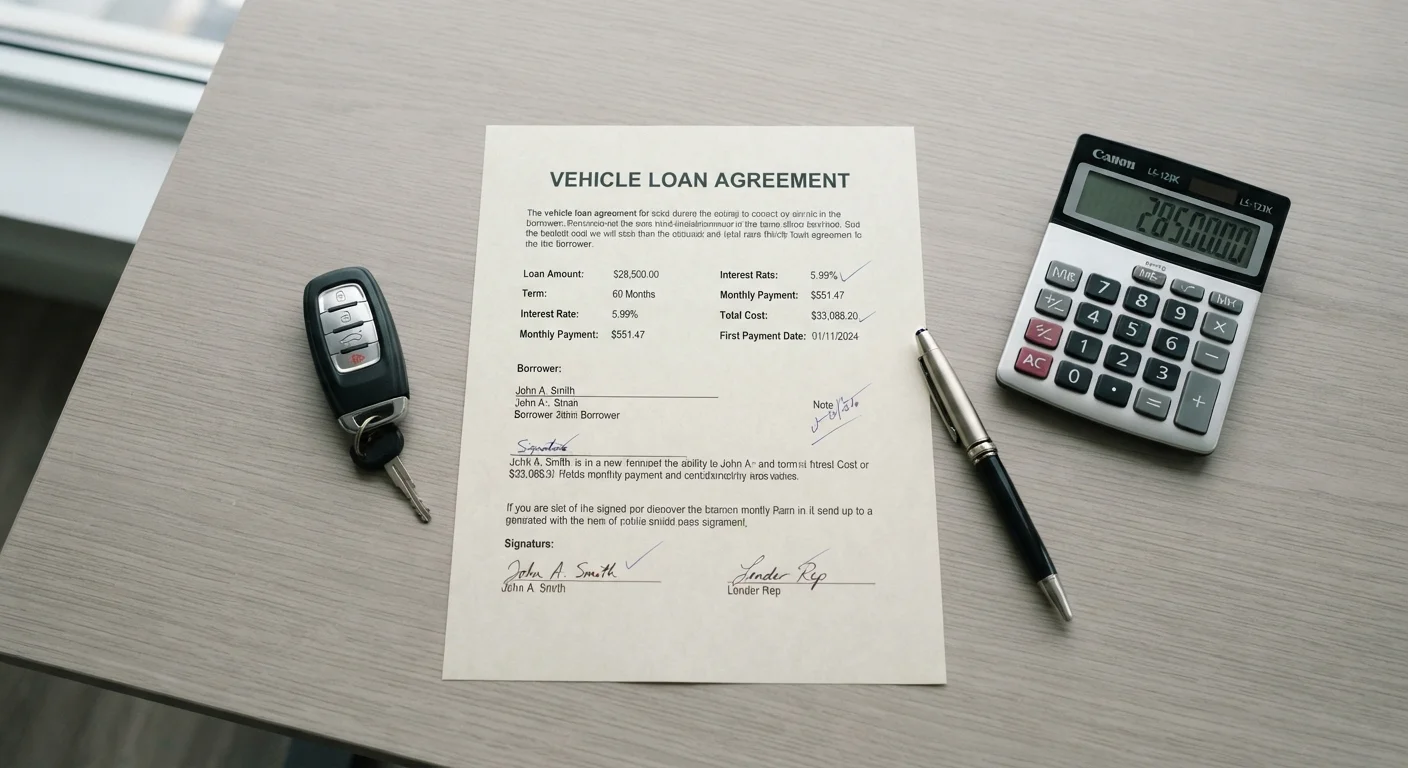
The Four Variables That Define Every Auto Loan
Every auto loan - whether sourced from a bank, credit union, or dealership finance office - is governed by the same four structural components. Understanding how they interact is the foundation for evaluating any financing deal.
- Principal: The amount you actually borrow after subtracting any down payment and trade-in value from the vehicle price.
- APR (Annual Percentage Rate): The annualized cost of borrowing, expressed as a percentage. It incorporates the interest rate plus lender fees, making it the most reliable comparison figure.
- Loan Term: The number of months over which you repay the loan - commonly 36, 48, 60, or 72 months.
- Down Payment: Cash paid upfront that directly reduces the principal you need to finance.
These variables don't operate independently. Adjusting one shifts the others. Reducing your principal through a larger down payment, for example, cuts monthly payments and total interest simultaneously. For a deeper look at how rates and terms interact across loan types, see our complete field guide to auto financing rates and terms.
68 months
Average new-vehicle loan term in the U.S.
According to Experian's State of the Automotive Finance Market reports, average loan terms have stretched progressively over the past decade as vehicle prices have risen.
~$1,000+
Extra interest from a 72- vs. 48-month term
On a typical mid-range vehicle financed at a moderate APR, extending from a 48- to a 72-month term commonly adds over $1,000 in cumulative interest charges.
3-5%
Typical APR spread between credit tiers
Industry data consistently shows that borrowers in lower credit tiers pay materially higher APRs than prime borrowers, often by three to five percentage points or more on the same loan amount.
How Principal and Down Payment Shape Your Loan
The principal is the engine of your loan cost. On a $35,000 vehicle, a $5,000 down payment means you finance $30,000 - on which interest accrues for the full loan term. A $10,000 down payment drops that financed amount to $25,000, shrinking both the monthly payment and the total interest owed.
Down payments also affect loan-to-value (LTV) ratio - the proportion of the vehicle's value being financed. Lenders treat high LTV loans as riskier, which can influence the rate offered. Starting with equity in the vehicle also protects against being "underwater" - owing more than the car is worth - as depreciation takes hold in the early ownership years.
Calculate Total Cost, Not Just Monthly Payment
Before agreeing to any loan structure, multiply the monthly payment by the number of months and add any fees to get the total amount you will pay. Then compare that figure - not the monthly number - across loan offers. A lower monthly payment funded by a longer term often means a significantly higher total cost.
If you're newer to the fundamentals of vehicle financing, our auto financing fundamentals guide covers the essential concepts before you reach the dealership.
Loan Term, Monthly Payments, and Total Interest
The loan term is where many buyers make a costly tradeoff without realizing it. A longer term feels attractive because it lowers monthly payments, but it means interest accumulates for more months. Consider a $28,000 principal at 7% APR:
| Term | Monthly Payment | Total Interest Paid |
|---|---|---|
| 48 months | ~$670 | ~$4,160 |
| 60 months | ~$554 | ~$5,240 |
| 72 months | ~$477 | ~$6,344 |
The 72-month option costs roughly $2,200 more in interest than the 48-month option, despite the lower monthly figure. The total cost of the loan - not the monthly payment - is the more meaningful comparison point.
To understand how the type of rate structure (fixed versus variable) interacts with term length, see our article on fixed-rate vs. variable-rate auto loans.
Credit, APR, and What Lenders Are Evaluating
Your APR isn't arbitrary - lenders derive it from an assessment of credit risk. A borrower's credit score, debt-to-income ratio, employment history, and existing obligations all factor into the rate offered. Lenders in the U.S. typically tier borrowers into credit bands (sometimes called prime, near-prime, and subprime), with each band corresponding to a range of available APRs.
“The interest rate is ultimately a price signal - it tells the borrower exactly how much the lender believes they are being compensated to take on the risk of non-repayment. Understanding that framing helps buyers see that improving creditworthiness is not just a bureaucratic exercise, but a direct lever on the cost of their vehicle.”
— Consumer Financial Protection Bureau, U.S. federal agency overseeing consumer financial products and services
This means that improving your credit profile before applying - reducing outstanding balances, correcting errors on your credit report, and avoiding new hard inquiries - can directly lower the rate a lender offers. The Credit and Approval hub covers the mechanics of how lenders evaluate applicants in detail.
For a comprehensive walkthrough of how credit intersects with every stage of the financing process, see Understanding Auto Financing: Credit, Approval, and Interest from Start to Finish.
This article is for general informational and educational purposes only. It does not constitute personalized financial, legal, or tax advice. Consult a qualified financial adviser or lending professional for guidance specific to your circumstances.