
Why the Numbers on a Lease Disclosure Matter
A lease offer can look straightforward - a monthly payment, a term, and a due-at-signing amount - while concealing dozens of variables that collectively determine whether the deal is reasonable. Unlike a loan, where the principal, rate, and term are the core mechanics, a lease payment is the product of at least five distinct figures, each of which can be independently adjusted to make a deal appear more attractive than it is.
Understanding the full picture requires engaging with the actual disclosure document, not just the dealer's summary. For a broader foundation on lease mechanics, Leasing a Vehicle: The Full Picture Before You Sign provides comprehensive context. If you're also evaluating a loan against a lease, Reading a Loan Offer Before You Sign applies the same analytical discipline to financing agreements.
What you will need
How to Read Through a Lease Offer Step by Step
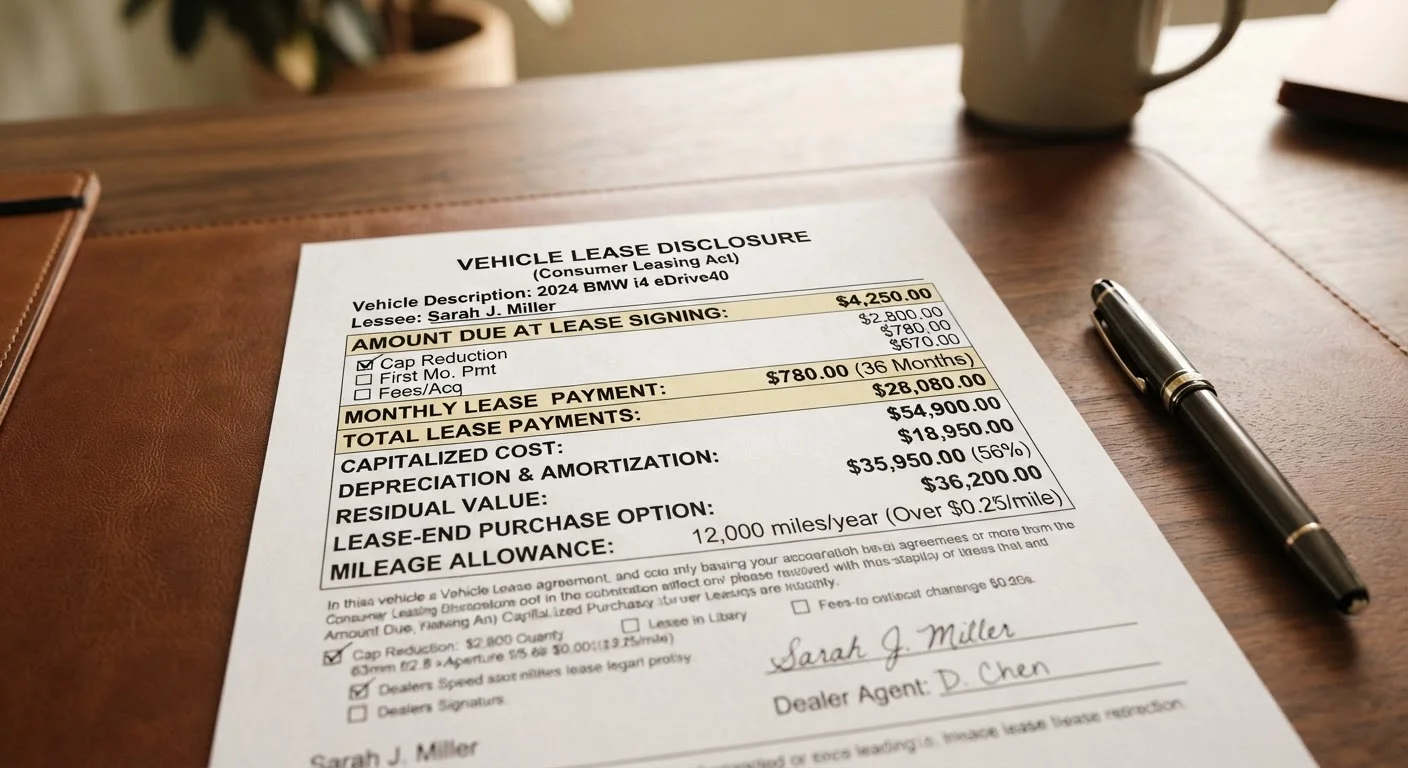
The steps below follow the logical sequence of a standard lease disclosure - from the vehicle's negotiated cost through to total outlay. Work through them with the actual document in hand.
Lease Disclosures Are Legally Required
Under the federal Consumer Leasing Act, lessors must provide a standardized written disclosure of all key lease terms before you sign. Review this document - not just the dealer's summary sheet - line by line. Discrepancies between verbal promises and the written disclosure are resolved in favor of what's written.
Lease Disclosure Document
The legally required written summary of all lease terms - the primary document you will analyze in each step.
Calculator or Spreadsheet
Used to verify monthly payment math and calculate total cost across the lease term.
Current Market Residual and Money Factor Data
Published by third-party automotive research sources; lets you verify whether dealer-quoted figures align with prevailing lease program terms.
Confirm the Capitalized Cost
The capitalized cost ("cap cost") is the agreed vehicle price that forms the basis of your lease. It should match the negotiated selling price, not the MSRP, unless you chose not to negotiate. Check that any dealer-applied fees - such as acquisition fees or add-on products - are itemized separately and that you agreed to each one.
Subtract any capitalized cost reductions (down payment, trade-in credit, or manufacturer rebates applied at signing) to arrive at the adjusted capitalized cost. This is the figure that directly drives your monthly payment calculation.
Identify and Evaluate the Residual Value
The residual value is the projected worth of the vehicle at lease end, expressed as a dollar amount or percentage of MSRP. A higher residual means you're financing a smaller portion of the vehicle's depreciation, which typically lowers monthly payments.
The residual is set by the lessor (usually the automaker's captive finance arm) and is generally non-negotiable. However, verifying that the stated residual is consistent with the manufacturer's published lease program protects you from an artificially deflated figure that inflates your payment.
Decode the Money Factor
The money factor is the lease equivalent of an interest rate, expressed as a small decimal (e.g., 0.00175). It applies to the sum of the adjusted cap cost and the residual value to produce the finance charge portion of each monthly payment.
Convert it to an approximate APR by multiplying by 2,400. Cross-reference that figure against prevailing auto loan rates to judge whether the lease's financing cost is competitive. Like residual values, money factors are published by manufacturers and can be verified through independent automotive research sources.
Verify the Monthly Payment Calculation
A lease payment has two components: a depreciation charge and a finance charge.
- Depreciation charge: (Adjusted Cap Cost − Residual Value) ÷ Lease Term in Months
- Finance charge: (Adjusted Cap Cost + Residual Value) × Money Factor
Add these two figures to obtain the base payment before taxes and fees. If your calculated figure diverges significantly from the quoted payment, ask the dealer to walk through each variable line by line until the discrepancy is resolved.
Tally Total Lease Cost
Multiply the monthly payment by the number of months in the term, then add all upfront costs paid at signing (first month, security deposit, acquisition fee, taxes, and registration). This produces your total out-of-pocket lease cost.
Compare this figure against the total cost of purchasing the same vehicle over a comparable loan term to understand the full financial picture. For a structured comparison framework, see Questions to Ask Before Choosing Between a Loan and a Lease.
Review Mileage Allowance and Excess Charges
Every lease specifies an annual mileage allowance - commonly 10,000, 12,000, or 15,000 miles per year. Excess mileage fees typically range from $0.10 to $0.30 per mile and are charged at lease return. Underestimating your driving habits is one of the most common and costly lease miscalculations.
If your expected annual mileage exceeds the base allowance, ask the dealer about prepurchasing additional miles at signing - the per-mile cost is generally lower than the end-of-lease overage rate.
Convert the Money Factor Immediately
Dealers rarely express the money factor as a percentage, but converting it takes seconds: multiply the stated money factor by 2,400. A money factor of 0.00175 becomes an approximate 4.2% APR. This lets you benchmark the lease's financing cost against current loan rates side by side.
Low Monthly Payments Can Obscure High Total Cost
A reduced monthly payment achieved through a large capitalized cost reduction (upfront cash) doesn't lower your total lease outlay - it shifts cost to the front end. If the vehicle is totaled or stolen early in the lease, gap coverage - not your upfront payment - determines your financial exposure.
Once you've worked through each figure, you'll have a defensible, complete picture of what the lease actually costs. For strategies on negotiating and managing whichever path you choose, see Getting the Most from Either a Loan or Lease Arrangement. Rate and term benchmarks to contextualize your findings are available through the Rates & Terms hub.
This article provides general financial education about lease disclosure documents and is not personalized financial or legal advice. Consult a qualified financial professional for guidance specific to your situation.