What Each Number Actually Measures
Every auto loan offer will quote at least one percentage - and often two. Understanding what each measures is fundamental to decoding financing math before you sign anything.
Interest rate (also called the nominal rate) is the annualized cost of borrowing the loan principal. It determines how much interest accrues each month on the outstanding balance. For example, a $30,000 loan at a 6% interest rate accumulates roughly $150 in interest in the first month (0.06 ÷ 12 × $30,000). That figure shrinks each month as the principal is paid down - a structure called amortization.
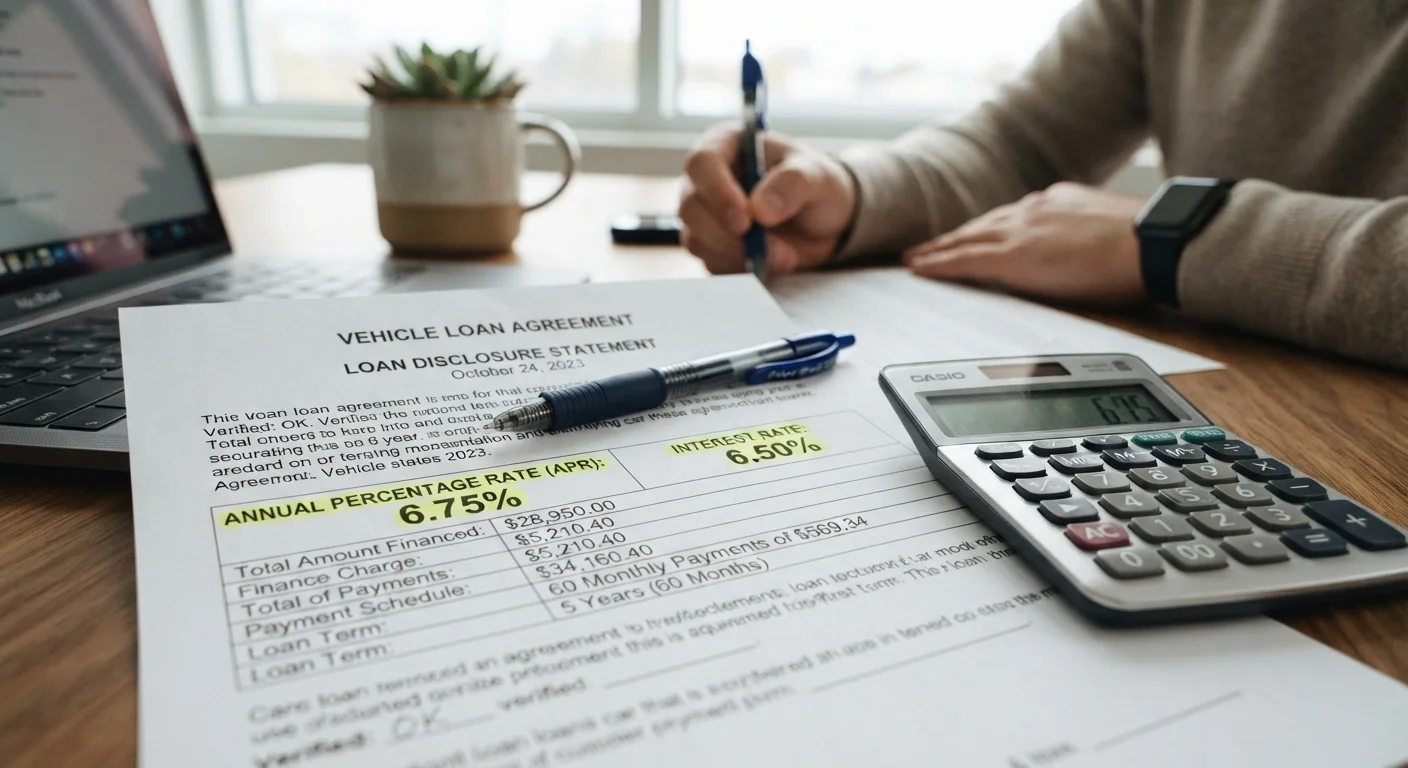
APR - Annual Percentage Rate - is a broader measure. It incorporates the interest rate plus certain fees and finance charges that the lender requires as a condition of the loan. Common items folded into APR on auto loans include origination fees, dealer documentation fees charged by the financing source, and prepaid finance charges. Spreading these costs over the loan term and expressing them as an annualized rate produces the APR.
Federal law under the Truth in Lending Act (TILA) requires lenders to disclose APR on consumer loans, including auto financing, so borrowers have a standardized basis for comparison. See our complete field guide to auto financing rates and terms for a broader breakdown of every concept you'll encounter in a financing agreement.
| Criterion | Interest Rate | APR |
|---|---|---|
| What it measures | Cost of borrowing principal only | Total annualized cost including fees |
| Includes lender fees | No | Yes |
| Required disclosure (TILA) | Yes | Yes |
| Best use | Calculating monthly accrual | Comparing loan offers |
| Relative size | Always ≤ APR on same loan | Always ≥ interest rate on same loan |
| Changes with fees? | No | Yes - rises as fees increase |
Why the Gap Between the Two Numbers Is Telling
On a straightforward loan with no origination or finance fees, APR and interest rate will be identical - or extremely close. The moment a lender layers in fees, the APR climbs above the interest rate. That gap is informative.
A small gap - say, 0.1 to 0.3 percentage points - typically indicates modest processing fees. A larger gap - 0.5 points or more - suggests meaningful fees are baked into the financing. Dealer-arranged financing can sometimes produce a notably wider spread because dealers may receive a financing markup (called a dealer reserve) from the lender, which is effectively a hidden cost absorbed into the APR.
0.5%+
APR gap that may signal significant dealer fees
Industry financing analysis suggests a spread exceeding 0.5 percentage points between the nominal rate and APR often reflects meaningful origination or dealer-markup fees.
$1,000+
Potential fee cost buried in a wide APR spread
On a typical $30,000 auto loan, fees that widen the APR by 0.5 points over a 60-month term can equate to roughly $750-$1,200 in additional financing cost.
This is why comparing two offers solely on interest rate can mislead you. A loan quoted at 5.9% interest with a wide APR gap may cost more than one at 6.2% interest with minimal fees. The financing math buyers get wrong at the dealership frequently involves ignoring this spread and fixating on the monthly payment figure instead.
Always request both numbers in writing and ask the lender to itemize every fee included in the APR calculation. That itemization, found in the TILA disclosure or loan estimate, is the clearest window into your loan's true structure.
Applying This to Real Loan Comparisons
When shopping financing from multiple sources - a bank, a credit union, and a dealership's financing arm - put APR front and center in your comparison. Matching loan terms (same repayment period, same down payment scenario) ensures the APR comparison is valid. A 48-month APR and a 72-month APR on the same principal are not directly comparable: the longer term typically reduces the monthly payment but increases total interest paid. For a deeper look at how loan length drives total cost, see how interest payments inflate the total you pay.
If you're weighing a fixed-rate loan against a variable-rate structure, APR comparison becomes more complex - a variable rate's APR is typically disclosed based on the initial rate and may not reflect future adjustments. Our article on fixed-rate vs. variable-rate auto loans addresses how to think through that comparison.
APR Comparison Requires Matching Loan Terms
APR is most meaningful when compared across loans with identical repayment lengths and down payment amounts. Comparing a 48-month APR to a 72-month APR on the same vehicle can be misleading because the longer term spreads fees differently and increases total interest paid. Always standardize the term before using APR as your primary comparison metric.
Your credit profile shapes which APR range you'll actually qualify for. Lenders tier their rates based on credit score, debt-to-income ratio, and loan-to-value. Exploring how those factors interact is covered in the Credit & Approval hub.
This article is for general informational and educational purposes only. It does not constitute personalized financial or legal advice. Consult a qualified financial professional regarding your specific circumstances before making financing decisions.