Why Used Car Negotiation Operates by Different Rules
When you negotiate on a new vehicle, you have a concrete anchor: the manufacturer's suggested retail price (MSRP) and, with some research, the dealer invoice price. Those figures are publicly available and largely consistent across locations. Used cars don't work that way.
Every used vehicle is a one-of-a-kind proposition shaped by mileage, accident history, local market supply, how long the car has been listed, and the seller's own financial pressure. That variability creates wider negotiating room - but only for buyers who have done the work to understand what the vehicle is actually worth. Buyers who haven't are more likely to anchor on the asking price rather than the market value, which is exactly the dynamic sellers benefit from.
For a grounding in how dealership negotiations are structured generally, see how dealership negotiations actually work. The used car context adds several layers on top of that foundation.
| New Car | Used Car (Dealership) | Used Car (Private Seller) | |
|---|---|---|---|
| Pricing transparency | High - MSRP and invoice data available | Moderate - market comps required | Low - fully market-dependent |
| Negotiating floor reference | Dealer invoice price | Comparable listings + condition | Seller's urgency + comps |
| Inspection leverage | Rarely applicable | Strong - supports price reduction | Critical - no fallback recourse |
| Financing rate environment | Lower rates typical | Higher rates typical | Higher rates typical |
| Warranty coverage | Full manufacturer warranty | Limited - CPO or none | None (as-is) |
| Price variability | Low | Moderate to high | High |
Building Your Research Base: What Replaces Invoice Pricing
On a new car, dealer invoice data gives you a reliable floor. On a used car, your equivalent tools are:
- Comparable listings: Search the same make, model, year, trim, and mileage range within your local market. Three to five genuine comps give you a defensible price range - not just a single estimate from one valuation tool.
- Vehicle history report: A reported accident, rental use, or multiple prior owners all affect value. Use this as a negotiating data point, not just a screening filter.
- Market-based valuation guides: Published guides offer retail and private-party value ranges based on condition. Treat these as ranges, not precise targets, since regional supply and demand affect actual transaction prices.
Walking in without a clear target number is one of the most common preparation gaps buyers have. Here's the research process that closes that gap before you set foot on the lot.
Pull Comps Before You Contact the Seller
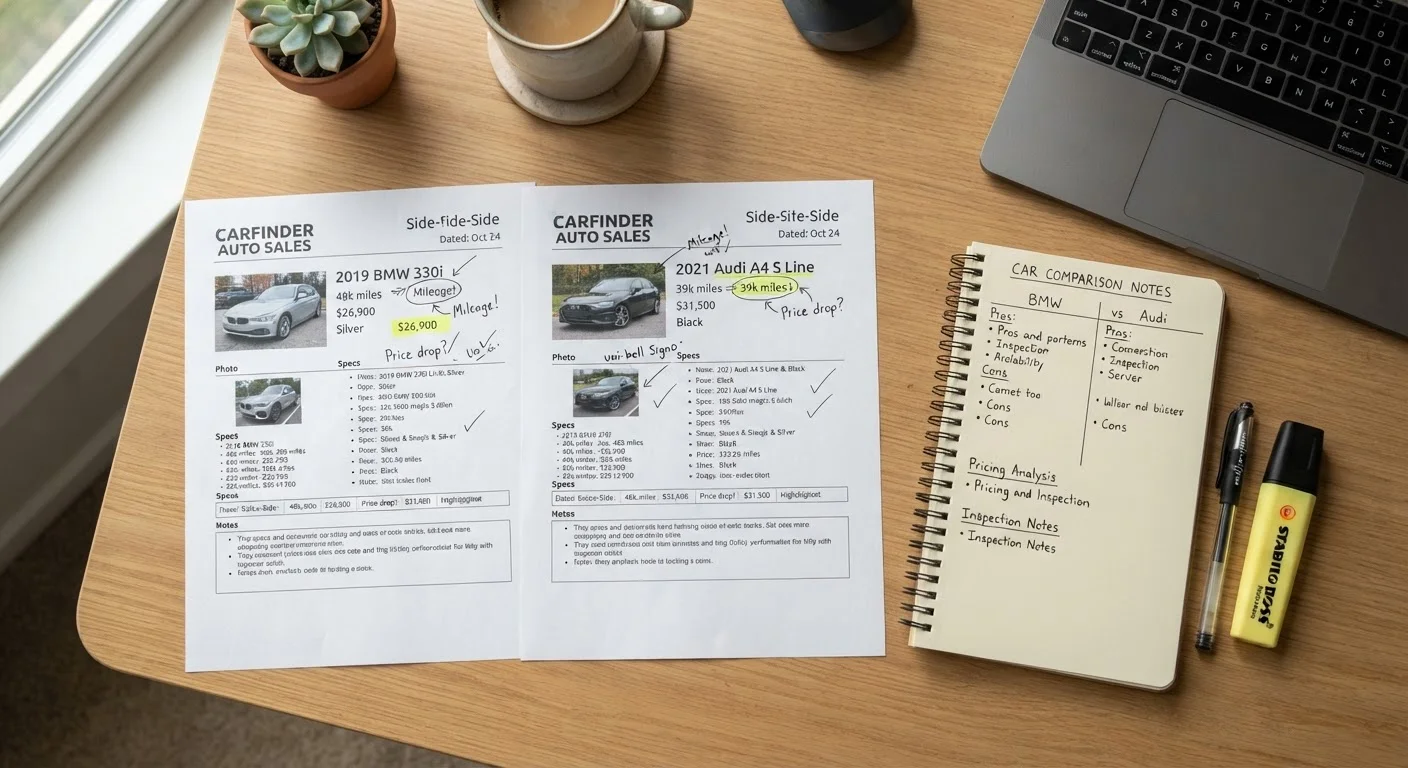
Gather three to five comparable listings from your local market before making contact with any seller. Note differences in mileage, trim, and condition alongside asking price. When you enter negotiation with a printed or documented comp set, your price argument is factual rather than subjective - which shifts the burden of justification to the seller.
The Inspection Advantage: Leverage New Car Buyers Don't Have
New cars come with manufacturer warranties and no prior use to scrutinize. Used cars, by contrast, carry an unknown maintenance history - and that uncertainty is a negotiating tool when handled correctly.
An independent pre-purchase inspection (PPI) by a qualified mechanic typically costs between $100 and $200 and can identify deferred maintenance, wear items nearing replacement, or undisclosed damage. Any legitimate issue the inspection surfaces is a documented, factual basis for requesting a price reduction - far more persuasive than simply asserting the car is overpriced.
If a private seller or dealership refuses a pre-purchase inspection, that itself is information worth weighing carefully before proceeding.
Don't Skip the Pre-Purchase Inspection
Skipping an independent inspection to save time or appear more committed to a deal is one of the costlier shortcuts used car buyers make. Repair costs discovered after purchase become entirely the buyer's responsibility. Even on vehicles with clean history reports, mechanical wear is not always disclosed - or even known - by the seller. Budget the inspection fee into your process from the start.
Dealership vs. Private Seller: How Tactics Shift
A dealership selling a used vehicle has overhead, inventory costs, and a finance office behind the transaction. A private seller typically has none of those structures - and therefore a different set of motivations.
At a dealership: The used car department operates with more pricing flexibility than the new car floor, partly because acquisition costs vary. Days-on-lot is a useful signal: a vehicle listed for 45 or more days is more likely to generate movement on price. Dealerships may also bundle add-ons - extended warranties, paint protection - into the deal; evaluate each separately rather than as a package.
With a private seller: There's no finance office and no certified pre-owned markup, but there's also no warranty, no title prep done for you, and typically no recourse if problems surface post-sale. Price flexibility can be greater, but due diligence burden falls entirely on the buyer.
In both contexts, keeping the purchase price separate from trade-in and financing discussions preserves your ability to evaluate each number clearly. Our guide on trade-in timing and deal separation explains when and why to make that separation explicit.
Financing on a Used Car: A Different Calculation
Interest rates on used auto loans are typically higher than on new vehicle loans, because lenders view used vehicles as higher-risk collateral. The gap can be meaningful over a multi-year loan term - which makes pre-arranged financing from a credit union or bank particularly valuable before you negotiate the vehicle price.
Arriving with your own financing approval accomplishes two things: it removes the dealer's financing margin as a negotiating lever, and it gives you a concrete monthly payment baseline that isn't shaped by the dealership's rate markup. Understanding why the purchase price and monthly payment are separate negotiating targets is especially important in the used car context, where rate differences compound quickly.
For a broader look at how loan terms affect total ownership cost - and how used cars compare to new over time - see new vs. used ownership cost trade-offs over five years.
This article provides general educational information about vehicle purchasing and negotiation. It is not personalized financial or legal advice. Consult a qualified financial professional for guidance specific to your situation.