Why Bike Lighting Specs Can Mislead You
Walk into any bike shop or browse cycling accessories online and you'll find lights advertised with lumen counts ranging from 100 to over 3,000. The assumption most riders make - that higher lumens always means better - misses the bigger picture. Lumens measure total light output, but a poorly designed reflector or a beam that scatters sideways rather than forward can leave you seeing far less than a lower-lumen unit with a well-engineered lens.
Compounding this, bicycle lighting sits at the intersection of multiple standards: consumer product specs, voluntary industry certifications, and state-level road-legal requirements. None of these speak the same language, and none are universally enforced in the same way. Knowing which standard applies to your situation - and what it actually requires - is how you move from guesswork to a genuinely informed purchase.
Decoding the Key Specifications
The following are the specifications that appear most frequently on bicycle lighting packaging, and what they actually measure:
Lumens
A measure of total light output emitted by a source in all directions. Higher lumens indicate more total light, but do not indicate how effectively that light is directed forward or where the beam falls on the road.
Lux
A measure of illuminance - how much light falls on a specific surface area at a given distance. More relevant than lumens for assessing how well a light actually illuminates the road ahead of you.
Beam Pattern
The shape and distribution of light projected by the lens and reflector assembly. Road-oriented beam patterns concentrate light low and forward with a defined cutoff; flood patterns spread light more widely.
Candela
A measure of luminous intensity in a specific direction. Useful for comparing how powerful a beam is along its central axis, which correlates with how far ahead a light can illuminate.
IP Rating
Ingress Protection rating, expressed as two digits (e.g., IPX4, IP67). The first digit indicates dust resistance; the second indicates water resistance. IPX4 means splash-resistant from any direction; IP67 means dust-tight and submersible to one meter.
StVZO
A German road-use standard that requires bicycle lights to project a shaped, cutoff beam that does not blind oncoming road users. Widely used as a quality benchmark outside Germany due to its strict beam-shape requirements.
Runtime
How long a light operates on a full charge or set of batteries. Published runtime figures often reflect the lowest power mode; runtime at maximum output is typically much shorter and should be checked separately.
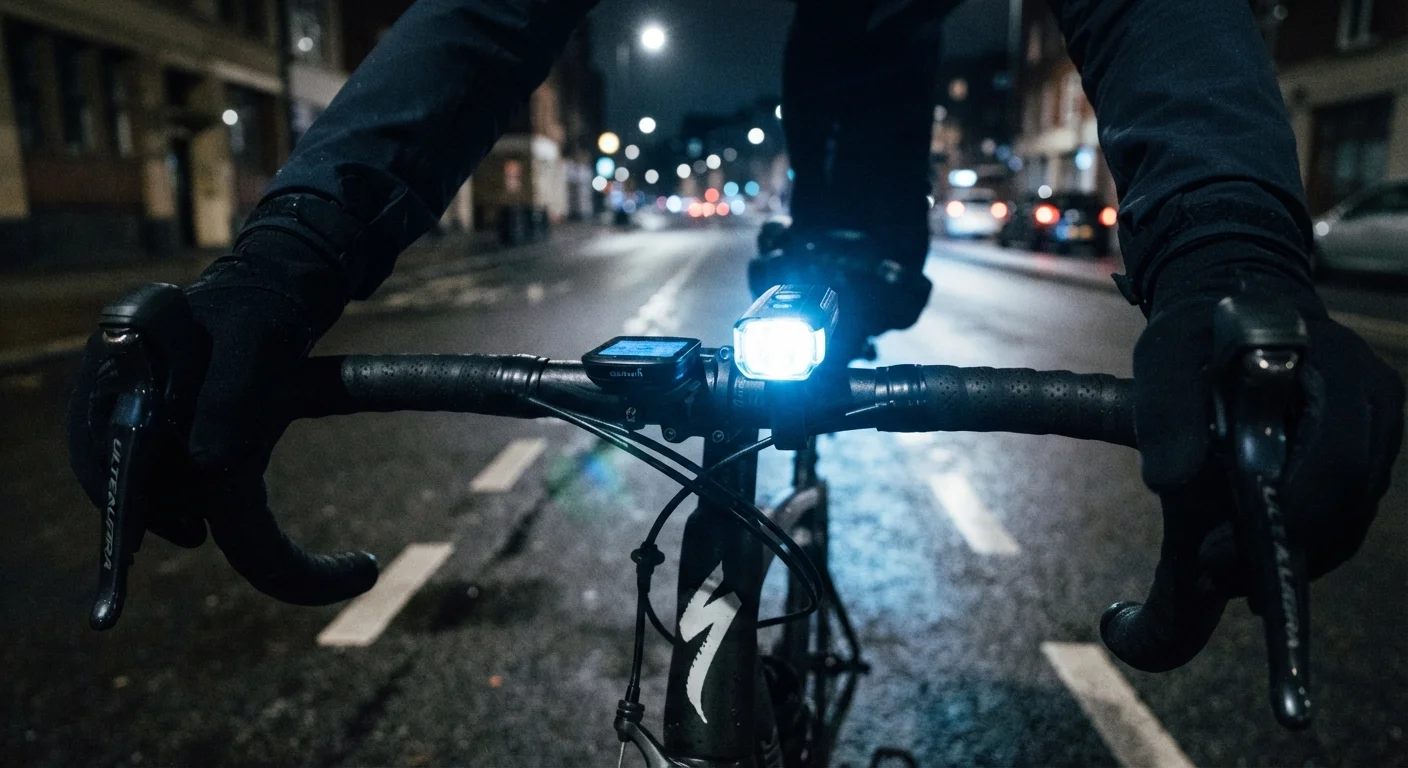
Of these, beam pattern is arguably the most underappreciated. A front light designed for road cycling should cast a defined, forward-directed beam - not a wide flood that blinds oncoming cyclists and pedestrians. Lights marketed primarily for trail use often prioritize flood width over forward throw, making them inappropriate for road riding at higher speeds.
Battery runtime claims also warrant scrutiny. Manufacturers typically publish runtime at the light's lowest mode. A light rated at eight hours may only sustain its maximum output for 60-90 minutes before stepping down automatically. Check whether the spec sheet lists runtime at full output separately - this is the figure that matters for unlit road use.
Road-Legal Requirements in the United States
Bicycle lighting law in the U.S. is administered at the state level, not federally. Most states follow a similar framework derived from the Uniform Vehicle Code, but the specifics vary. Common requirements include:
- Front light: White light visible from at least 500 feet, required when riding between sunset and sunrise or in low-visibility conditions.
- Rear reflector or red light: Visible from 200-600 feet to the rear, depending on the state. Many states now permit or require a red rear light in addition to or in place of a reflector.
- Side reflectors: Required in some states, particularly for bicycles sold new - though enforcement on existing bikes varies.
Notably, most state laws describe visibility distances, not lumen thresholds. A light can technically comply while being quite dim if it's visible at the required distance under the test conditions. Compliance is a floor, not a guide to practical safety.
Flashing Mode and Road-Legal Status
Many riders default to flashing modes to conserve battery and increase visibility. However, some U.S. states and several countries require a steady-burning front light during hours of darkness - flashing alone may not satisfy the legal requirement. Check your state's vehicle code for the specific language before relying solely on a flashing front light at night.
If you're riding specialty or unconventional cycles - trikes, recumbents, cargo bikes - lighting height and visibility angles can differ from a standard upright bicycle. Our overview of three-wheeler classifications and legal status touches on how regulatory grey zones affect non-standard cycles generally.
Voluntary Standards and What They Signal
Beyond state law, several voluntary standards influence how lights are rated and compared. The German StVZO standard (Straßenverkehrs-Zulassungs-Ordnung) is particularly respected among road cyclists because it imposes a strict cutoff line in the beam - preventing light from projecting above the horizontal and into oncoming road users' eyes. A light bearing StVZO approval has been tested for beam shape, not just raw output.
The ANSI FL1 standard, developed by the American National Standards Institute for flashlights and portable lights, is sometimes applied to cycling lights. FL1 defines how manufacturers must measure and report lumens, beam distance, and runtime - reducing the scope for misleading claims when a product is genuinely certified to this standard (not merely inspired by it).
Neither standard is legally required for bicycle use in U.S. states, but their presence on packaging is a meaningful signal about engineering intent. For context on how auxiliary lighting standards work in the motorized vehicle space, see our piece on auxiliary lighting for trucks and SUVs, which covers similar beam-pattern and compliance concepts in a different context.
47 U.S. states
States requiring a front white light at night
According to the League of American Bicyclists' analysis of state vehicle codes; the remaining states have varying or less specific requirements.
IPX4
Minimum water resistance for all-weather riding
IPX4 (splash-resistant from any direction) is widely considered the practical minimum for lights used in variable weather conditions by cycling safety organizations.