Why Three Wheels Demand Their Own Framework
Three-wheeled vehicles have never fit neatly into the automotive taxonomy that governs everything else on American roads. They are neither motorcycle nor automobile in the conventional sense, yet regulators, engineers, and collectors must treat them as one or the other - or carve out a third path entirely. That ambiguity is precisely what makes them fascinating to a dedicated community of enthusiasts.
The category stretches from Edwardian cyclecar survivors to purpose-engineered 21st-century performance machines. Understanding how trikes are classified - and why - requires looking at geometry, physics, federal definitions, and fifty separate state rule sets simultaneously. For anyone considering ownership, or simply curious about the segment, this guide maps the terrain systematically.
For broader context on niche vehicle categories and the communities that preserve them, see our guide to classic car ownership. The early precursors of today's trikes are also explored in depth in our piece on cyclecars and voiturettes.
30+
U.S. states with autocycle statutes
A majority of states had enacted dedicated autocycle legislation by the mid-2020s, though definitions and exemptions vary by jurisdiction.
1,500 lbs
NHTSA motorcycle GVWR threshold
Federal regulation classifies three-wheelers under 1,500 lbs gross vehicle weight rating as motorcycles, shaping registration and safety standards.
2
Primary geometric configurations
All three-wheelers fall into either the delta (one front wheel) or tadpole (two front wheels) layout, each with distinct engineering implications.
The Two Fundamental Configurations: Delta vs. Tadpole
Every three-wheeler on the road belongs to one of two geometric families, and the distinction drives nearly every downstream decision about handling, regulation, and use case.
Delta Configuration
A delta trike places a single wheel at the front and two wheels at the rear. This is the layout most associated with traditional motorcycle-based trikes - including factory conversions of large-displacement touring bikes. The single steered front wheel behaves like a conventional motorcycle front end, and the paired rear wheels provide lateral stability at rest. However, delta trikes are susceptible to oversteer in tight, high-speed corners because the weight distribution places most mass over the rear axle.
Tadpole Configuration
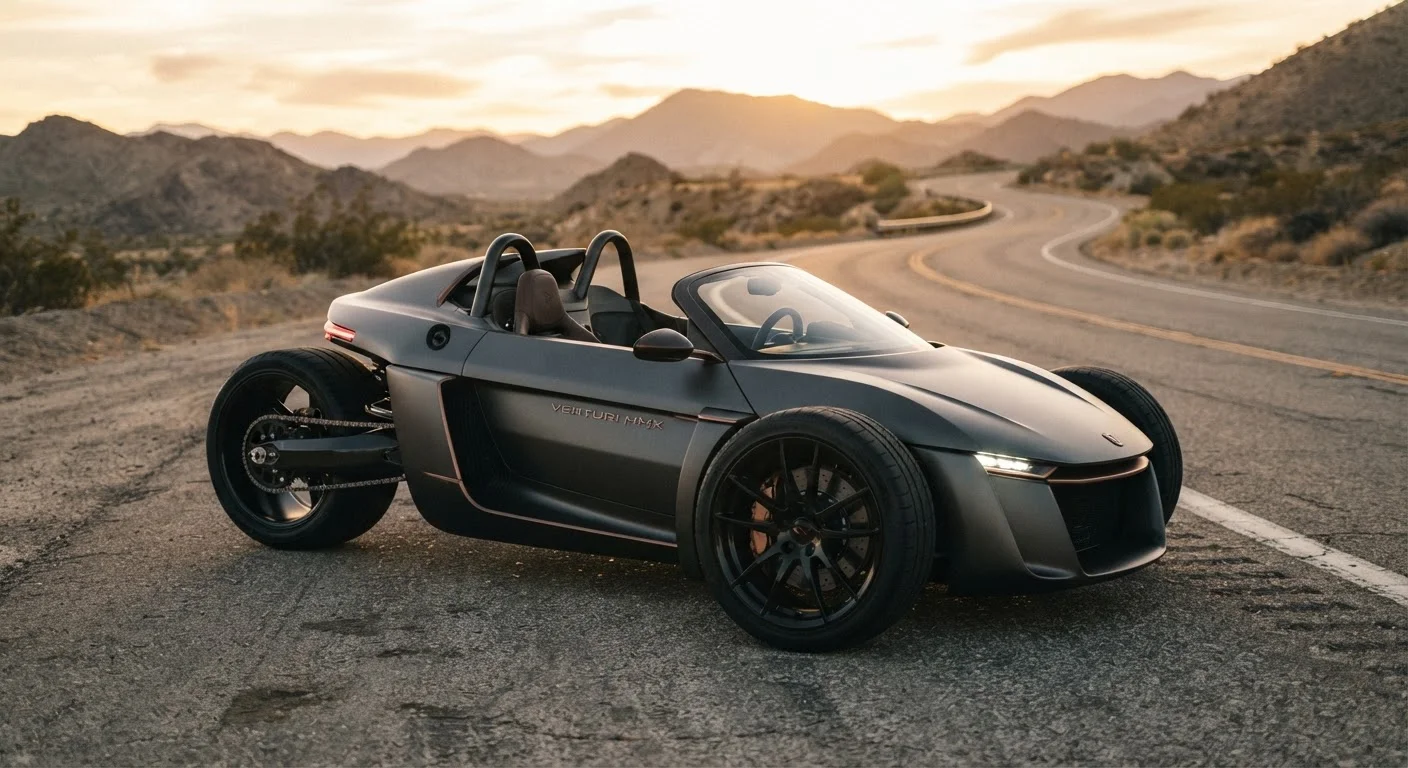
A tadpole trike reverses the geometry: two wheels at the front, one at the rear. The dual front wheels create a wider track, distribute braking force across two contact patches, and lower the vehicle's center of gravity relative to a delta layout. This configuration dominates performance-oriented designs and most enclosed cabin three-wheelers manufactured in recent decades. Tadpoles tend to understeer predictably, which many drivers find more intuitive under emergency inputs.
The choice of configuration is not cosmetic. It determines which axle handles steering, which handles primary braking, and how the vehicle behaves when a tire fails - all of which feed directly into the engineering decisions discussed below.
When evaluating a used three-wheeler, identify its configuration first - delta or tadpole - and then inspect the unique structural components of that layout: the single steered axle in a delta, or the dual front suspension geometry in a tadpole. These are the highest-wear areas and the most expensive to rebuild.
Configuration-specific wear points are frequently overlooked in pre-purchase inspections because general mechanics may not be familiar with three-wheel suspension geometry.
Before committing to a purchase, call your state DMV and ask specifically how the vehicle's VIN is currently titled - as a motorcycle, autocycle, or passenger vehicle. The title designation controls your licensing requirement, registration fees, and insurance options more than the vehicle's physical appearance does.
Title history mismatches between states are a common source of post-purchase complications, particularly for vehicles previously registered under different state autocycle laws.
Legal Classification: Where Trikes Sit in U.S. Law
Federal law provides the baseline. Under NHTSA regulations, a three-wheeled vehicle with a gross vehicle weight rating under 1,500 lbs is classified as a motorcycle. Heavier enclosed three-wheelers may fall under the autocycle designation, a category that has been adopted by a growing number of states since roughly 2012 to address enclosed, steering-wheel-operated trikes that don't fit the traditional motorcycle mold.
Autocycle Laws Are Not Uniform Nationwide
A three-wheeler legally operated without a motorcycle endorsement in one state may require that endorsement the moment you cross a state line. Operators who travel interstate with a trike classified as an autocycle in their home state should research destination-state requirements before departure. Enforcement varies, but registration and licensing violations carry real legal and insurance consequences.
The Autocycle Distinction
As of the mid-2020s, the majority of U.S. states have enacted autocycle statutes. These laws typically define an autocycle as a three-wheeled motor vehicle equipped with a steering wheel, foot-operated controls, and non-straddle seating. Autocycles qualifying under state law often exempt operators from motorcycle endorsement requirements and, in some jurisdictions, from mandatory helmet laws applicable to motorcycles.
State-Level Variation
States that have not adopted autocycle statutes continue to regulate enclosed three-wheelers as motorcycles, meaning operators need a motorcycle endorsement regardless of whether the vehicle has a steering wheel and seatbelts. Before purchasing or registering a three-wheeler, prospective owners must verify current rules with their state DMV - no generalization holds across all fifty jurisdictions.
Engineering Logic Behind Three-Wheel Design
The decision to build a vehicle with three contact patches instead of four involves genuine tradeoffs, not arbitrary novelty. Three-wheel designs emerged historically because they reduced manufacturing cost and weight, circumvented early road tax bands tied to wheel count, and simplified drivetrains. Today, engineers return to the format for aerodynamic efficiency, narrow-lane urban packaging, and weight reduction in performance applications.
Stability and the Three-Point Plane
Three points define a plane without ambiguity - a four-wheeled vehicle on uneven terrain can rock diagonally, whereas a three-wheeler always has all contact patches on the road surface. This is a meaningful advantage on rough terrain but a liability in dynamic cornering, where the lateral load transfer across only one axle can lift an inside wheel in sharp turns. Suspension geometry, track width, and center-of-gravity height all work together to manage this tendency.
Weight and Powertrain
Eliminating one wheel assembly, its suspension components, and (in many designs) a driven axle sheds meaningful weight. A lighter vehicle can achieve competitive performance figures with a smaller engine or motor, which matters increasingly as electrification enters the segment. Several contemporary three-wheelers use electric powertrains specifically because the weight savings of the three-wheel format amplify the efficiency gains of the drivetrain.
Collector Appeal and Market Segments
The collector trike market segments along historical lines. Pre-war cyclecars - light, minimal machines that often used motorcycle engines and three-wheel layouts to exploit tax loopholes - represent one end of the spectrum. These are genuinely rare, mechanically simple enough to restore, and documented in enthusiast registries that help authenticate surviving examples. Their stories overlap directly with the broader cyclecar narrative covered in our cyclecar history piece.
Mid-century three-wheelers - including microcar-era machines from postwar Europe that were imported in small numbers to the U.S. - occupy a second collector band. Condition grading for these vehicles follows the same 1-6 scale used across the broader collector car market, though parts availability is a persistent challenge that significantly affects restoration cost estimates.
Contemporary performance trikes attract a different buyer: enthusiasts seeking an open-air driving experience with sports car handling metrics, often licensed as motorcycles to reduce regulatory overhead. These are not yet deeply embedded in the auction market, but tracked data from major auction houses shows growing lot frequency since 2018.
“The three-wheeler occupies a genuinely liminal space in automotive engineering - it is constrained enough to demand creative solutions, and free enough from four-wheel convention to produce vehicles that feel unlike anything else on the road.”
— Carroll Smith, Motorsport engineer and author of engineering reference works on vehicle dynamics
Ownership Realities: Licensing, Insurance, and Registration
Prospective trike owners frequently discover that the purchasing process is straightforward compared to what follows. Insurance carriers vary widely in how they categorize three-wheelers: some write policies under motorcycle schedules, others under specialty vehicle programs, and a minority will classify enclosed autocycles under personal auto policies. Each approach carries different premium structures, liability limits, and exclusions.
Insurance Classification Gaps Are Common
Some three-wheelers fall into coverage gaps where standard motorcycle policies exclude enclosed-cabin vehicles and personal auto policies exclude non-standard wheel configurations. Request written confirmation of coverage scope from your insurer before finalizing a purchase. Gaps discovered after an incident are rarely resolved in the policyholder's favor.
Registration follows a parallel complexity. A vehicle titled as a motorcycle in one state may face re-classification challenges when moved to a state with different autocycle statutes. Collectors who relocate or buy across state lines should request a title history and confirm how the vehicle was previously registered before completing a purchase.
For licensing, the presence or absence of a motorcycle endorsement requirement depends entirely on state classification. In autocycle states, a standard driver's license is typically sufficient for enclosed, steering-wheel-operated three-wheelers. In non-autocycle states, a motorcycle endorsement - obtained through a written and riding skills test - is generally required regardless of the vehicle's physical configuration.
Emissions testing requirements also vary. Some states exempt three-wheelers classified as motorcycles from standard OBD-II inspection protocols, while others apply the same standards as passenger cars to enclosed three-wheelers above a certain weight threshold.
This article is for general informational and educational purposes only. Vehicle classification, licensing requirements, emissions standards, and insurance rules differ by state and change over time. Consult your state DMV and a licensed insurance professional for guidance specific to your situation and jurisdiction.