What Each Wrench Actually Does
Both tools measure rotational force - torque - applied to a fastener, but they do it in fundamentally different ways.
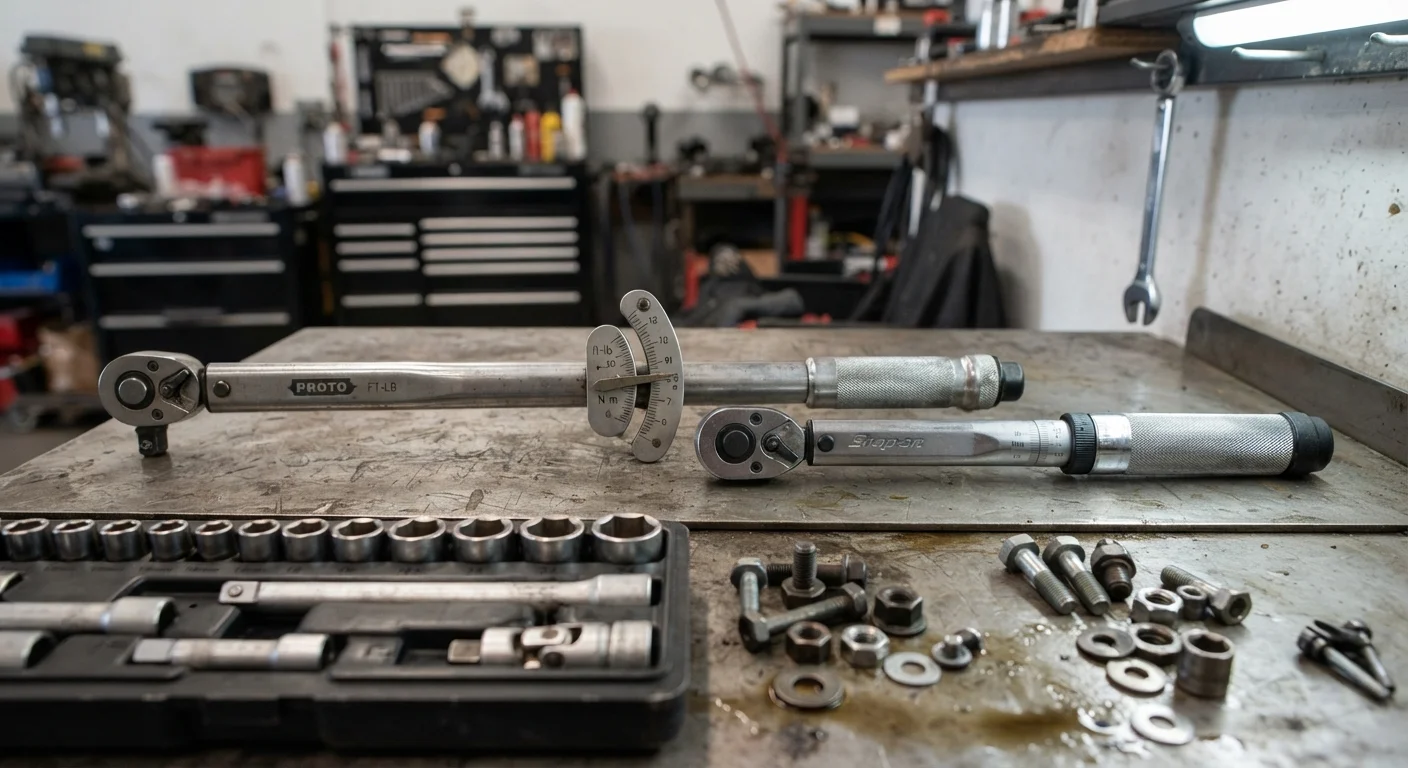
A beam (deflection) wrench works on a simple physics principle: as you apply force to the handle, a long steel beam flexes while a rigid pointer remains stationary. A scale printed along the beam shows the live torque reading. There are no springs, no ratcheting pawls, and no preset mechanism. You simply watch the needle and stop when it hits the target value.
A click wrench uses an internal spring-loaded clutch mechanism. You dial in your target torque on an adjustable scale, then tighten the fastener normally. When the applied force reaches the preset value, the clutch releases and the wrench produces a distinctive click - both felt and heard. That signal tells you to stop. Unlike the beam wrench, you don't need to watch a gauge mid-turn.
A third category worth knowing: digital torque wrenches use an electronic strain gauge and display the live reading on an LCD. They can store peak readings and alert you with a beep or vibration. They sit at the high end of the price range and are common in professional service environments, though serious hobbyists occasionally invest in them for engine work.
| Criterion | Beam Wrench | Click Wrench |
|---|---|---|
| How it signals torque | Live needle on a graduated scale | Audible and tactile click at preset value |
| Calibration required | No - inherently stable design | Yes - periodic verification recommended |
| Ease of use mid-task | Must watch scale while turning | Click signals you without looking |
| Angle-torque capability | No | With angle adapter, yes |
| Typical price range | Lower cost entry point | Moderate; quality affects accuracy |
| Maintenance | None required | Store at lowest setting; verify periodically |
| Best application | Infrequent use, verification tasks | Regular repetitive torquing |
Accuracy, Calibration, and Real-World Reliability
The beam wrench has a genuine advantage here: it has no mechanism to wear out or drift. Its accuracy depends on the structural integrity of the beam itself, which doesn't degrade under normal use. The tradeoff is that reading the needle accurately requires a straight line of sight and steady hands - parallax error (viewing the scale at an angle) can introduce small inaccuracies.
Click wrenches are accurate when properly maintained, but the internal spring and clutch mechanism can drift over time, especially if the wrench is stored with the adjustment collar left at a high torque setting rather than backed off to its lowest position. Industry guidance generally recommends calibration verification every 5,000 cycles or once per year for tools used in professional settings. For home use, verifying against a calibrated beam wrench or a torque testing device every couple of years is a reasonable practice.
±4%
Typical accuracy tolerance for click wrenches
Most quality click torque wrenches are rated to ±4% accuracy in the clockwise direction per ISO 6789 standards when properly calibrated.
±3-5%
Accuracy range for beam wrenches
Beam wrenches generally achieve ±3-5% accuracy under normal reading conditions, with no moving parts to wear or drift over time.
5,000 cycles
Recommended calibration interval for click wrenches
ISO 6789 guidance and many tool manufacturers recommend calibration verification after approximately 5,000 cycles of use or annually, whichever comes first.
One common mistake: leaving a click wrench set at its maximum torque setting in a toolbox. This keeps constant tension on the internal spring, which can cause it to take a permanent set and affect accuracy. Always dial the collar back to minimum after use.
Understanding how torque interacts with vehicle specs is a broader skill worth developing. If you're curious how torque figures - engine output included - factor into capability ratings, see our look at which specs carry real weight when evaluating trucks and SUVs.
Matching the Tool to the Task
Not every fastener carries the same consequences for under- or over-torquing. Understanding the stakes helps you choose the right tool.
Always Verify OEM Torque Specs
Torque specifications vary significantly by vehicle make, model, engine, and even model year. Before torquing any critical fastener, consult the factory service manual or a verified OEM source - not generic online tables. Using the wrong spec can result in stripped threads, gasket failure, or component damage. When in doubt about a high-stakes fastener sequence, a qualified mechanic's guidance is the appropriate next step.
Wheel lug nuts are among the most commonly torqued fasteners in home garages. OEM specs typically fall between 80 and 120 ft-lb depending on the vehicle, and under-torquing can lead to wheel separation while over-torquing can warp brake rotors or stretch wheel studs. A click wrench in the 10-150 ft-lb range handles this job well.
Spark plugs have far lower torque specs - often 10-20 ft-lb - and are easily damaged if overtightened. A smaller click wrench or a quality beam wrench works here; just verify the scale range matches the spec before you start.
Cylinder head bolts and connecting rod caps often require angle-torque sequences: a baseline ft-lb value followed by a specified degree of additional rotation. This is a job where a torque angle adapter (used with a click wrench) or a dedicated angle torque wrench is the right call. Beam wrenches alone don't handle angle specs.
For the occasional shade-tree mechanic tackling oil drain plugs, caliper bracket bolts, and lug nuts, a mid-range click wrench covering roughly 10-150 ft-lb addresses the vast majority of tasks. A beam wrench makes a solid backup or verification tool. Neither choice requires a large investment to be genuinely useful.