Why Coolant Myths Are Surprisingly Persistent
The cooling system is one of the most misunderstood under-hood systems on any vehicle. Myths about when to flush, what to use, and what warning signs actually mean circulate freely in forums, auto parts store advice lines, and word-of-mouth guidance. Acting on bad information can lead to unnecessary service bills - or, worse, real engine damage from a neglected system.
For a broader look at how these misconceptions fit into overall engine cooling, see our companion piece on coolant system myths that lead to overheating. What follows focuses specifically on the flush - when it's needed, when it isn't, and what the chemistry behind modern coolant actually tells us.
Myth
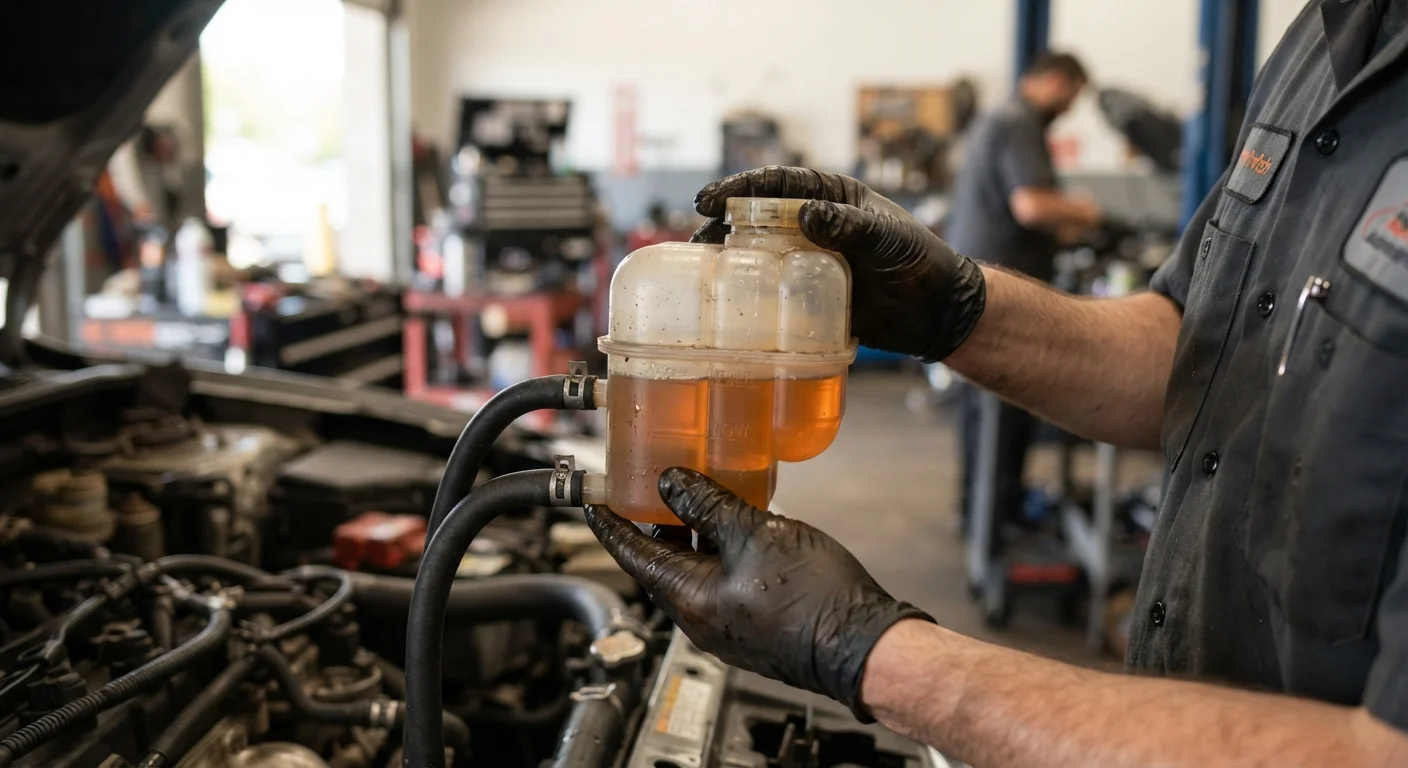
If the coolant has turned orange or brown, it's definitely bad and must be flushed immediately.
Fact
Color change is a rough indicator at best. A proper test strip or refractometer reading - checking pH, freeze point, and inhibitor depletion - is the only reliable way to assess coolant condition.
Modern OAT and HOAT coolants are engineered to last 5 years or 150,000 miles in many applications. Over that span, dye pigments degrade and the fluid darkens - but this doesn't necessarily mean the corrosion inhibitors are exhausted. Conversely, coolant can look perfectly green or pink while its inhibitor package is nearly spent. Inexpensive test strips, available at most auto parts stores, check pH and freeze point in seconds and give a far more accurate picture than color alone.
Myth
Water works fine as a short-term coolant substitute, especially in warm weather.
Fact
Plain water accelerates corrosion, lacks freeze protection, and raises the boiling point of the system far less than a proper coolant-water mix. It should only be used in an emergency to reach a service location.
A 50/50 mix of ethylene glycol coolant and distilled water raises the boiling point of the system to approximately 226°F (compared to 212°F for water alone at sea level) and lowers the freeze point to around -34°F. Plain tap water introduces minerals that deposit scale on aluminum and cast-iron surfaces. Even a brief period of running water-only accelerates galvanic corrosion inside the block, heater core, and radiator. If you top off with water in an emergency, flush and refill with the correct coolant mixture as soon as possible.
Myth
You should flush your coolant every 30,000 miles, no matter what.
Fact
The 30,000-mile interval is outdated and applies mainly to older IAT (green) coolant formulations. Many modern vehicles specify intervals of 5 years or 100,000-150,000 miles.
The 30,000-mile rule dates from an era when silicate-based green coolant was universal. Today's OAT and HOAT formulations use carboxylate inhibitors that last significantly longer. Over-flushing a system that uses long-life coolant wastes money and generates unnecessary chemical waste. Always defer to your vehicle's service schedule - OEM documentation is more reliable than generic mileage rules repeated in popular media.
Myth
Mixing different coolant colors is fine as long as you top off a little at a time.
Fact
Different coolant chemistries - particularly OAT and IAT - are chemically incompatible. Mixing them can cause silicate gel formation that clogs narrow passages in modern aluminum radiators and heater cores.
Coolant color is set by the manufacturer and varies by brand, so color alone doesn't identify chemistry. A green coolant from one manufacturer may be OAT; from another, IAT. When silicate-based and carboxylate-based inhibitors mix in certain ratios and temperatures, they can form a gelatinous precipitate that blocks coolant flow. If you're unsure what's in your system, a complete drain-and-fill with the correct OEM-specified type is safer than repeated top-offs with a different product.
Myth
A coolant flush always requires a professional flush machine and should never be DIY.
Fact
A basic drain-and-fill - which handles the vast majority of residential maintenance needs - is DIY-appropriate on most vehicles with basic hand tools, proper disposal methods, and manufacturer-specified coolant.
A professional pressure flush machine circulates new coolant through the entire system and can remove stubborn deposits, which is useful after a system contamination event or when a head gasket repair introduces combustion gases. For routine maintenance on a vehicle with a clean, well-maintained cooling system, a gravity drain from the petcock, a distilled water rinse, and a refill with fresh coolant is generally sufficient. Refer to your service manual for bleed procedures - some vehicles require burping air pockets from the system after a refill to prevent air lock and overheating.
Reading the Evidence Correctly
Even after you've sorted myth from fact, a few practical points are worth keeping in mind before you touch the cooling system.
Never Open a Hot Cooling System
Coolant under pressure can reach temperatures well above 212°F. Removing the radiator cap or any hose fitting while the engine is warm can cause severe burns from escaping steam and fluid. Always allow the engine to cool completely - typically at least 30-45 minutes after shutdown - before opening any part of the cooling system. Dispose of used coolant properly; it is toxic to animals and must not be poured down drains or into soil.
Always check your owner's manual or a factory service document for your vehicle's specific coolant type - typically identified as OAT (Organic Acid Technology), HOAT (Hybrid OAT), or IAT (Inorganic Additive Technology). Using the wrong formulation can degrade seals and cause the very corrosion you're trying to prevent. For a full reference on checking all your vehicle's fluids correctly, see fluid checks every driver should know.
Coolant myths don't exist in isolation. They're part of a larger pattern of automotive folklore that costs hobbyists unnecessary time and money. Our overview of common maintenance myths that persist despite being wrong covers related misconceptions across oil changes, engine warm-ups, and more.
5 yr / 150k mi
Typical OAT coolant service life
Many OEM service manuals specify this interval for long-life OAT formulations, far exceeding the commonly cited 30,000-mile rule.
226°F
Boiling point of 50/50 coolant mix
A 50/50 ethylene glycol and distilled water mix raises the effective boiling point roughly 14°F above plain water at sea level.