
Why Spec Sheets Mislead More Than They Inform
Walk any dealership lot and the stickers shout the same three numbers: horsepower, towing capacity, and cargo volume. Manufacturers know buyers respond to them. The problem is that none of those three figures, taken in isolation, reliably predicts whether a truck or SUV will perform the job you actually need it to do.
Spec sheets for trucks and SUVs are denser and more consequential than those for passenger cars. A number misread in a sedan purchase costs you comfort or fuel economy; the same mistake on a work truck can mean a vehicle that legally cannot carry the load you planned for it. For a broader look at how to read spec sheets across vehicle types, see our guide on reading sedan spec sheets without getting lost in the numbers.
Below, we break down the metrics that carry genuine predictive weight - and call out a few that are routinely inflated by marketing departments.
Torque Curve, Not Peak Torque
Manufacturers list peak torque as a single number - say, 460 lb-ft - but that figure only describes the engine's output at one specific RPM. What matters for towing and hauling is how wide the torque band is and where it begins. An engine that delivers peak torque from 1,600 to 3,200 RPM gives a driver far more usable pulling power than one that hits its peak only at 4,500 RPM, regardless of the headline figure.
When comparing powertrains, look for torque curve graphs in independent dyno reviews rather than relying on the single-number spec. Diesel engines typically develop peak torque at lower RPMs than gasoline equivalents - a genuine advantage for heavy hauling at low speeds.
A wide, low-RPM torque band outperforms a high peak torque number that arrives at 4,500 RPM.
Payload Rating and GVWR
The Gross Vehicle Weight Rating (GVWR) is the maximum allowable total weight of the vehicle, passengers, cargo, and any tongue weight from a trailer. Subtract curb weight from GVWR and you get payload capacity - the actual usable load the truck can carry without exceeding its structural and legal limits.
Exceeding payload is not just a mechanical concern; it can void warranties, compromise braking performance, and create legal liability. Always locate the payload sticker inside the driver's door jamb for the exact certified number for your specific build - it differs from the advertised maximum, which applies to an idealized configuration.
The door-jamb payload sticker is the only number that applies to your specific truck configuration.
Axle Ratio and Its Trade-Offs
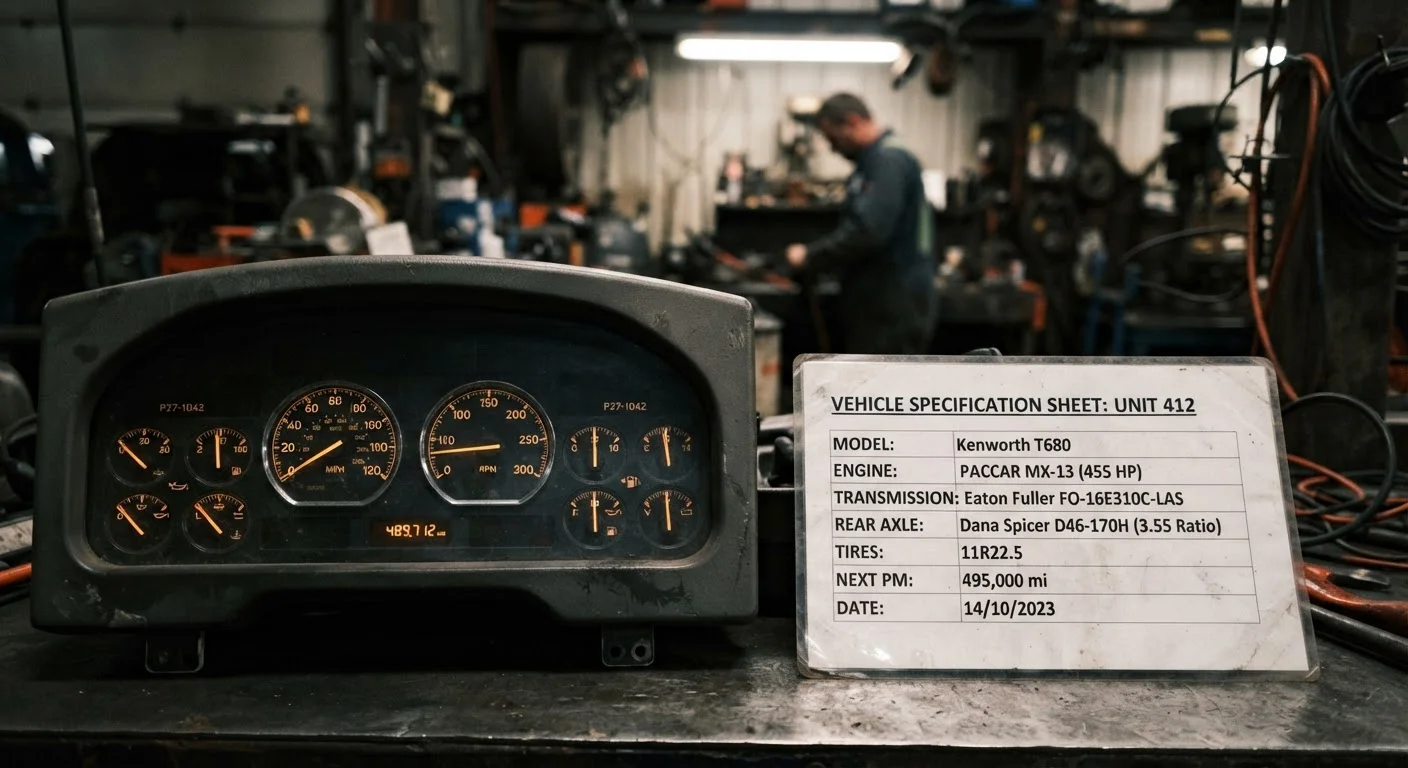
The rear axle ratio (expressed as a number like 3.55:1 or 4.10:1) determines how many times the driveshaft rotates for each wheel rotation. A numerically higher ratio - say 4.10 - multiplies torque more aggressively, which helps when climbing grades or launching heavy loads. A numerically lower ratio like 3.31 prioritizes highway efficiency over brute pulling force.
Most manufacturers offer multiple axle ratio options tied to specific towing packages. If a truck's advertised maximum tow rating requires the optional 3.73 axle and you ordered the base 3.31, you are not driving the truck that achieved that rating. This is one of the most common misread specs in truck shopping.
Ordering the wrong axle ratio can quietly reduce your towing capacity by thousands of pounds.
Wheelbase and What It Actually Controls
Wheelbase - the distance between front and rear axle centerlines - governs two competing priorities. A longer wheelbase improves stability under load and reduces trailer sway at highway speeds, which is why heavy-duty trucks favor extended wheelbases. A shorter wheelbase improves approach and departure angles off-road and tightens turning radius, which is why trail-oriented SUVs are often engineered with more compact dimensions.
For buyers who tow fifth-wheel trailers, wheelbase also determines cab-to-axle length and whether a given bed will clear the trailer's overhang during tight turns. This is a constraint many buyers discover only after purchase. See our dedicated piece on the variables that shape off-road capability for how wheelbase interacts with suspension travel and approach angles.
Longer wheelbase improves towing stability; shorter wheelbase improves off-road geometry - these goals conflict.
0-60 Times (For Work Trucks: Largely Irrelevant)
0-60 mph acceleration is a legitimate performance metric for sports cars and performance sedans. For a three-quarter-ton pickup evaluated on its ability to haul construction materials or pull a horse trailer up a mountain grade, it tells you very little. Manufacturers know this, yet the figure appears prominently in truck marketing because it is dramatic and easy to compare.
What 0-60 does not capture: sustained torque output at speed, thermal management under prolonged load, or transmission behavior in tow-haul mode. A truck with a slower 0-60 but a broader torque curve will consistently outperform a quicker-launching rival on a loaded 6% grade.
A truck's 0-60 time is a marketing tool, not a towing or hauling capability indicator.
Tongue Weight Capacity
Maximum tow rating gets the headline; tongue weight capacity is the number that actually constrains trailer selection. Tongue weight - typically 10-15% of the loaded trailer's weight - represents the downward force the trailer exerts on the hitch ball. Exceed the receiver's or hitch's tongue weight rating and you destabilize the rear axle, degrade steering feel, and risk hitch failure.
Fifth-wheel and gooseneck setups transfer pin weight directly over or ahead of the rear axle, changing the load dynamics significantly compared to a conventional ball hitch. Any spec comparison involving trailers must include tongue or pin weight capacity alongside total tow rating - they are not interchangeable figures.
Tongue weight capacity constrains trailer selection as much as total tow rating does.
Cargo Volume Figures (And Why Configuration Matters More)
Advertised cargo volume in cubic feet is useful for SUVs when comparing passenger-mode versus maximum-cargo configurations, but the figure is often measured with rear seats folded and every variable set to its most favorable state. Load floor height, width between wheel wells, and whether the floor is flat or stepped are not captured in a single cubic-foot number.
For pickups, bed length and width at the floor - not volume - are the operative specs. A 6.5-foot bed that is narrower between the wheel wells than a competitor's 5.5-foot bed may carry less usable cargo despite appearing larger on paper. Measure the load floor dimensions against the largest items you regularly transport before treating volume as a comparator.
Load floor width between wheel wells often dictates real cargo utility more than total cubic footage.
Putting the Numbers to Work
Every metric above becomes more meaningful when cross-referenced. A high tow rating paired with a short wheelbase and a steep axle ratio tells a very specific story: strong low-speed pulling but a tendency toward instability at highway speeds with a heavy trailer. Neither number alone tells that story.
Cross-Reference Specs Within the Same Build
When pulling specs from a manufacturer's website or a third-party database, always match cab style, bed length, drivetrain, and engine to a single, consistent configuration. Mixing specs from different configurations is the single most common error in truck comparisons, and it can inflate or deflate apparent capability by thousands of pounds. If you're comparing across model years, the methodology gets even more complex - read up on how model-year comparisons go wrong before drawing conclusions.
Before finalizing any comparison, verify that you are reading specs for the same trim, cab configuration, and drivetrain. Manufacturers publish ratings across dozens of permutations, and the variance between a base two-wheel-drive regular cab and a crew cab four-wheel-drive can be several thousand pounds of payload capacity. Common missteps when comparing trucks across model years explores exactly how these permutation errors compound when shoppers mix data from different generations.
For those weighing powertrain type alongside capability metrics, the trade-offs between diesel torque curves and gasoline power delivery are examined in depth in our piece on diesel vs. gasoline engines in heavy-duty trucks. And if an EV or hybrid variant is in scope, the same analytical discipline applies - see our framework for comparing EV and hybrid options.
This article is for general informational purposes only. Ratings and specifications vary by trim, configuration, and model year - always verify figures directly with the manufacturer or an authorized dealer before making a purchase decision.