How Fuel Injectors Work
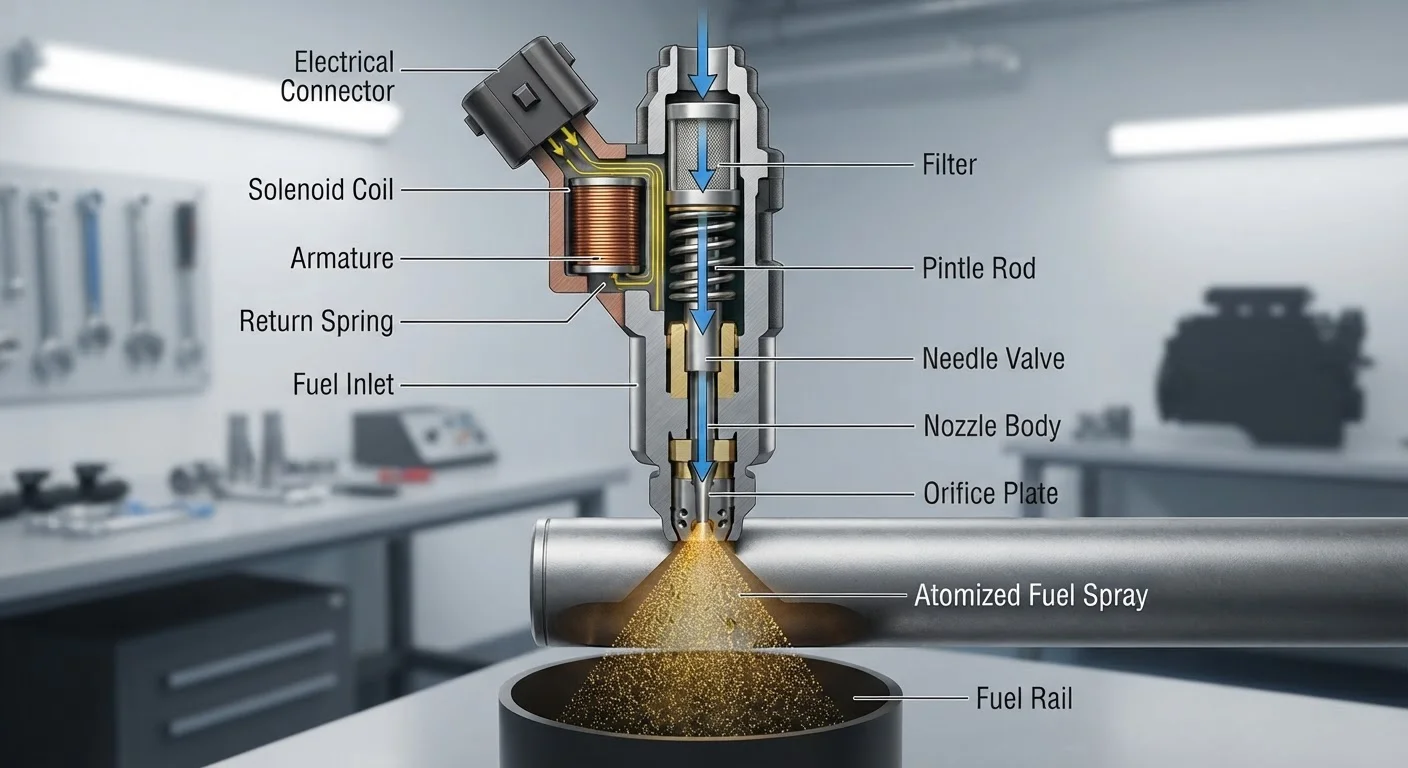
At its core, a fuel injector is an electromagnetic solenoid valve. When the ECU sends a voltage pulse to the injector's coil, a magnetic field lifts a small needle or pintle valve off its seat, allowing pressurised fuel to pass through a precision-machined nozzle and atomise into a fine mist. The moment the pulse ends, a return spring snaps the valve shut.
This open-and-close cycle happens once per engine cycle on most vehicles. The ECU continuously adjusts pulse width - the length of time the valve stays open - to deliver exactly the right volume of fuel for current conditions. Sensors feeding this calculation include the mass airflow (MAF) sensor, manifold absolute pressure (MAP) sensor, coolant temperature sensor, and oxygen sensors in the exhaust.
The result is a stoichiometric air-fuel ratio of approximately 14.7:1 by mass under normal conditions, which keeps combustion clean and the catalytic converter working efficiently. Richer or leaner mixtures are commanded deliberately during cold starts, wide-open throttle, or deceleration fuel cut-off.
~14.7:1
Ideal stoichiometric air-fuel ratio
This ratio maximises combustion efficiency and keeps three-way catalytic converters operating at peak conversion efficiency.
2-4 ms
Typical injector pulse width at idle
Pulse width extends significantly under load; precise timing is managed by the ECU based on real-time sensor input.
100,000+ mi
Common injector service life with clean fuel
Injector longevity depends heavily on fuel quality, filter maintenance, and the presence of carbon-building direct-injection combustion environments.
What Causes Injectors to Clog or Fail
Injectors are remarkably durable, but they operate in a harsh environment. The two most common enemies are fuel deposits and contamination.
- Carbon and varnish deposits: Repeated heat soak after engine shutdown causes residual fuel in the injector tip to bake onto the nozzle. Over time, this narrows the spray holes, distorts the spray pattern, and reduces flow rate. Direct-injection engines are especially susceptible because the injector tip sits directly in the combustion chamber heat.
- Contaminated fuel: Water, particulates, or degraded fuel can clog the injector filter basket - a fine mesh screen at the inlet - or score the valve seat.
- Electrical failure: The solenoid coil can fail open or short, causing the injector to remain closed (lean cylinder) or stuck open (rich cylinder and potential fuel wash of the cylinder bore).
- O-ring deterioration: Rubber O-rings at the injector inlet and tip seal the injector against the fuel rail and intake manifold. Age and heat cause them to harden and crack, leading to external fuel leaks or vacuum leaks that upset the air-fuel mixture.
Protect Injectors With Regular Filter Changes
The fuel filter is the primary defence against particles reaching your injectors. On vehicles with a serviceable inline fuel filter, replacing it on the manufacturer's recommended schedule - commonly every 30,000 miles, though intervals vary - is one of the most cost-effective ways to extend injector life. Check your owner's manual for the interval specific to your vehicle.
Recognising the Symptoms
Injector problems rarely announce themselves dramatically at first. More often, symptoms creep in gradually:
- Rough or fluctuating idle - a partially clogged injector delivers inconsistent fuel amounts cycle to cycle, creating uneven combustion.
- Engine misfire codes - a specific cylinder misfiring (P030X codes) often points to that cylinder's injector, though ignition and compression faults must also be ruled out.
- Poor fuel economy - a leaking or stuck-open injector wastes fuel; a clogged injector forces the ECU to compensate with longer pulse widths on other cylinders.
- Hard starting or stalling - insufficient fuel delivery on cold starts is a classic symptom of clogged or weak injectors.
- Fuel smell inside or outside the vehicle - always take this seriously. External injector leaks are a fire hazard and require immediate attention from a qualified mechanic.
A useful companion diagnostic is inspecting your spark plugs. Fouled or oil-washed plugs can point directly to injector or fuelling issues. See our guide to reading spark plug condition for a detailed breakdown of what plug deposits reveal about combustion health.
Cleaning, Testing, and Replacement
Before condemning an injector, it helps to understand the diagnostic options available:
- Fuel system cleaner: Detergent additives introduced through the fuel tank can dissolve mild varnish deposits on port injectors. Results vary by product and severity of buildup - this is a maintenance measure, not a repair for mechanically failed injectors.
- Professional on-car cleaning: A shop can connect a cleaning canister directly to the fuel rail, running a concentrated solvent through the injectors under pressure while the engine runs. This is more effective for moderate deposits.
- Off-car flow testing: Removed injectors can be bench-tested and ultrasonically cleaned by a specialist. Flow rate, spray pattern, and leak-down are measured against OEM specs. This is the most thorough diagnostic and is particularly worthwhile for performance or classic vehicle applications where injector matching matters.
- Replacement: Severely clogged, electrically failed, or leaking injectors typically need replacement. OEM-specification injectors are generally the straightforward choice for daily drivers. Always replace O-rings when reseating any injector, regardless of whether the injector itself is new.
GDI Engines and Intake Valve Deposits
Gasoline direct-injection (GDI) engines inject fuel past the intake valves rather than onto them, so fuel detergents never wash the valve backsides. Carbon deposits can build up on intake valves over time, restricting airflow independently of injector condition. Some manufacturers recommend periodic walnut shell blasting or chemical intake cleaning as a separate maintenance item on GDI-equipped vehicles.
Fuel system work involves pressurised, flammable liquid. Always depressurise the fuel rail before disconnecting any injector, work in a well-ventilated area, and have a fire extinguisher accessible. If you are uncomfortable with these steps, a qualified mechanic should perform the service.