The Core Mechanism: Spinning Exhaust into Power
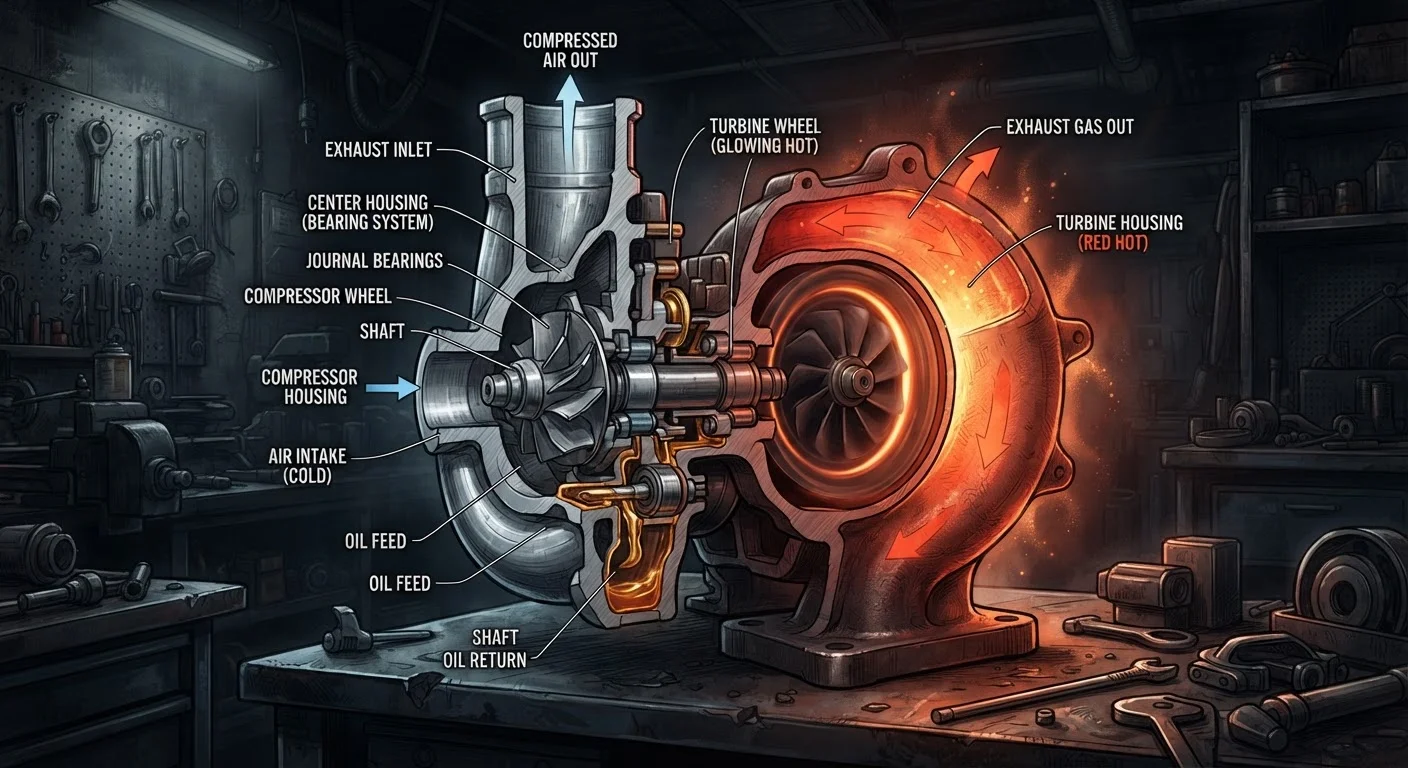
Every turbocharged engine contains two distinct sides joined by a common shaft: the turbine side and the compressor side. Exhaust gases exiting the combustion chamber flow into the turbine housing, striking the turbine wheel and causing it to spin. Because the turbine wheel is rigidly attached to the compressor wheel via that shared shaft, the compressor spins at the same speed.
The spinning compressor draws in fresh ambient air and pressurizes it before it enters the intake manifold. When compressed air is delivered at pressures above atmospheric - measured in pounds per square inch (psi) or bar of boost - the engine can inject and ignite proportionally more fuel per combustion cycle. The result is a meaningful increase in torque and horsepower from an engine that might otherwise be quite modest in displacement.
A wastegate - either internal or external - acts as a pressure-relief valve, bypassing a portion of exhaust gases around the turbine once target boost pressure is reached. This prevents overboosting and protects both the turbo and the engine.
“The turbocharger is essentially a miniature jet engine bolted to your exhaust system. Respecting the heat and lubrication demands it places on the rest of the powertrain is fundamental to getting full service life from it.”
— Society of Automotive Engineers Technical Community, Professional engineering organization focused on mobility engineering standards
Why Heat Is the Turbocharger's Primary Adversary
The thermodynamics that make a turbocharger effective are the same ones that threaten its survival. Exhaust gases entering the turbine housing can exceed 1,600°F (870°C) under hard acceleration. The turbine wheel and its housing must tolerate this continuously, which is why high-nickel alloys and ceramic composites are increasingly common in modern turbine construction.
Heat creates two compounding problems. First, compression itself raises air temperature - a physics principle called the adiabatic heating effect. Highly compressed air arrives at the intake manifold warmer than ambient, reducing its density and partially negating the gains from boosting. This is why an intercooler (also called a charge-air cooler) is fitted between the turbo outlet and the intake on most modern turbocharged vehicles: it drops compressed air temperature, restoring density and reducing detonation risk.
Second, and more critically for longevity, heat concentrates in the turbo's center housing - the section that contains the shaft bearings. Oil circulates through this housing to lubricate and cool the bearings. If the engine is shut off immediately after hard driving, oil flow stops while the housing is still extremely hot. The residual oil can oxidize and form hard, varnish-like deposits called oil coking on the shaft and bearings. Even modest coking accelerates bearing wear and restricts oil passages over time.
1,600°F+
Turbine inlet temperature under full load
Exhaust gas temperatures at the turbine housing are cited in engineering literature as commonly exceeding 870°C (1,600°F) on gasoline engines under sustained hard acceleration.
100,000+ RPM
Typical turbocharger shaft speed
Most passenger-car turbochargers operate between 80,000 and 150,000 RPM, according to widely cited automotive engineering references, making bearing lubrication critical.
30-60 sec
Recommended post-drive idle time
Many turbocharger manufacturers and OEM service documentation reference a short idle period after sustained boost use to prevent oil coking in the center housing.
Maintenance Practices That Follow Directly from the Physics
Understanding the thermal environment inside a turbocharger makes most maintenance advice self-explanatory rather than arbitrary.
- Use the correct oil and change it on schedule. Fresh, full-synthetic oil of the specified viscosity maintains a stable film on the shaft bearings even at extreme temperatures. Degraded oil loses viscosity and shear strength, allowing metal-to-metal contact at 100,000+ RPM.
- Allow a brief idle after hard driving. Thirty to sixty seconds of idle time after sustained boost use keeps oil and coolant circulating through the center housing as temperatures begin to drop, preventing coking.
- Check oil level regularly. A turbocharger demands a consistent, uninterrupted oil supply. Running low on oil - even briefly - can score the bearings irreparably.
- Inspect charge pipes and intercooler connections. Boost leaks downstream of the turbo reduce pressure, causing the turbo to compensate by spinning faster than intended - a condition called overspeeding that shortens bearing life.
For those weighing a turbocharged vehicle against a conventional alternative, our comparison of turbocharged vs. naturally aspirated family sedans explores how these engineering trade-offs translate into real-world ownership experience.
Check Your Oil Before Long Trips
Because a turbocharger depends on a steady, uninterrupted oil supply, verifying both oil level and condition before any extended drive is a simple but effective preventive step. Low oil level under sustained boost loads can damage the center housing bearings within minutes - damage that may not produce obvious symptoms until the turbo is already compromised.
When to Consult a Professional
Some turbo-related symptoms - a high-pitched whine, visible oil smoke from the exhaust, or a noticeable loss of boost pressure - warrant inspection by a qualified mechanic rather than a DIY diagnosis. Internal bearing wear, cracked turbine housing, or shaft play require precise measurement tools (such as a dial indicator to check axial and radial play) that most home garages don't have on hand.
Replacement turbochargers range from remanufactured OEM-specification units to upgraded aftermarket options. A qualified technician can inspect the oil feed and return lines, the wastegate actuator, and the surrounding heat shielding at the same time - components that frequently contribute to repeat failures if left unaddressed.
The turbocharger is a precision component operating in one of the harshest thermal environments in your vehicle. Treating its maintenance as an extension of basic oil care - rather than as a specialized, exotic concern - is the most practical framework for keeping it healthy through high mileage.