
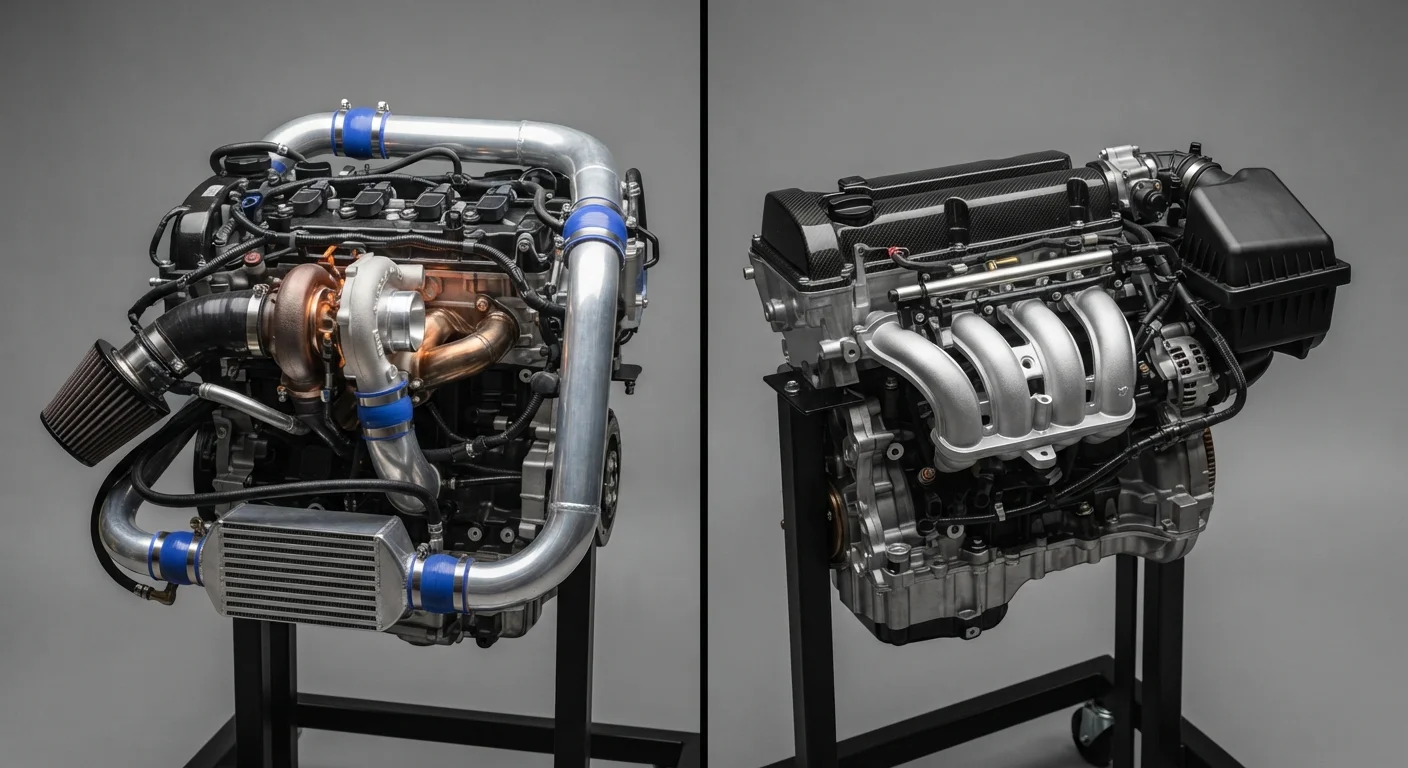
How Each System Generates Power
A naturally aspirated (NA) engine draws in air purely through atmospheric pressure - combustion depends entirely on the displacement of the cylinders and how efficiently the engine breathes. There are no additional components forcing air into the intake. The result is a system that is mechanically straightforward and whose power delivery scales predictably with engine speed.
A turbocharged engine compresses intake air using a turbine driven by exhaust gases, forcing a denser charge into the combustion chamber. This allows a smaller displacement to produce power outputs that would otherwise require a significantly larger engine. The trade-off is additional thermal and mechanical complexity - an intercooler, wastegate, boost pressure management, and additional oil lines all enter the equation.
Understanding this distinction is foundational. It shapes not just performance, but maintenance schedules, warm-up behavior, and how each engine responds when you call for sudden acceleration. For a deeper look at how powertrain choices interact with chassis dynamics, see our guide to suspension tuning and sedan character.
Performance and Throttle Response Compared
On paper, turbocharged family sedans often show an advantage in peak torque figures - and that advantage is real under the right conditions. The surge of torque available at relatively low RPM makes turbo sedans feel responsive during everyday driving: pulling onto a freeway, overtaking a slower vehicle, or climbing a grade with a full passenger load.
However, turbo lag - the brief delay between throttle input and boost build - remains a factor, particularly in older or less sophisticated implementations. Modern twin-scroll and electric-assist turbochargers have reduced this gap considerably, but the characteristic is not entirely eliminated.
Naturally aspirated engines counter with a linearity that turbo units struggle to replicate. Throttle response tracks driver input directly and consistently, which many experienced drivers find easier to modulate in traffic or during spirited cornering. The absence of a boost threshold means power delivery doesn't surge unexpectedly.
| Criterion | Turbocharged | Naturally Aspirated |
|---|---|---|
| Peak torque delivery | Strong at low-to-mid RPM | Builds with engine speed |
| Throttle response | Can exhibit slight lag | Linear, immediate |
| Engine complexity | Higher (turbo, intercooler, boost control) | Lower, fewer auxiliary parts |
| EPA fuel economy (label) | Often competitive or favorable | Typically straightforward to achieve |
| Real-world city economy | Can underperform label under load | Generally consistent with estimates |
| Maintenance sensitivity | High - oil quality critical | Moderate - more tolerant |
| Long-term repair exposure | Turbo components add potential cost | Lower additional component risk |
For buyers weighing how powertrain behavior fits their specific commute or route, our sedan-to-driving-pattern matching guide lays out a structured approach.
Fuel Economy: Label vs. Reality
EPA estimates for turbocharged sedans frequently look compelling - smaller engines with equivalent or superior horsepower ratings often post strong combined MPG numbers. But those figures are generated under controlled conditions that favor light throttle inputs and steady-state cruising.
~10-15%
Typical real-world MPG shortfall vs. EPA estimate
The U.S. Department of Energy notes that actual fuel economy commonly falls 10-15% below EPA combined ratings in real-world driving conditions.
1.5-2.0L
Common turbo displacement in mid-size family sedans
Many current mid-size sedan turbo engines displace between 1.5 and 2.0 liters while producing outputs previously associated with 2.5-3.0L naturally aspirated units.
2-3x
Greater oil degradation rate in turbo vs. NA engines
Engineering studies indicate turbocharger operating temperatures can accelerate oil degradation significantly compared to naturally aspirated equivalents, underscoring the importance of interval compliance.
In everyday use - particularly urban driving with frequent stops, cold starts, and periods of spirited acceleration - many turbo engines consume fuel at rates closer to their larger NA counterparts. The boost system delivers efficiency gains mainly when the driver exercises restraint. Aggressive inputs spool the turbo and fuel consumption rises accordingly.
Naturally aspirated engines, by contrast, tend to deliver fuel economy that more closely aligns with real-world driving across a broader range of inputs. There's no boost-induced spike when you accelerate firmly. For buyers doing a lot of city driving, this consistency can matter more than a favorable EPA label.
This dynamic is explored in detail in our mid-size sedan powertrain comparison, which includes real-world economy data across multiple configurations.
Maintenance, Reliability, and Ownership Costs
Turbocharged engines require more attentive maintenance. High-quality oil is essential - the turbocharger bearings rely on proper lubrication and are sensitive to degraded or low oil. Extended oil change intervals, acceptable in some NA applications, carry greater risk in a forced-induction system. Turbo components can also require replacement over time, adding a potential long-term cost that NA owners won't face.
Naturally aspirated engines are generally more forgiving. Fewer auxiliary systems mean fewer potential failure points, and many NA units in family sedans have established long-term reliability records. Routine maintenance - oil, filters, spark plugs, belts - covers most of what these engines need over a typical ownership period.
That said, modern turbocharged sedans from established manufacturers have closed the reliability gap considerably. Buyers should examine model-specific owner data and service records rather than applying broad generalizations. If you're comparing this to the added complexity of a hybrid drivetrain, our hybrid vs. conventional petrol sedan comparison addresses those trade-offs directly.
This article provides general educational information about engine types and is not a substitute for professional mechanical advice. Always consult a qualified mechanic for maintenance decisions specific to your vehicle.