Two Organizations, Two Different Questions
When sedan shoppers encounter a safety rating, the first question should be: who ran the test and what were they measuring? NHTSA and IIHS are independent organizations with distinct methodologies, funding structures, and evaluation goals. Treating their scores as interchangeable leads to misreads.
NHTSA administers the federally run New Car Assessment Program (NCAP). Its mandate is consumer information at scale - a 1-5 star system that covers frontal, side, and rollover performance and rolls them into a single Overall Vehicle Score. The tests use conditions standardized across all manufacturers, enabling broad comparisons across vehicle classes.
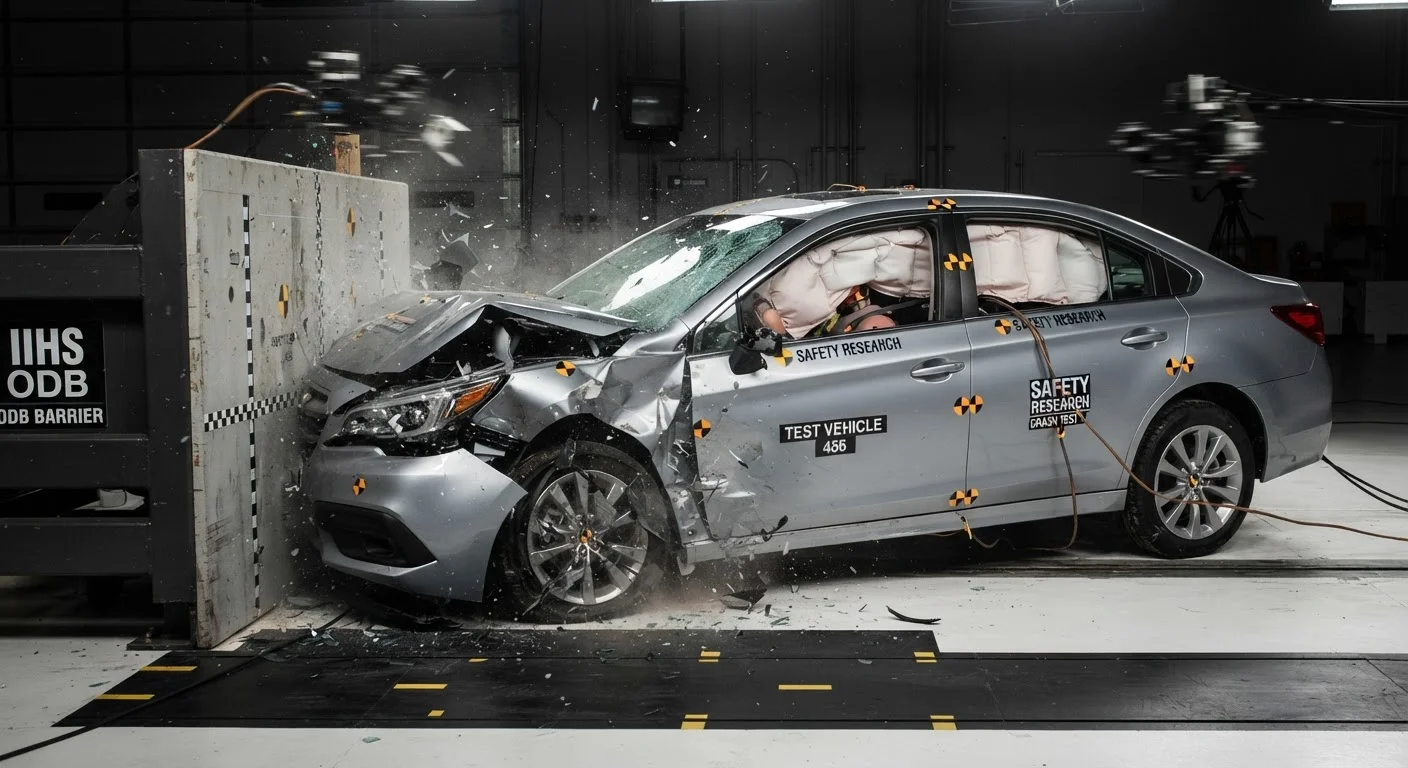
The IIHS, funded by insurers rather than government, designs its tests specifically to expose real-world crash patterns that regulatory tests sometimes miss. Critically, IIHS updates its test protocols more frequently and introduced the small overlap frontal test in 2012 specifically because vehicles were engineered to pass the full-width federal test without adequately protecting occupants in common angular collisions. The result: a vehicle can hold a 5-star NHTSA rating and a Marginal IIHS rating simultaneously - and both can be technically accurate.
| NHTSA Rating Scale | 1-5 stars (5 = highest safety) |
| IIHS Rating Scale | Good / Acceptable / Marginal / Poor |
| IIHS Small Overlap Test Speed | 40 mph into 25% of front corner (IIHS test protocol) |
| NHTSA Full-Width Frontal Test Speed | 35 mph into a rigid barrier (NHTSA NCAP protocol) |
| Top Safety Pick+ Requirement | Good/Acceptable across all crash tests + headlight standard (IIHS designation criteria) |
| NHTSA Side Pole Test | Simulates narrow object intrusion (e.g., utility pole) (NHTSA NCAP protocol) |
For a broader look at how to interpret sedan specification data alongside safety scores, see Reading a Sedan Spec Sheet Without Getting Lost in the Numbers.
Breaking Down What Each Test Actually Measures
NHTSA's frontal test sends the vehicle into a full-width rigid barrier at 35 mph. This measures how well the restraint system - airbags, seatbelts, pretensioners - manages deceleration forces on a 50th-percentile male dummy. It does not challenge structural corners.
IIHS's small overlap test strikes just 25% of the vehicle's front corner at 40 mph using a deformable barrier introduced in an updated protocol. The objective is structural integrity at the A-pillar and footwell - areas that a full-width test does not adequately load. IIHS also runs a moderate overlap frontal test at 40 mph covering 40% of the vehicle's width, bridging the gap between these extremes.
Side impact tests differ too. NHTSA's moving deformable barrier represents a vehicle-to-vehicle strike; its pole test simulates hitting a narrow fixed object. IIHS introduced an updated side test in 2021 using a heavier, taller barrier to reflect the growing prevalence of SUVs and pickup trucks in the vehicle fleet - a meaningful real-world calibration that older IIHS side ratings did not capture.
A 5-Star Rating Is Not Unconditional
NHTSA's 5-star overall score is a composite of separate subcategory ratings. A sedan can earn 5 stars overall while scoring 3 stars in a specific subcategory, such as the side pole test. Always review individual subcategory scores - not just the headline number - before drawing conclusions about a specific crash scenario.
25%
Barrier overlap in IIHS small overlap test
This narrow strike zone is specifically designed to challenge the structural corner of the vehicle that full-width frontal tests do not adequately stress.
4
IIHS rating tiers for each test category
Good, Acceptable, Marginal, and Poor - a finer-grained vocabulary than NHTSA's star scale, particularly useful for identifying marginal performers.
35 mph
NHTSA full-width frontal barrier test speed
NHTSA's standard frontal test impacts the full width of the vehicle's front end, prioritizing deceleration forces and restraint system performance.
Reading the Scores Side by Side on Any Sedan
The practical approach: pull both IIHS and NHTSA results for any sedan you are seriously evaluating, then review subcategory scores rather than headline composites. Follow this structure:
- Frontal protection: Check IIHS small overlap (driver- and passenger-side separately), moderate overlap, and NHTSA frontal star rating. Mismatches here often signal that a vehicle's structure performs unevenly across strike geometries.
- Side protection: Identify whether the IIHS result uses the post-2021 updated side test or the older protocol - results are not directly comparable. NHTSA side and pole scores complement this picture.
- Headlights: IIHS rates headlights on the same Good-to-Poor scale. Poor or Marginal headlights can affect a vehicle's eligibility for Top Safety Pick+ even if crash scores are strong. NHTSA does not currently rate headlights.
- Front crash prevention: Both organizations evaluate automatic emergency braking (AEB) in vehicle-to-vehicle and vehicle-to-pedestrian scenarios, but their test speeds and scoring differ. Superior IIHS vehicle-to-pedestrian performance does not automatically translate to a higher NHTSA sub-score.
Cross-referencing both sources is especially useful when comparing sedans across model years, as protocol changes can make year-over-year score drops appear that reflect a stricter test rather than a worse vehicle. For a structured comparison of how mid-size sedans have performed across these metrics, see Mid-Size Sedans Side by Side.
If you are early in the shopping process, Sedan Shopping From Scratch outlines how to prioritize safety alongside other purchase criteria before visiting a dealership.