
Why Towing Charts Are More Complicated Than They Appear
A manufacturer's published maximum towing capacity is an envelope figure - the highest number achievable across an entire model family under a controlled set of conditions. It is not a universal specification that applies to every truck wearing that nameplate. The chart behind that headline number is where the real engineering constraints live, and navigating it correctly is the difference between a safe tow and an overloaded one.
As detailed in our companion piece on why advertised tow ratings rarely apply to your actual truck, factors like cab style, bed length, axle ratio, and option packages each independently constrain the final figure. A crew-cab short-bed model with a base axle ratio can rate thousands of pounds below the regular-cab long-bed version of the same model - even with identical powertrains. Understanding the chart structure before you shop is therefore as important as knowing what you plan to tow.
If you're also comparing ratings across model years, be aware that ratings can shift dramatically between generations, sometimes due to regulatory test procedure changes rather than actual capability improvements.
What you will need
How to Read Your Chart and Apply It Correctly
Never Rely on the Headline Number Alone
The maximum towing figure printed on a window sticker or advertised in a campaign typically reflects the most favorable configuration available - often a specific powertrain, axle ratio, and cab-and-bed combination. Exceeding your actual truck's rated capacity is a safety and liability issue. Always verify the figure against your specific build before attaching any trailer.
Follow the steps below in sequence. Each one eliminates a specific source of error that commonly leads buyers to overestimate what their truck can safely move.
Locate the Correct Towing Guide for Your Model Year
Manufacturer towing guides are version-specific. A guide from one model year may not reflect a platform update, powertrain addition, or rating revision in the next. Download the towing guide that matches your truck's exact model year directly from the manufacturer's website - typically found under owner resources, fleet resources, or the truck's dedicated product page.
Identify Every Variable That Affects Your Row in the Chart
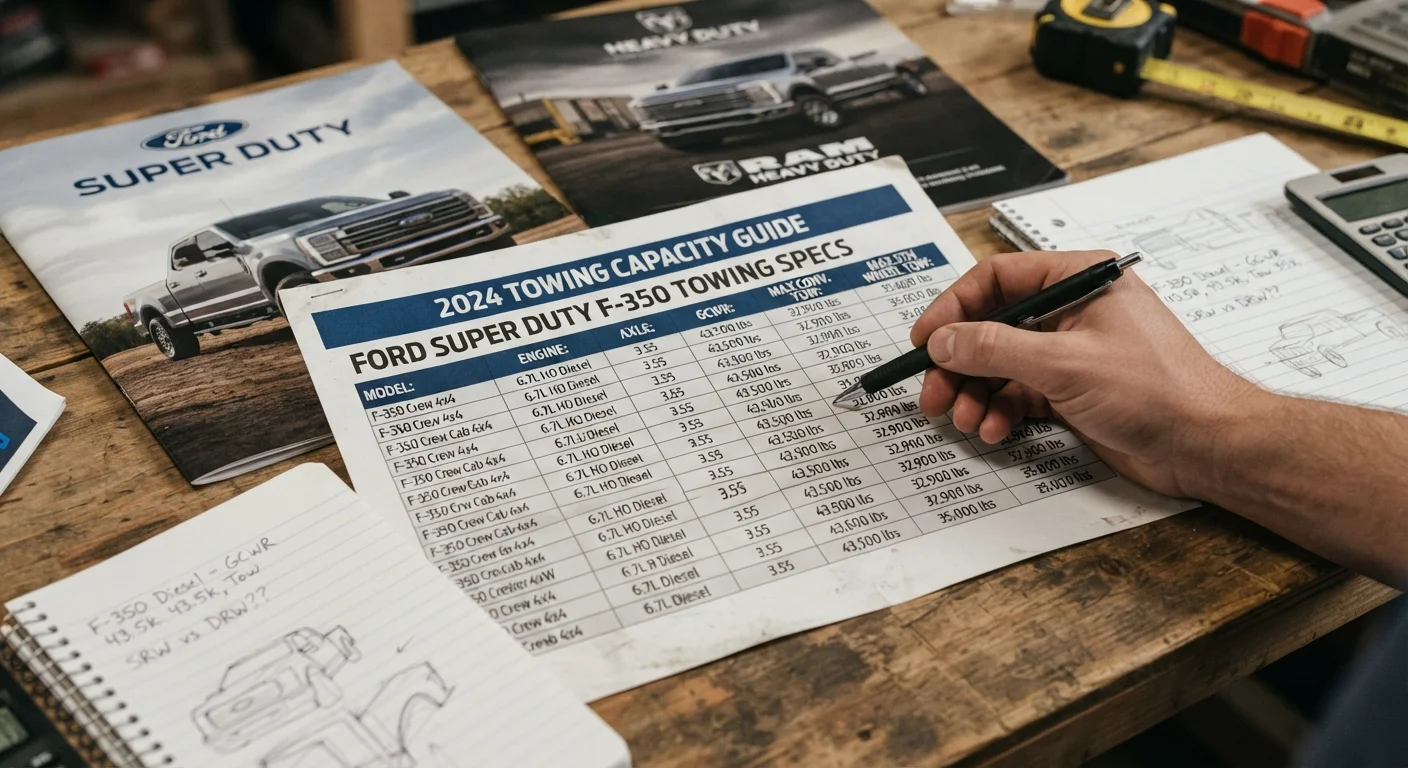
Towing charts are matrix tables, and the correct row depends on multiple simultaneous variables. For most full-size trucks, the relevant columns include: cab configuration (regular, extended/SuperCab, crew), bed length (short, standard, long), engine and transmission pairing, rear axle ratio, and 2WD vs. 4WD. Changing any single variable can shift the rating by hundreds - or thousands - of pounds. Check your window sticker or build sheet to confirm each value before finding your row.
Find the Rating at the Intersection of Your Exact Configuration
Once you've identified every applicable variable, locate the cell in the chart where your configuration intersects. This single number - not the headline figure at the top of the brochure - is your truck's maximum trailer weight rating for that build. Record it. If your truck isn't yet purchased and you're comparing configurations, run this step for each option package you're considering to see how much the rating changes.
Check Tongue Weight Limits Against Your Trailer
Every towing chart lists a maximum tongue weight - typically 10-15% of the maximum trailer weight rating - alongside the tow figure. Your trailer's tongue weight (the downward force the hitch ball bears when the trailer is loaded) must fall within this range. Too low and the trailer pushes the rear of the truck; too high and you've exceeded the payload budget. Calculate tongue weight from your trailer's loaded weight, not its dry weight.
Cross-Check Against Your Truck's Payload Rating
Tongue weight is a cargo load on the truck, not on the trailer. Add tongue weight to everything else in the cab and bed - passengers, gear, fuel - and compare the total against the payload figure on your door-jamb sticker. If that sum exceeds the Gross Vehicle Weight Rating (GVWR) minus the truck's curb weight, you're overloaded regardless of what the towing chart shows. This is the step most buyers skip, and why advertised ratings rarely apply to real-world use.
Note Any Footnotes That Apply Conditional Restrictions
Towing charts frequently carry footnotes that impose additional conditions: trailer brake requirements above a certain weight, maximum trailer length limits, mandatory equipment packages, or altitude derating. A rating may only apply when a factory integrated trailer brake controller is equipped, for example. Read every footnote associated with your configuration row before treating the figure as unconditional.
Tongue Weight and Payload Are Separate Constraints
A truck rated to tow 12,000 lbs can still be overloaded if the tongue weight of your trailer exceeds the hitch's rated tongue weight limit or pushes your payload past the Gross Vehicle Weight Rating (GVWR). These are independent caps - both must be respected simultaneously. Ignoring payload when planning a tow setup is one of the most common and dangerous mistakes buyers make.
Use the Build Sheet, Not the Brochure
When researching a specific truck, download the manufacturer's towing guide for the exact model year - not the marketing brochure. These guides are typically available on the brand's owner resources page and are organized by powertrain, cab, bed, and drivetrain. Cross-referencing your actual option codes against that document takes under five minutes and eliminates guesswork entirely.
Once you've confirmed your truck's actual tow rating and verified that both tongue weight and payload constraints are satisfied, you have a reliable baseline for equipment decisions. For guidance on what hitch hardware, weight distribution systems, and brake controllers to pair with your setup, see our walkthrough on upgrading your truck's towing setup. If you're evaluating trucks for RV towing specifically, the RV Types and Classes hub provides trailer weight ranges by category that map directly against these figures.
This article provides general educational information about interpreting manufacturer towing specifications. It is not a substitute for your vehicle's owner's manual, the manufacturer's official towing guide, or the advice of a qualified mechanic or commercial vehicle specialist. Always consult the documentation specific to your vehicle before towing any load.