
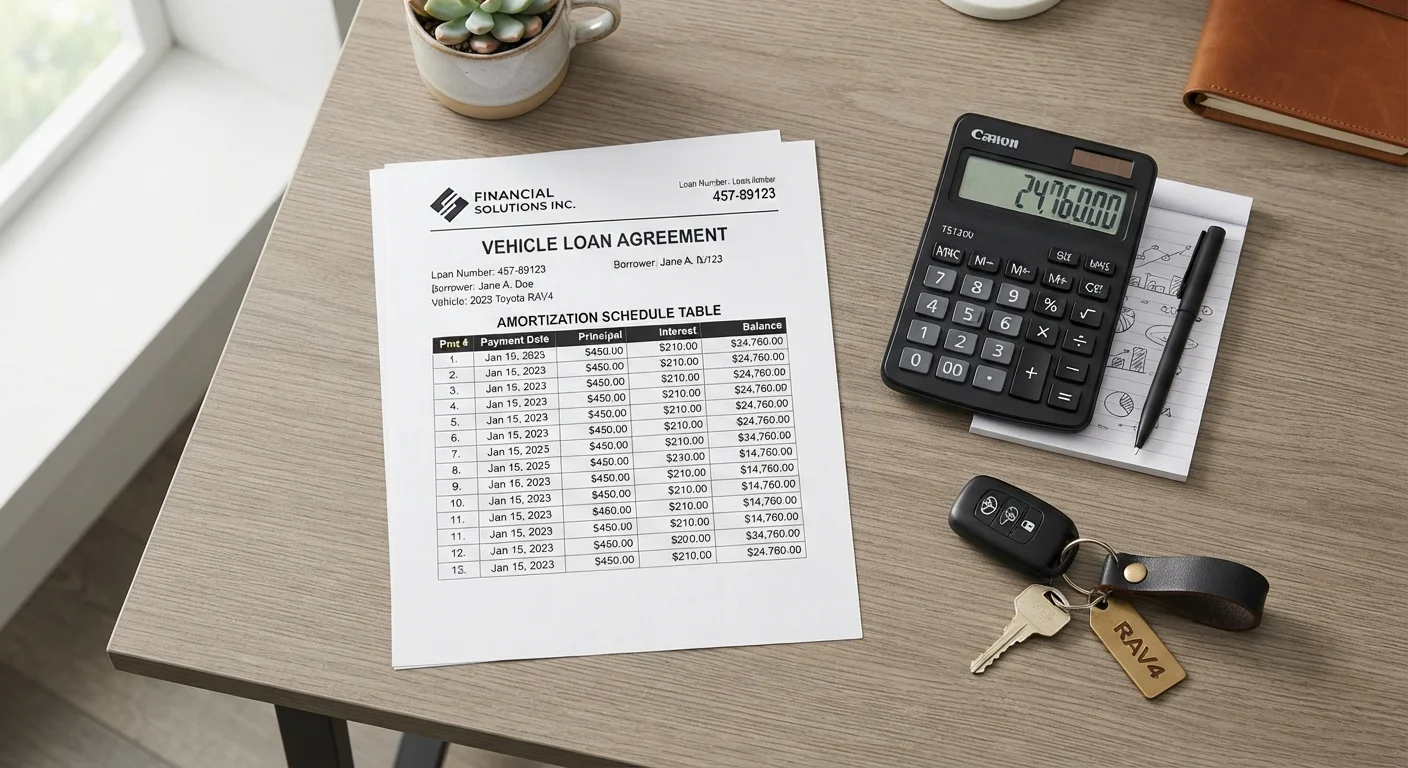
How an Amortization Schedule Is Built
Every standard auto loan uses a fixed monthly payment calculated so the loan reaches a zero balance on the final due date. That payment amount stays constant, but its internal composition changes with every single payment.
The calculation works like this: at the start of each billing period, the lender multiplies the remaining principal by the monthly periodic rate (your APR divided by 12). The result is that month's interest charge. The rest of the fixed payment reduces the principal. Because the principal is lower the following month, so is the interest - meaning a slightly larger slice of the same payment attacks the balance.
This shifting ratio is captured in an amortization schedule: a row-by-row table for every payment in the loan. Reading an amortization schedule in detail reveals exactly how much equity you are building at any point in time - information that becomes critical when you consider refinancing, a trade-in, or early payoff.
Amortization vs. Simple Interest Loans
Most US auto loans use simple interest amortization, meaning interest accrues daily on the outstanding balance and is collected with each monthly payment. This differs from precomputed interest loans, where the total interest is fixed at origination. Understanding which structure applies to your loan matters when evaluating early payoff savings. Check your loan agreement or ask your lender directly.
The Front-Loading Effect and Why It Matters
On a typical 60-month auto loan, a borrower may find that well over half of all interest paid across the life of the loan is collected in the first 18 to 24 months. This front-loading is not a lender trick - it is simply the mathematical consequence of interest accruing on a large outstanding balance.
The practical implication is significant: if you sell or trade in a vehicle in the first two to three years, the remaining loan payoff will be higher - relative to what you have actually paid - than most buyers intuitively expect. Combined with vehicle depreciation, this dynamic is the primary driver of negative equity situations. Understanding how auto loans are structured before signing helps buyers plan for this phase rather than be caught off-guard by it.
~60%
Interest paid in first half of a 60-month loan
On a standard fully-amortizing auto loan, roughly 60% of total interest is collected during the first half of the repayment period due to declining-balance interest calculation.
72-84 mo.
Common extended auto loan terms in the US
Industry data from sources including the Consumer Financial Protection Bureau has noted growing prevalence of 72- and 84-month auto loan terms, which extend the interest-heavy early payment phase.
Early Payoff, Extra Payments, and Prepayment Penalties
Because interest accrues on the remaining balance, any additional principal payment immediately reduces future interest charges. Making even one or two extra principal-only payments per year can shorten the effective loan term and reduce total interest paid - the savings compound because a lower balance generates lower interest in every subsequent month.
Before pursuing this strategy, review the loan agreement for a prepayment penalty clause. While less common in consumer auto lending than in some mortgage products, they do appear - particularly in certain dealer-arranged financing arrangements. A penalty that equals several months of interest can erode the benefit of early payoff, so the math deserves a close look.
Request Your Full Amortization Schedule
Before finalizing any vehicle loan, ask the lender or finance office for a complete amortization schedule. Most are required to provide one on request. Reviewing it lets you see your equity position at any future month - essential information if you plan to sell, trade in, or refinance before the loan term ends.
Loan term length also interacts directly with amortization dynamics. Stretching to a 72- or 84-month term keeps the monthly payment lower but extends the period during which interest accumulates on a high balance. The trade-offs of longer loan terms deserve careful consideration alongside any monthly payment discussion. Buyers who focus only on the monthly figure - a common negotiation dynamic explored in our piece on why dealers structure deals around monthly payments - may inadvertently accept terms that cost significantly more over time.
This article provides general financial education and is not personalized financial or legal advice. Consult a qualified financial professional for guidance specific to your situation.