The Core Math: Why Term Length Multiplies Your Interest
Every auto loan payment covers two things: a portion of the principal you borrowed, and the interest that has accrued on the remaining balance. Because interest is calculated on that outstanding balance each month, the longer the balance stays high, the more interest accumulates - regardless of the rate.
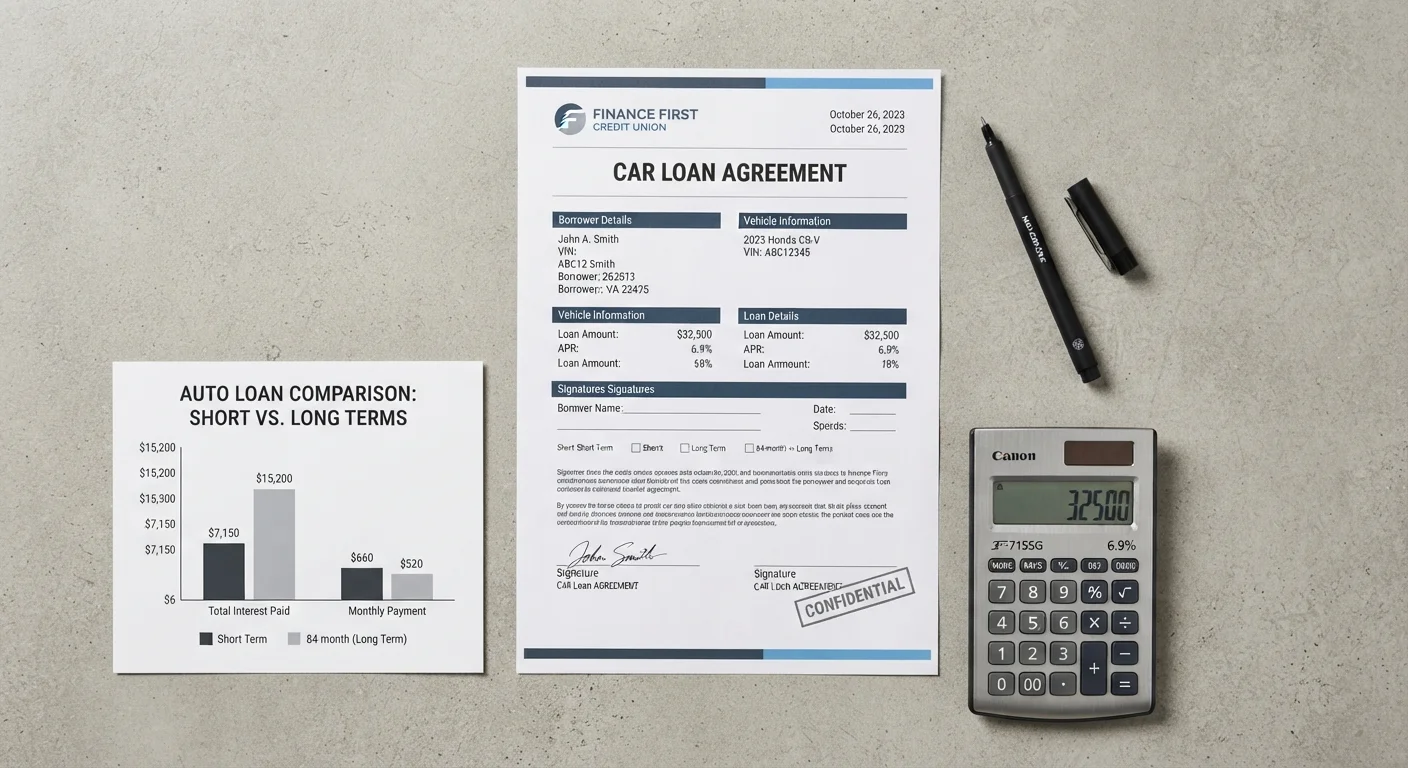
Consider a $35,000 loan at 7% APR. Over 48 months, total interest paid is approximately $5,255, with a monthly payment around $837. Stretch that identical loan to 72 months and the monthly payment drops to roughly $597 - but total interest climbs to approximately $7,994. The rate didn't change; only the time did. That difference of nearly $2,740 is the direct cost of the extra two years.
At 84 months, the monthly payment falls further to around $529, yet total interest approaches $9,416. In other words, the convenience of a lower monthly bill comes at a cumulative cost that can rival a significant car repair fund.
Understanding how principal, interest, and term interact is the essential first step before comparing any financing offers.
~$2,740
Extra interest: 48-month vs. 72-month loan
Illustrative calculation on a $35,000 loan at 7% APR - interest cost rises from roughly $5,255 to $7,994 when term extends from 48 to 72 months.
72-84 mo.
Most common extended loan terms in US market
Industry data consistently shows that loans of 72 months or longer have grown as a share of new vehicle financing as average transaction prices have risen.
~20-30%
Typical new-vehicle depreciation in year one
Vehicles commonly lose a significant portion of their value in the first 12 months, a loss rate that often outpaces early principal reduction on long-term loans.
Depreciation and the Negative Equity Trap
Loan term math doesn't exist in isolation - vehicle depreciation runs alongside it, and the two can work against you simultaneously. A new vehicle typically loses a significant portion of its value in the first two to three years of ownership. On a long-term loan, the amortization schedule is weighted toward interest in the early months, meaning principal reduction is slow precisely when depreciation is fastest.
The result: a buyer who finances over 72 or 84 months may find, after 18 to 24 months, that the remaining loan balance exceeds what the vehicle would fetch on the open market. This is negative equity - sometimes called being "underwater" or "upside down" on the loan. It creates a financial bind if you need to sell, trade in, or replace the vehicle after an accident.
Balloon payment structures share a similar dynamic: low interim payments can obscure the gap between what you owe and what the asset is worth.
For a detailed look at how early payments skew toward interest, see how amortization schedules work for vehicle buyers.
Using Term Length Strategically
None of this means longer terms are always wrong - but they should be chosen deliberately, with full knowledge of the trade-offs rather than because the monthly number looks comfortable.
One practical approach: use a loan calculator to model both a shorter and longer term on any vehicle you're considering, then compare total interest paid, not just the monthly payment. That gap is the real price of the extended timeline.
If cash flow genuinely requires a lower monthly payment, a longer term may be appropriate - provided you plan to make occasional extra principal payments to offset interest accumulation. Even one additional payment per year can meaningfully shorten the payoff timeline and reduce total interest.
Run the Total Cost Comparison First
Before accepting any financing offer, ask for - or calculate - the total amount paid over the loan's full life, including all interest. Subtract the vehicle's purchase price; the difference is your pure borrowing cost. Comparing this figure across term options, rather than comparing monthly payments alone, reveals the true cost of each structure. Many online loan calculators can generate this figure in seconds.
Term length also interacts with the rate environment. A lender may quote a lower APR on a 60-month term than a 72-month term for the same borrower. Comparing offers on equivalent terms - rather than mixing and matching term lengths - gives you a cleaner picture of which lender is actually offering the better deal.
For a deeper look at how rates and terms combine, compare short-term and long-term auto loans side by side. And to understand the full cost picture beyond the loan itself, explore ownership costs over the life of a vehicle.
This article provides general financial education and is not personalized financial advice. Consult a qualified financial professional for guidance specific to your circumstances.