
The Core Mechanics: What Changes When You Extend a Loan Term
When a lender calculates your monthly payment, two inputs dominate: the principal balance and the loan term. Stretch the term and the monthly payment drops - but the total interest paid rises, sometimes sharply. This is the foundational trade-off every buyer encounters at the dealership or through direct lending.
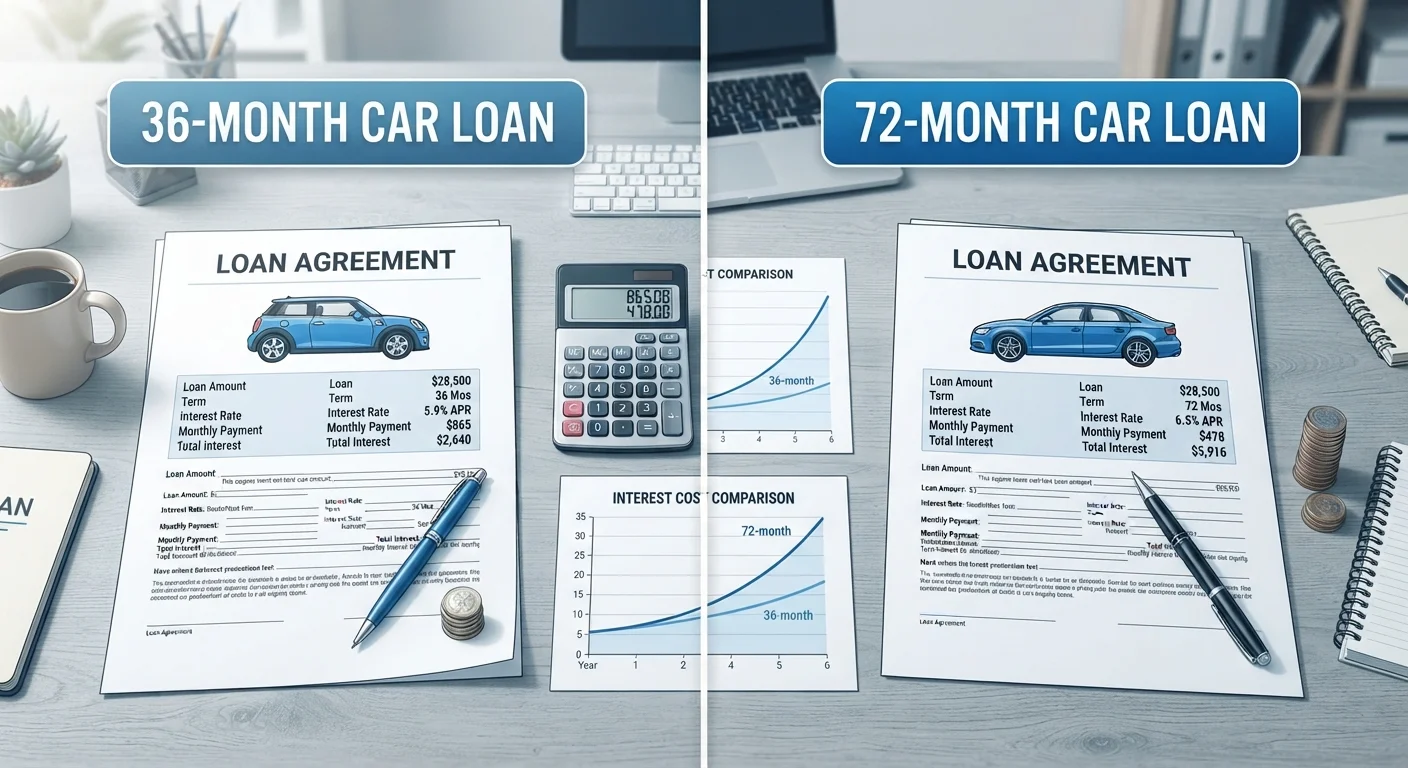
Consider a $35,000 loan at 6% APR. Over 36 months, the monthly payment is approximately $1,065 and total interest paid is roughly $3,340. Extend that same loan to 72 months and the payment drops to about $580, but total interest climbs to approximately $6,760 - more than double. That $485 in monthly savings costs an additional $3,420 over the loan's life.
For a deeper look at how the math compounds across term lengths, see how loan term length shapes total cost. Understanding that relationship is essential before committing to any financing structure.
| Short-Term (36-48 months) | Long-Term (60-72 months) | |
|---|---|---|
| Monthly Payment | Higher | Lower |
| Total Interest Paid | Significantly lower | Significantly higher |
| Typical APR | Generally lower | Often carries a rate premium |
| Equity Build Speed | Fast - balance tracks depreciation closely | Slow - negative equity risk for years |
| Flexibility if Selling Early | Low gap risk | High negative equity risk |
| Best Vehicle Type Fit | High-depreciation or luxury vehicles | Trucks, work vehicles with slower depreciation |
| Cash Flow Impact | Tighter monthly budget required | More monthly breathing room |
Depreciation, Equity, and the Negative Equity Trap
A vehicle's market value does not decline in sync with a loan balance. In the first two years of ownership, many vehicles shed 20-30% of their purchase price, while a long-term loan amortizes slowly - meaning the remaining balance can exceed the vehicle's worth for an extended period. This condition is called negative equity, or being "underwater" on the loan.
For buyers on 72-month or 84-month terms, negative equity can persist for three or more years. This creates a compounding problem: if the vehicle is totaled, stolen, or if the buyer needs to sell or trade in before the loan matures, they may owe more than they receive - leaving a gap they must cover out of pocket or roll into the next loan, adding further debt.
Rolling Negative Equity Forward Is Costly
If you trade in a vehicle on which you still owe more than its market value, many dealers will offer to "roll" that negative equity into your next loan. This practice increases the principal on the new loan and can start a cycle that is difficult to escape. Before trading in early on a long-term loan, calculate your payoff amount against current market value so you understand the actual gap you are carrying.
Short-term borrowers, by contrast, build equity faster. A 36-month loan front-loads principal repayment relative to interest, meaning the loan balance tracks closer to - and in some cases below - the vehicle's depreciated value within the first year. This structural protection is particularly valuable on vehicles known for steep early depreciation.
Rate Premiums: Why Longer Terms Often Carry Higher APRs
Many buyers assume the interest rate remains constant regardless of term selection. In practice, lenders frequently price longer-term loans at higher APRs to compensate for extended credit exposure and elevated default risk. A lender offering 5.5% on a 48-month loan may price a 72-month product at 6.5% or higher - a spread that meaningfully widens the total-cost gap between the two options.
This rate differential varies by lender, credit tier, and vehicle type, so it is worth requesting quotes at multiple term lengths from any lender you are evaluating. The goal is to compare total cost of financing, not just monthly payment. Buyers who focus exclusively on the monthly figure can underestimate their actual cost by thousands of dollars.
Request Quotes at Multiple Term Lengths
When comparing loan offers, always ask the lender to provide the APR, monthly payment, and total interest cost at two or three different term lengths simultaneously. This makes the true cost difference visible before you commit. A lender quoting a lower monthly payment on a 72-month loan at a higher rate may be offering you a worse deal overall than a 48-month offer with a slightly higher payment.
Rate structure interacts with term in ways that also affect refinancing decisions down the line. If you are weighing how interest rate type compounds these dynamics, fixed-rate vs. variable-rate auto loans explores how rate behavior over time shapes total cost alongside term considerations.
Matching Term to Purpose: Practical Decision Criteria
The right loan term is not a universal answer - it is a function of your specific financial position and intended use. Several factors should anchor the decision:
- Monthly cash flow: If a short-term payment strains your budget to the point of jeopardizing other financial obligations, a longer term may be necessary - but treat any payment savings as a cost, not a benefit.
- Planned ownership period: Financing a vehicle for 72 months when you expect to trade in at 48 months almost guarantees a negative equity problem. Align the term with your realistic holding period.
- Vehicle depreciation rate: Trucks and certain SUVs tend to hold value longer than sedans or luxury vehicles. The depreciation curve should inform how aggressive you are about building equity early.
- Prepayment flexibility: Some lenders allow extra principal payments without penalty, enabling buyers to take a longer term for payment flexibility while paying it down faster voluntarily. Verify this before signing.
For buyers considering whether a loan is even the right structure, comparing auto loans and leases side by side provides a structured breakdown of how the two financing paths differ on total cost and equity. And if your credit profile is a limiting factor in term options available to you, subprime auto loan trade-offs covers the specific dynamics buyers in that segment should weigh carefully.
This article is for general informational and educational purposes only and does not constitute personalized financial or legal advice. Consult a qualified financial professional before making decisions specific to your situation.