What the Window Sticker Is Actually Telling You
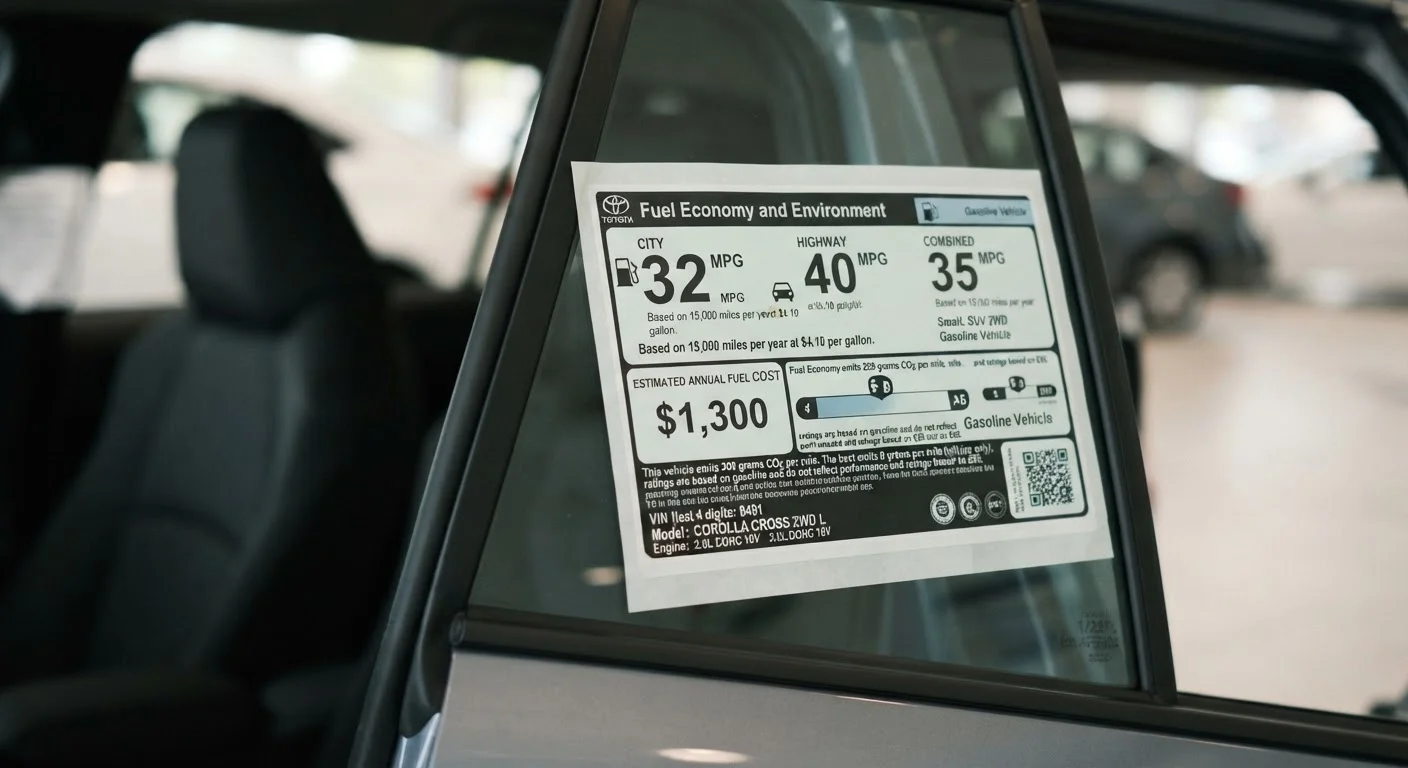
Every new vehicle sold in the United States must display a Monroney sticker - a federally mandated label that includes the EPA's fuel economy estimates, a five-year fuel cost comparison against the average new vehicle, and an estimated annual fuel cost. Most buyers glance at the MPG number and move on. That's a mistake.
The sticker presents three separate figures: a city rating, a highway rating, and a combined rating. The combined number - the one most often cited in advertising - is a weighted average of 55% city and 45% highway driving. If your commute is mostly highway miles, your real-world efficiency will likely exceed the combined figure. If you're navigating dense urban traffic daily, it may fall short of the city rating.
The annual fuel cost estimate is calculated using a standardized assumption: a fixed number of miles and a national average fuel price determined at the time of testing. That price may bear little resemblance to what you pay at your local station. Use the sticker's cost estimate as a relative comparison tool between vehicles - not as a line item for your actual household budget. For a broader view of what a vehicle truly costs over time, see our guide to total ownership costs.
City vs. Highway: Which Number Applies to You?
The combined MPG figure on the sticker assumes a 55/45 split between city and highway miles. If your actual driving skews heavily toward one type, the combined rating may give you a distorted picture. Before using any MPG figure for cost planning, estimate your own city-to-highway ratio based on your typical routes and weight the two ratings accordingly.
The Gap Between Lab Numbers and Real-World Driving
EPA test cycles are designed for consistency, not prediction. They are run on a dynamometer - essentially a treadmill for vehicles - under controlled temperature, speed, and load conditions. Several real-world factors routinely widen the gap between rated and actual efficiency:
- Temperature: Cold engines and cabin heating systems can reduce fuel economy by 10-25% in winter months, according to data from the U.S. Department of Energy.
- Speed: Aerodynamic drag increases sharply above 50 mph. Sustained highway driving at 75-80 mph can reduce fuel economy noticeably compared to the highway test cycle.
- Cargo and passengers: Added weight increases fuel consumption, particularly in city driving with frequent acceleration.
- Accessories: Air conditioning places a meaningful load on the engine, with the EPA acknowledging it can reduce MPG by roughly 25% under some conditions.
- Driver behavior: Hard acceleration and late braking are among the largest contributors to real-world MPG shortfalls.
A practical rule of thumb: discount the combined EPA rating by 10-15% when modeling fuel costs for your own driving patterns. For a detailed look at how this plays out for sedans specifically, see how paper ratings compare to real-world driving.
10-25%
Cold weather MPG reduction
U.S. Department of Energy data indicates fuel economy can drop by this range during winter months due to cold engine operation and heating demands.
~25%
Air conditioning MPG impact
The EPA acknowledges that air conditioner use can reduce fuel economy by approximately 25% under some driving conditions.
15,000
Annual miles assumed on sticker
The EPA's annual fuel cost estimate on the Monroney sticker uses a standardized 15,000-mile annual mileage assumption, which may not match your actual driving.
Translating MPG Into Actual Dollar Costs
The most empowering thing you can do with a fuel economy rating is convert it into an annual dollar figure using your own inputs. The formula is straightforward:
Annual fuel cost = (Annual miles ÷ MPG estimate) × Local fuel price per gallon
Walk through an example: Say you drive 14,000 miles per year, expect real-world efficiency of 30 MPG (discounted from a 33 MPG combined rating), and your area's current average is $3.60 per gallon. That works out to approximately $1,680 per year in fuel - or $140 per month. Run that same formula on a vehicle rated at 24 MPG real-world, and the annual cost rises to roughly $2,100 - a $420 annual difference that compounds over a five-year ownership period.
That $2,000-plus gap is meaningful, but it must be weighed against the full acquisition cost. A vehicle with a lower MPG rating may carry a lower purchase price, lower insurance premiums, or lower maintenance costs. Understanding what each pricing figure represents is foundational - our breakdown of MSRP, invoice price, and market value explains those numbers in plain language.
Use fueleconomy.gov for Real-World Averages
The U.S. Department of Energy's fueleconomy.gov publishes user-reported real-world MPG data alongside official EPA ratings for thousands of vehicle models. Before settling on an MPG estimate for your calculations, check the user-reported average for the specific year and trim you're considering - it will typically land closer to what you'll experience than the EPA combined figure alone.
Fuel Economy as One Input, Not the Whole Answer
MPG is a useful comparison tool, but it becomes misleading when treated as the primary measure of a vehicle's affordability. A few pitfalls worth avoiding:
- Premium fuel requirements: Some vehicles with impressive MPG ratings require premium-grade gasoline. At a typical price premium of 20-30 cents per gallon, that surcharge can meaningfully erode the savings suggested by the rating.
- EV and hybrid complexity: Electric and plug-in hybrid vehicles introduce new variables - electricity rates, home charging equipment costs, and the relationship between your daily mileage and the vehicle's electric-only range. Common financial miscalculations for EV and hybrid buyers covers this terrain in detail.
- The attractive sticker price trap: A vehicle with strong fuel economy but a heavily loaded contract may cost more than a less efficient alternative with a leaner deal. A low asking price can sometimes be the most expensive number on the page - a principle that applies equally to fuel-efficient vehicles.
Fuel costs are real and worth calculating carefully. But they sit alongside insurance, financing terms, scheduled maintenance, and depreciation as components of total ownership cost. Treat the MPG figure as the starting point of a calculation, not the conclusion of one.
This article provides general educational information about vehicle fuel economy ratings. It is not personalized financial advice. For guidance specific to your situation, consult a qualified financial or automotive professional.