Why Tyre Costs Get Left Out of Ownership Budgets
When buyers calculate what a vehicle will cost to own, they tend to focus on the obvious line items: monthly payments, insurance premiums, and fuel. Tyres almost never appear in those early-stage estimates - even though they are one of the most predictable recurring expenses a vehicle generates.
Part of the reason is timing. At the point of purchase, the tyres on a used vehicle may look fine, and new-vehicle buyers have fresh rubber on all four corners. The cost feels distant. But for a driver covering 12,000-15,000 miles per year, the first replacement set is typically due within three to five years. Over a ten-year ownership period, that can mean two or three full replacement cycles.
For a full picture of what a vehicle will actually cost you, see the Vehicle Running Costs reference guide, which covers every expense category from registration through to components like tyres.
$1,500-$4,000
Estimated lifetime tyre spend for a passenger car
Represents two to three full replacement cycles over a 10-year ownership period, including mounting, balancing, and alignment costs at each interval.
10-20%
Potential tyre life extension from proper maintenance
Consistent rotation, correct inflation, and periodic alignment checks are cited by tyre industry sources as the primary factors extending useful tyre life.
$150-$250
Typical service add-ons per tyre set replacement
Covers mounting, balancing, disposal fees, and valve stems - costs that are separate from the tyre purchase price but unavoidable in most replacement scenarios.
What a Realistic Tyre Budget Looks Like by Vehicle Type
Tyre costs vary considerably depending on what you drive. Vehicle category, tyre size, and load rating all affect per-unit price - and the differences compound significantly over time.
- Compact and mid-size sedans: Entry-level replacement tyres typically run $80-$130 per tyre; mid-range options $130-$200. A full four-tyre set with mounting, balancing, and alignment can total $500-$900. Over a ten-year period with two replacement cycles, budget $1,000-$1,800.
- SUVs and crossovers: Larger tyre sizes push per-unit costs to $120-$250 or more. Full replacement sets commonly run $700-$1,200 installed. Lifetime cost over ten years: $1,400-$2,400.
- Full-size trucks: Load-rated truck tyres in popular sizes can run $150-$300 each. Owners with larger-diameter configurations or off-road tread patterns often see installed set costs of $1,000-$1,600. Lifetime tyre spend can exceed $3,000 over a decade.
- RVs and motorhomes: Specialist tyres operating under high load carry premium prices, and age-based replacement (regardless of tread depth) adds cost unpredictability. A full motorhome set can cost several thousand dollars. See RV tyre safety and load ratings for specifics on age codes and pressure requirements.
- Classic vehicles: Specialty tyre sizes for older vehicles can be harder to source and priced accordingly. Collectors should factor sourcing lead time alongside cost - as discussed in the guide to running costs first-time collectors underestimate.
Hidden Add-On Costs That Inflate the Final Bill
The tyre price you see advertised is rarely the price you pay at the counter. Several service charges attach to every tyre replacement, and they add up quickly.
Tyre Prices Vary Significantly by Region and Retailer
The figures used throughout this article are general estimates intended to illustrate the scale of lifetime tyre costs. Actual prices vary by geographic market, tyre brand tier, and current supply conditions. Always obtain multiple quotes from local tyre shops when planning a replacement to understand current pricing in your area.
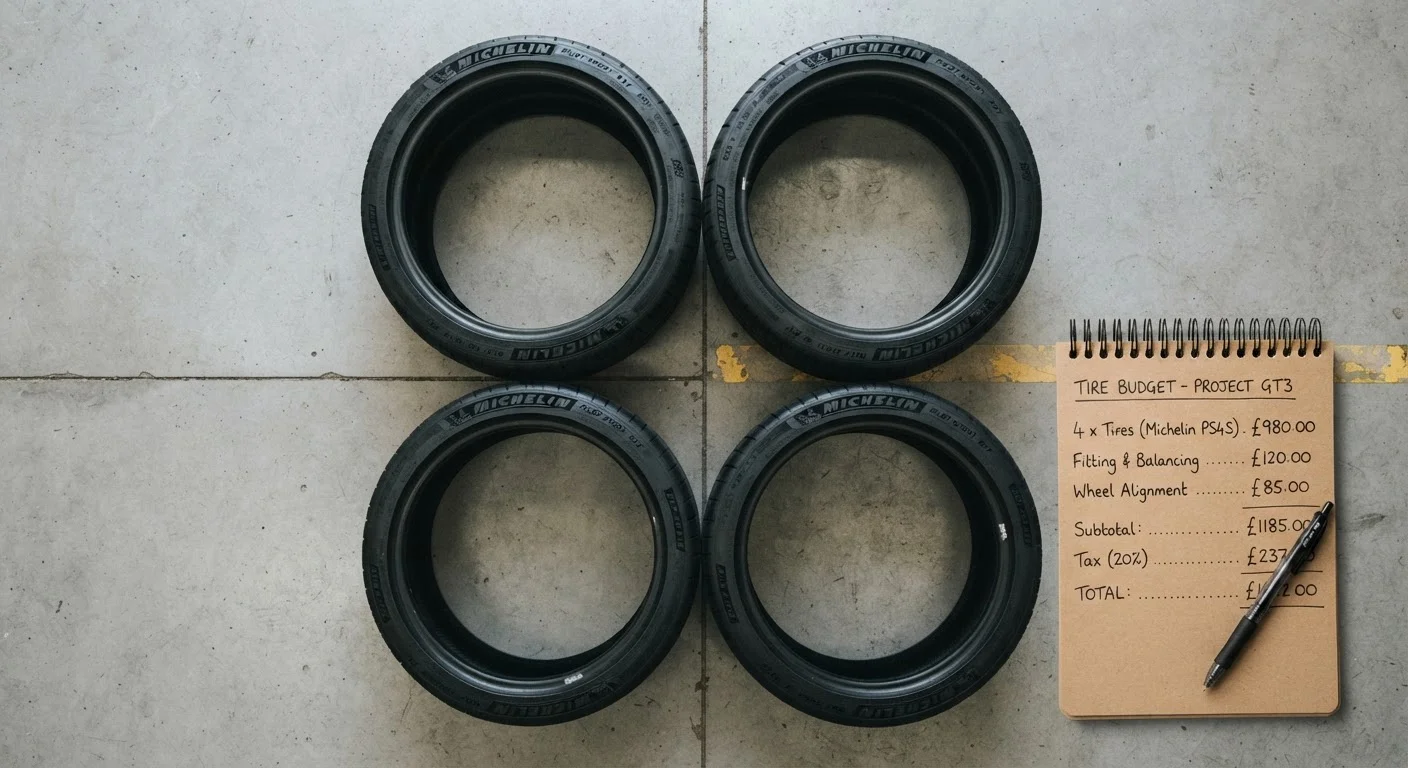
- Mounting and balancing: Typically $15-$30 per tyre, so $60-$120 for a full set.
- Wheel alignment: Not always required with every tyre change, but misalignment causes rapid uneven wear. A full four-wheel alignment check costs $75-$150 and is worth doing whenever tyres are replaced.
- Tyre disposal fees: Most shops charge $5-$15 per tyre to dispose of old rubber legally.
- Valve stems: Often replaced at the same time; budget $5-$10 per wheel.
- Road hazard warranty: Some owners purchase these separately; costs vary.
Adding these to the cost of the tyres themselves, a realistic total for a set of four on a mid-size SUV can run $800-$1,400 - a figure rarely quoted in ownership cost comparisons.
When estimating your vehicle's total financial footprint, the total ownership cost estimation guide offers a structured approach for building these figures into a pre-purchase calculation.
How Maintenance Habits Affect Total Tyre Spend
The single most controllable variable in lifetime tyre cost is how well you maintain the tyres you have. Three practices have the greatest measurable impact:
- Correct inflation: Under-inflated tyres wear faster on their outer edges; over-inflated tyres wear fastest in the center. Either pattern shortens tyre life significantly. The guide to tyre pressure monitoring tools covers how to stay on top of inflation between service visits.
- Regular rotation: Front and rear tyres wear at different rates due to steering and weight distribution. Rotating every 5,000-7,500 miles evens out wear and can add several thousand miles to overall tyre life.
- Wheel alignment: Misalignment causes one-sided wear that no rotation schedule can fully correct. An alignment check every 12-18 months or after any significant road impact is a low-cost intervention that protects a much larger investment.
For a comprehensive maintenance framework, the tyre maintenance guide covers tread depth checks, pressure monitoring, and rotation schedules in detail.
Build Tyre Costs Into Your Annual Budget Now
Rather than facing a large unexpected bill at replacement time, set aside a monthly tyre fund based on your projected replacement cycle. Divide your estimated set cost (including service add-ons) by the number of months until replacement, and treat it as a fixed ownership expense. Use the annual ownership cost audit checklist to incorporate this alongside your other recurring vehicle expenses.
Owners who commit to these three habits can realistically extend tyre life by 10-20%, which across two or three replacement cycles over a vehicle's life represents meaningful savings - sometimes enough to offset the cost of one full replacement set.
This article provides general financial information for educational purposes only and is not personalised financial advice. Tyre prices and service costs vary by region, vehicle specification, and market conditions. Consult a qualified tyre specialist for guidance specific to your vehicle and situation.