Why RV Tyres Fail Differently
A blowout in a passenger car is alarming. A blowout on a 35-foot Class A motorhome or a loaded fifth wheel can be catastrophic. RV tyres operate under conditions that are fundamentally different from everyday driving: extreme sustained loads, weeks or months of static storage, high ambient temperatures, and long highway hauls at consistent speeds.
The two most common causes of RV tyre failure are improper inflation and age-related degradation - neither of which is immediately visible to the naked eye. Understanding how these factors interact is the foundation of responsible RV ownership. See our RV pre-trip inspection checklist for a practical framework covering tyres alongside other critical systems.
75%
RV tyre failures attributed to underinflation
Industry safety educators commonly cite underinflation as the leading factor in tyre-related RV incidents, contributing to heat buildup and sidewall failure.
5-7 years
Recommended RV tyre replacement interval by age
Most tyre manufacturers and RV safety organizations advise replacing tyres within this window from the DOT manufacture date, regardless of tread depth.
10-15 PSI
Pressure drop that significantly increases blowout risk
Operating a loaded RV tyre even 10-15 PSI below its correct load-adjusted pressure dramatically increases internal heat and structural stress.
Tyre Pressure: PSI Is Not One-Size-Fits-All
Every RV tyre has a maximum PSI stamped on its sidewall, but that number is a ceiling - not a target. The correct inflation pressure for your specific RV depends on the actual load carried by each tyre, which varies with cargo, fresh water, passengers, and even slideout positions.
To find your true target pressure, you need two things: a certified weigh station reading of your rig's axle weights while fully loaded, and the load-inflation tables published by your tyre manufacturer. Cross-referencing these gives you the PSI range that keeps each tyre operating within its safe capacity. Running even 10-15 PSI below optimal on a heavily loaded trailer tyre generates excessive heat in the sidewall - the leading precursor to a blowout.
Weigh Before You Set Your PSI
Never set tyre pressure based on estimates or dry-weight sticker data. Visit a certified truck scale or CAT scale location with your RV fully loaded as it would be for travel. Many RV owners find their actual loaded axle weights exceed their expectations by several hundred pounds - which directly affects the correct target pressure.
For long-haul travel, a tyre pressure monitoring system (TPMS) provides real-time alerts to sudden drops or slow leaks. Learn more about your options in our guide to tyre pressure monitoring and inflation tools for long-distance travel.
Reading the DOT Age Code
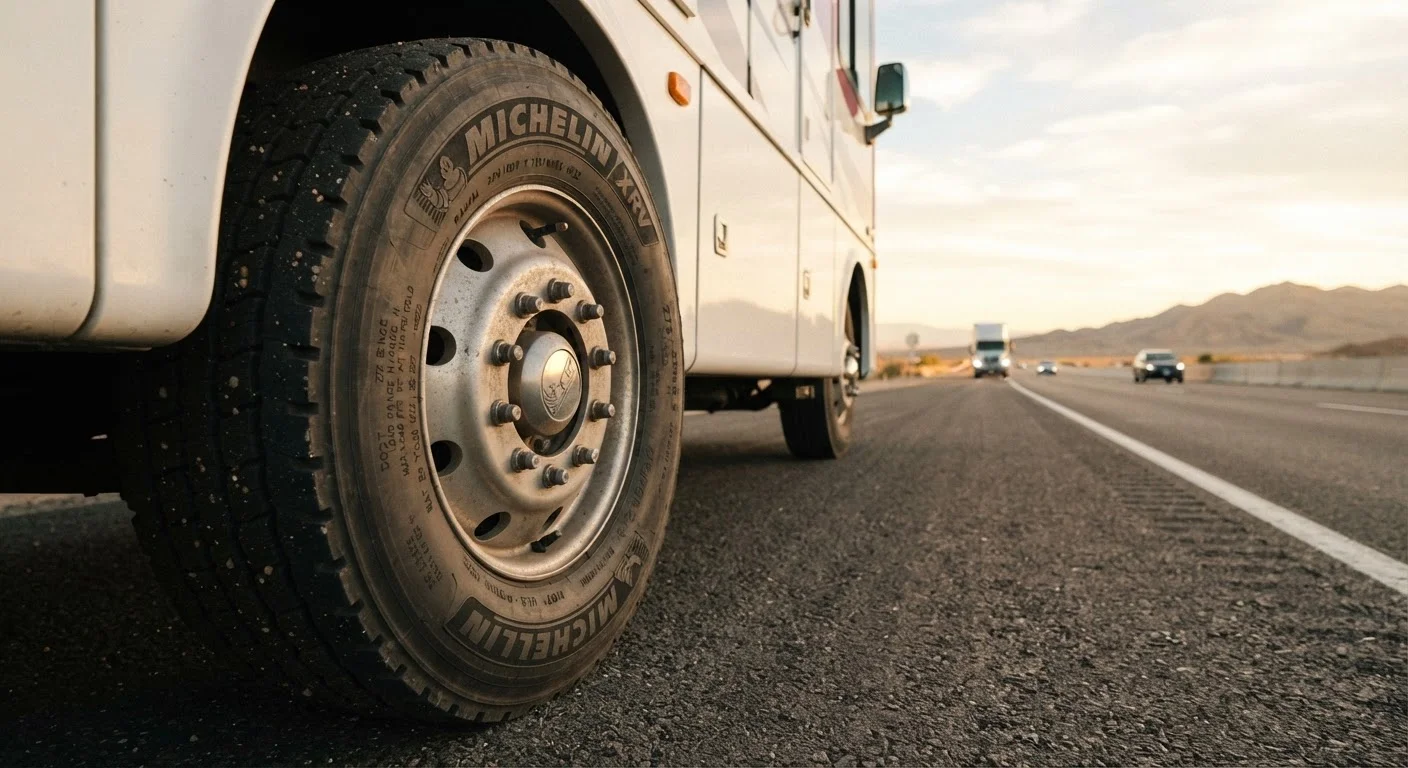
The Department of Transportation (DOT) requires all tyres sold in the US to carry a code on the sidewall that includes, critically, the manufacture date. The last four digits of the DOT string tell you everything: the first two digits represent the week of manufacture, and the second two represent the year. A code ending in 1822 means the 18th week of 2022.
This matters enormously for RVs because many rigs sit in storage for months at a time. Even a tyre with deep tread can have a compromised internal structure if it has been exposed to repeated heat cycles, UV radiation, and ozone over several years. Rubber polymers oxidize and lose elasticity from the inside out - a process that accelerates with heat and sunlight.
Age Degrades Tyres Even in Storage
A tyre stored in a cool, dark garage still undergoes chemical degradation over time. Ozone exposure - even at low ambient levels - attacks rubber compounds and causes micro-cracking in the sidewall structure that is not visible on the surface. This is why age from the DOT date code matters independently of tread depth or storage conditions.
If you are purchasing a used RV, check every tyre's DOT code before completing the transaction. Tyres that look new may be chronologically old. This check is also a useful data point when budgeting for ownership costs - our article on tyre costs over a vehicle's life covers what to realistically anticipate.
Load Ratings: Matching the Tyre to the Rig
Load range letters - C, D, E, or G on most RV applications - describe a tyre's maximum carrying capacity at its rated pressure. Each step up the alphabet represents a meaningfully stronger carcass construction. Fitting a tyre with an insufficient load range is a direct safety hazard, even if the tyre physically fits the rim.
The correct process: weigh each axle of your loaded RV (not the manufacturer's listed GVWR, which is a ceiling, not your actual weight), divide by the number of tyres on that axle, then select a tyre whose load rating exceeds that per-tyre figure with a safety margin. Many RV owners discover their actual loaded weights are higher than they assumed once slides, water tanks, and gear are accounted for.
For deeper context on how tyre specs relate to broader maintenance decisions, see Tyre Maintenance From the Ground Up and the Parts Explained hub.
Practical Steps Every RV Owner Should Take
Sound tyre management does not require specialized expertise - it requires consistent habits. Inspect sidewalls for cracking, bulging, or uneven wear before and after each trip. Store your RV away from direct sunlight when possible, or use tyre covers to slow UV degradation during extended storage. Never exceed the tyre's speed rating, which for many ST-rated trailer tyres is 65 mph.
When a puncture occurs, resist the impulse to simply plug it and move on. Our editorial on when to fix versus replace a punctured tyre lays out the criteria professionals use to make that call. An unmounted plug repair on a tyre carrying 3,000 pounds per axle is not equivalent to the same repair on a compact car.
This article provides general educational information about RV tyre safety. It is not a substitute for the guidance of a qualified tyre professional or your RV manufacturer's specifications. Always consult your owner's manual and a licensed technician for decisions affecting vehicle safety.