The Core Concept: Sold in Pieces, Built by Hand
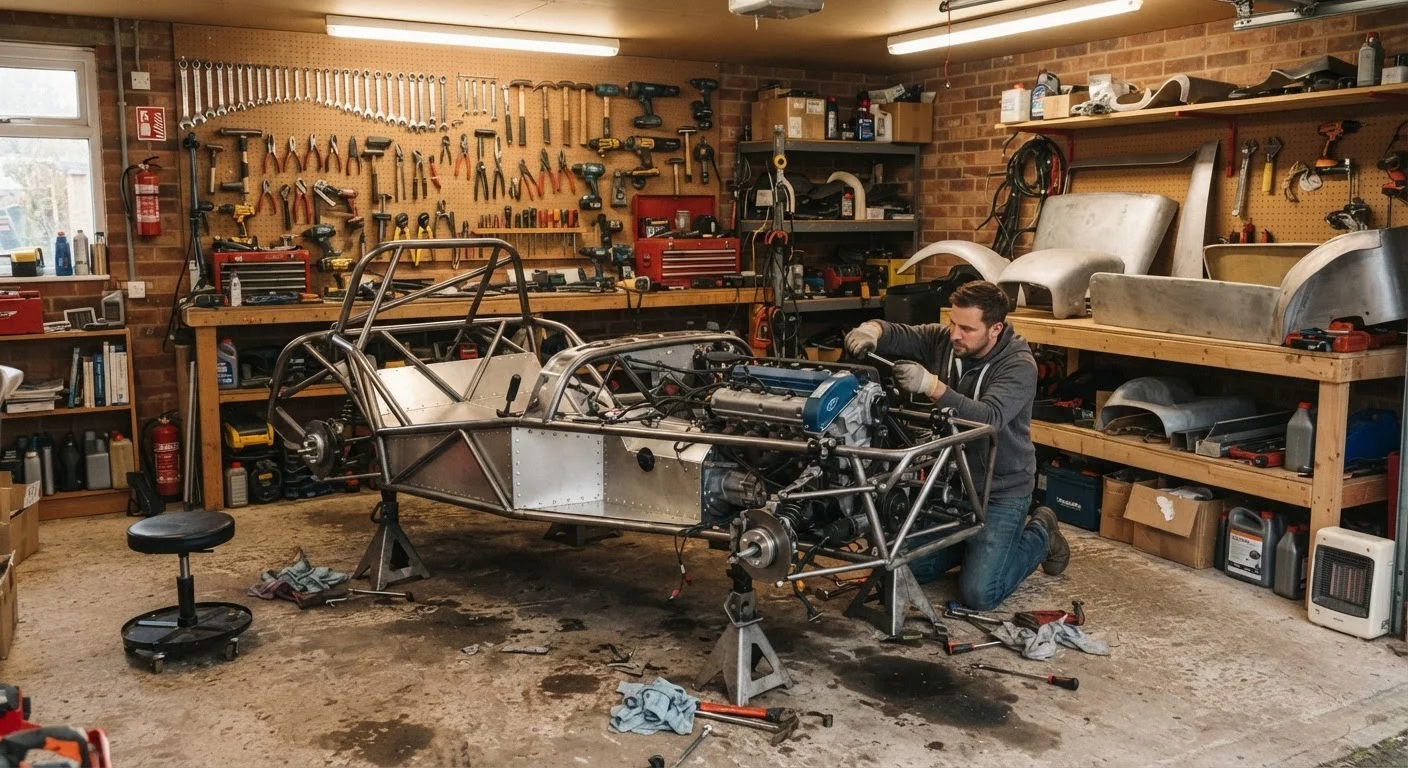
A kit car arrives not as a finished automobile but as a collection of components - body panels, a chassis, suspension pieces, and detailed instructions. The buyer supplies the labor, often sourcing a donor vehicle (a production car whose engine, transmission, and running gear are transplanted into the new build). The result is a vehicle that reflects the builder's choices at nearly every stage.
This model of vehicle production has roots stretching back to the early twentieth century, when several manufacturers sold cars in knockdown form to reduce shipping costs or avoid import duties. The modern kit car industry took its recognizable shape in the 1950s and 1960s, when fiberglass body technology made it practical for small companies to offer sports car designs without the capital investment of a full production line.
Kit cars differ meaningfully from both factory production cars and pure custom hot rods. Unlike a factory car, a kit car has no single VIN assigned at the plant; the builder applies for one through their state DMV after assembly. Unlike a scratch-built custom, the kit car builder follows a defined design provided by the kit manufacturer, working within an established template rather than engineering from a blank sheet. This middle ground is precisely what defines the segment's appeal - and its legal complexity. For context on how vehicle categories and definitions shape collector communities, see Classic Car Culture.
How the Build Process Works
Most kit car projects begin with sourcing a donor vehicle. Manufacturers specify compatible donors in their build manuals, and the choice matters: a well-documented donor with a strong parts supply makes the build far more straightforward. Common donors have historically included rear-wheel-drive compact platforms and mid-engine sports cars, chosen for their mechanical simplicity and community knowledge base.
Once donor components are in hand, the builder assembles the chassis - usually a tubular steel space frame or a backbone design - and mounts suspension components, the engine, and drivetrain. The body, typically fiberglass or aluminum, is then fitted and aligned. Electrical systems, interior finishing, and safety equipment follow. The entire process can take anywhere from several hundred hours for a simpler kit to several thousand hours for a fully detailed replica with custom fabrication.
Evaluate the Manufacturer's Support Network First
Before selecting a kit, research the manufacturer's reputation within the builder community - not just their marketing materials. Look for active owner forums, recent build documentation, and evidence that technical support is responsive. A kit from a company with a strong support ecosystem will almost always produce a better outcome than a marginally cheaper kit sold with minimal documentation.
Manufacturers vary considerably in how much support they provide. Reputable kit manufacturers publish detailed build manuals, maintain active owner communities, and offer technical phone support. A strong builder community is often as valuable as the manual itself, since experienced builders have solved most problems a first-timer will encounter.
Regarding vehicle components and their roles: kit builders must understand how each system interacts, since errors in suspension geometry or brake line routing carry real safety consequences. For complex fabrication tasks, consultation with a qualified mechanic or fabricator is strongly advisable.
The Replica Question: Tribute or Imitation?
A significant portion of the kit car market has always focused on recreating the appearance of famous sports and racing cars - British roadsters, open-wheel racers, and iconic American sports cars among them. These replicas sit at the center of an ongoing debate in collector communities: does a fiberglass body styled after a classic car carry any of the original's cultural value?
The consensus among serious collectors is clear: replicas and originals are categorically different, and market values reflect that gap decisively. A well-built replica can be a highly enjoyable driver's car and a legitimate piece of automotive craft in its own right, but it should never be represented as an original vehicle. Misrepresentation - whether deliberate or careless - is a significant ethical and legal concern in kit car transactions.
“The appeal of the kit car is not just the finished machine - it's the knowledge that you understand every bolt and weld in it. That relationship between builder and vehicle is something no showroom transaction can replicate.”
— Automotive Historian, Kit Car Industry Observer, Longtime contributor to specialty vehicle documentation and builder community resources
Kit cars that are distinct original designs - not replicas of existing cars - occupy somewhat different ground and have developed their own collector communities over time. This is a niche within a niche, comparable in some ways to the devoted followings that form around microcar collecting or early cyclecar categories - enthusiasts drawn together by shared passion for vehicles that fall outside mainstream classifications.
Registration, Titling, and What to Know Before You Build
The legal framework for kit cars in the United States is handled at the state level, and requirements differ substantially across jurisdictions. Most states offer a specially constructed vehicle or equivalent title category for home-built and kit-assembled vehicles. Builders typically submit documentation of major components, proof of ownership for donor parts, and a completed vehicle for inspection before a title is issued.
50+
Active kit car manufacturers in the U.S.
Industry observers estimate more than fifty active kit car kit suppliers operate in the American market, ranging from one-person operations to established multi-decade companies.
500-5,000+
Estimated build hours per project
Build time varies enormously by kit complexity; manufacturers typically publish estimated build hours in their documentation, with simpler kits targeting the lower end of this range.
Emissions compliance is a particularly variable area. Some states exempt specially constructed vehicles from standard emissions testing; others apply tailpipe standards based on the donor engine's model year; still others require full compliance with current standards regardless of build origin. Confirming your state's specific rules before selecting a kit and donor combination is not optional - it determines whether the finished vehicle can legally operate on public roads in your area.
Insurance for kit cars is available through specialty insurers that understand the agreed-value structure appropriate for these vehicles. Standard auto insurance policies may not adequately cover a kit car, since standard market valuation methods do not apply well to one-off builds. Consulting with an insurer experienced in specialty and collector vehicles before the build is complete - rather than after - is a practical step that many first-time builders overlook.
This article is for general informational and educational purposes only. It does not constitute legal, financial, or mechanical advice. Consult qualified professionals - including your state DMV, a licensed mechanic or fabricator, and an insurance specialist - before undertaking a kit car build or purchase.