Origins: Austerity, Innovation, and the Bubble Car Era
The microcar story is inseparable from the economic wreckage of postwar Europe. Between 1945 and the early 1960s, steel was rationed, fuel was expensive, and most working families could not afford a conventional automobile. Manufacturers across West Germany, Italy, France, and the United Kingdom responded with vehicles stripped to their engineering essentials - tiny two-stroke or single-cylinder engines, motorcycle-derived drivetrains, and bodies shaped more by production economy than aerodynamic theory.
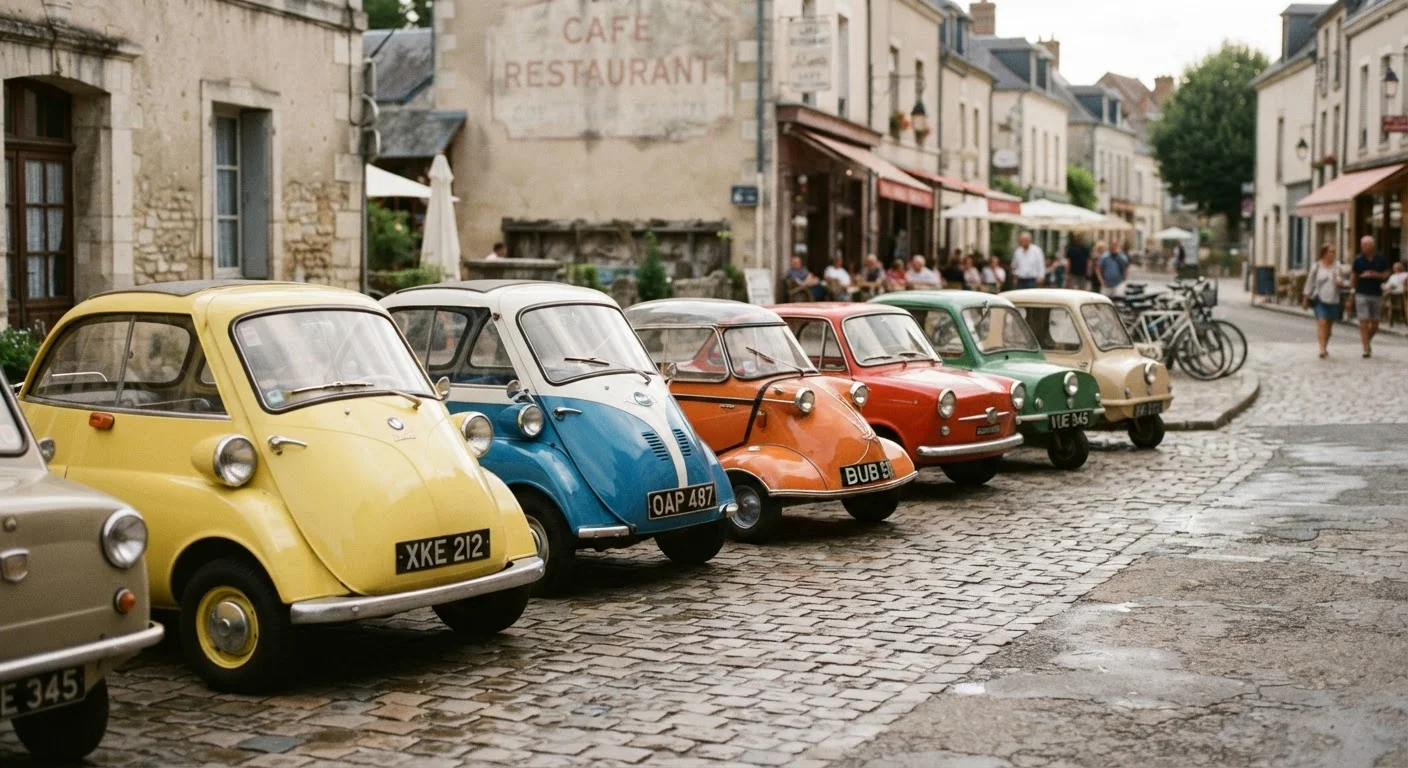
The results were visually unlike anything before or since. Egg-shaped cabins on three wheels, front-opening doors that incorporated the steering column, tiller steering, and canvas roofs became defining signatures of the form. German manufacturers including Messerschmitt and Goggomobil, Italian makers such as Iso and Fiat with its 500 line, and British producers like Reliant brought genuinely different engineering philosophies to the same fundamental brief: carry two people as cheaply as possible.
This era also intersected with broader motoring history that the cyclecars and voiturettes article explores in depth - many microcar manufacturers drew explicitly from cyclecar precedents established in the 1910s and 1920s.
“The microcar represents engineering under constraint taken to its logical extreme - every gram, every cubic centimeter justified by necessity. That discipline produced shapes and solutions that no amount of conventional automotive thinking would have generated.”
— Automotive Historian, Microcar Museum, Curator and author specializing in postwar European economy vehicles
What Defines the Collector Appeal
Scarcity is the most straightforward driver of microcar collector interest. Production numbers for the most celebrated marques rarely exceeded 50,000 units over an entire model run, and survival rates after decades of use, neglect, and parts cannibalization are considerably lower. Genuinely unrestored, mechanically complete examples are uncommon finds at any price point.
But survival statistics alone don't explain the passion. Collectors frequently cite the concentrated ingenuity visible in a microcar's engineering - the necessity-driven creativity that produced solutions a conventional automaker would never have considered commercially viable. Owning and operating one of these vehicles connects enthusiasts to a specific, unrepeatable moment in industrial history.
~700cc
Common engine displacement ceiling for microcar classification
Most collector registries and concours judging bodies use sub-700cc displacement as a primary threshold, though some include slightly larger engines where historical regulatory classification supports it.
<5%
Estimated survival rate for many bubble-era microcars
Marque registries for several prominent postwar European microcars suggest fewer than one in twenty produced units survives in any condition today, underscoring genuine scarcity in the collector market.
1945-1964
Core production era for classic bubble cars
The most historically significant microcar designs were produced during this window, spanning postwar austerity through the early years of European economic recovery.
The community dimension matters too. As with other niche segments discussed in our overview of collector registries and marque clubs, dedicated microcar organizations actively maintain chassis records, reproduce obsolete rubber seals and trim components, and organize annual gatherings where knowledge transfer happens informally but effectively.
Evaluating Condition and Originality
Microcars are assessed using the same broad condition-grading frameworks applied across classic vehicle collecting - from fully restored show-quality examples down to incomplete project cars. What differs in this segment is the weight placed on originality. Because reproduction body panels and correct-specification engines are far harder to source than for mainstream postwar American cars, a survivor with matching-numbers drivetrain and uncut body commands a disproportionate premium relative to a cosmetically superior but heavily modified example.
Documentation is similarly critical. Factory build records, original owner's manuals, and period dealer paperwork can meaningfully affect value and authentication, particularly for rarer marques where only a handful of examples are known to exist in collector hands. The misconceptions that distort the specialty vehicle market are especially prevalent here - rarity does not automatically confer investment-grade status, and condition disparities within the same model can produce dramatic price differences.
Prioritize Specialist Inspection Before Purchase
General classic car mechanics may lack familiarity with the motorcycle-derived drivetrains, proprietary fastener standards, and specific corrosion patterns common to microcar marques. Seek out an inspector with documented experience on the specific make before committing to any acquisition. Marque registries can often provide referrals to qualified specialists in your region.
For buyers considering their first microcar acquisition, a pre-purchase inspection by a specialist familiar with the specific marque is strongly advisable. General classic car mechanics may lack familiarity with motorcycle-derived components, proprietary fastener standards, or the specific corrosion patterns common to particular body constructions.
The Microcar in the Broader Collector Landscape
Microcars sit at an interesting intersection within collector culture. They contrast sharply with the displacement-maximizing philosophy behind vehicles covered in our American muscle car era timeline, yet share with that segment a devoted community built around marque identity and mechanical authenticity. They also differ meaningfully from kit cars, which are builder-assembled rather than factory-produced - an important distinction for titling and concours judging purposes.
Regional club events and all-make classic meets increasingly feature microcar displays, recognizing that these vehicles draw consistent public interest disproportionate to their size. The regional club scene has been instrumental in elevating microcar visibility at shows that once focused exclusively on conventional postwar American machinery.
For prospective collectors, the microcar segment rewards patience, thorough research, and a willingness to engage deeply with specialist communities. The vehicles themselves are not weekend drivers in the conventional sense - they demand mechanical attentiveness and a tolerance for driving dynamics that reflect their era's engineering priorities, not modern expectations. That friction, for many enthusiasts, is precisely the point.
This article provides general educational information about microcar history and collecting. It does not constitute financial, investment, or purchasing advice. Vehicle values, regulatory requirements, and parts availability vary; consult qualified specialists before making any acquisition or restoration decision.