Why These Categories Existed at All
In the first two decades of the twentieth century, the automobile industry had not yet coalesced around the body styles and displacement classes collectors now treat as givens. Manufacturers, racing clubs, and tax authorities in Europe and North America each invented their own terminology to describe the bewildering variety of light, low-powered vehicles rolling off improvised production lines. The result was a thicket of overlapping labels - cyclecar, voiturette, cycle-car, light car, motorette - that meant different things depending on who was using them and when.
Understanding these categories matters to collectors today because period documentation, marque registries, and auction houses still apply them. A vehicle catalogued as a voiturette at a European auction carries different provenance expectations than one listed as a cyclecar. Misidentifying a car's original class can affect insurance valuations, concours eligibility, and club membership. See our collector registries and marque clubs guide for how these organisations handle historical classification disputes.
| Peak cyclecar era | Approximately 1910-1920 (Cyclecar Club of Great Britain records, founded 1912) |
| Typical cyclecar weight limit | Under ~770 lb (350 kg) (British Cyclecar Club competition regulations, circa 1912) |
| Typical cyclecar engine limit | Under 1,100 cc displacement (Cyclecar Club of Great Britain classification standards) |
| Origin of 'voiturette' | France, 1890s motorsport classification (Automobile Club de France racing category definitions) |
| Key period publication | The Light Car and Cyclecar (UK, launched 1912) (British motoring press archive) |
| Collector classification authority (US) | Antique Automobile Club of America (AACA) (AACA membership and judging standards) |
Voiturette: The French Starting Point
The term voiturette - French for "little car" - entered motorsport vocabulary in the 1890s, popularised through early Gordon Bennett-style racing classifications. The Automobile Club de France used it to designate vehicles below a certain engine displacement or weight threshold, distinguishing them from full-weight voitures de course (racing cars). By the early 1900s, manufacturers such as Léon Bollée and De Dion-Bouton were marketing production vehicles under the voiturette banner as a selling point: these were genuine automobiles, not motorcycles, yet lighter and more affordable than full touring cars.
Critically, the voiturette label implied a degree of mechanical sophistication. Buyers expected a proper chassis, water-cooled or air-cooled single- or twin-cylinder engines, and at minimum a rudimentary weather shield. The category straddled the boundary between the motorcycle-derived devices below it and the established motorcar above - a boundary that would grow increasingly contested after 1910.
Voiturette
A French term meaning 'little car,' used from the 1890s onward to describe light, low-powered automobiles occupying a tier below full racing or touring cars. Implies a proper chassis and mechanical sophistication rather than motorcycle-derived construction.
Cyclecar
A category of ultra-lightweight, low-cost vehicles popular roughly 1910-1920, typically using motorcycle engines, belt or chain drives, and minimal bodywork. Defined by weight and displacement limits set by racing and club organisations.
Light Car
A loosely defined intermediate category above the cyclecar but below the full motorcar, used by manufacturers whose vehicles exceeded cyclecar limits yet fell short of conventional car specifications. Boundaries varied by country and publication.
Motorette
A largely American trade term of the 1910s describing three- or four-wheeled devices powered by motorcycle engines. It appeared in period advertising rather than regulatory definitions and is now primarily an archival label.
Displacement Class
An engine measurement - typically expressed in cubic centimetres (cc) or litres - used by racing clubs and tax authorities to assign vehicles to competitive or regulatory categories. Critical to period cyclecar and voiturette definitions.
Marque Registry
A database or organisation that tracks surviving examples of a specific vehicle make, recording chassis numbers, build histories, and ownership lineage. Registries are a primary authority for historical classification disputes.
Cyclecar: Economy Engineering Taken to Its Logical Extreme
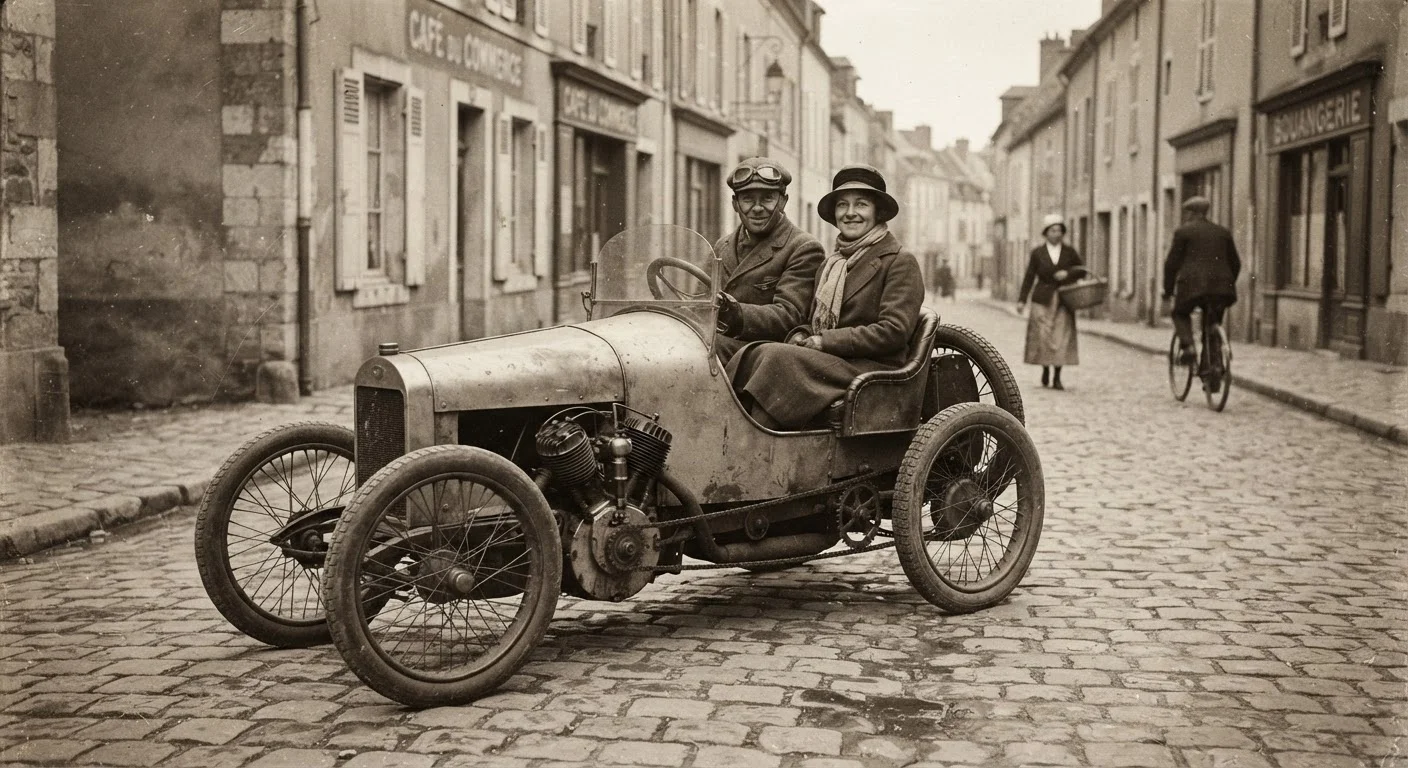
Where the voiturette aspired upward toward the motorcar, the cyclecar deliberately descended toward the motorcycle in search of economy. The cyclecar movement peaked roughly between 1910 and 1920, driven by the belief that motorcycle engines, belt or chain final drives, and minimal bodywork could produce a practical two-person vehicle at a fraction of a full car's cost. In Britain, the Cyclecar Club (formed 1912) published displacement and weight limits that defined the category for competition purposes: typically engines under 1,100 cc and total weight under 770 lb (approximately 350 kg).
American examples such as the Scripps-Booth Rocket and the Imp Cyclecar briefly attracted buyers before Model T Ford pricing collapsed the economic rationale for the entire segment. In France and Britain the movement lasted longer, producing marques that hardcore collectors still pursue today. For a closely related segment that shares cyclecar DNA, see our history of microcars.
200+
Cyclecar marques produced in Britain alone, 1910-1920
Historians of the British cyclecar movement estimate well over 200 distinct manufacturers entered and exited the market within the decade.
~$350
Approximate US cyclecar price point, circa 1914
Period trade publications cited entry-level cyclecars at prices designed to undercut the Model T Ford, though actual prices varied by manufacturer and specification.
Light Car, Motorette, and the Hyphenated Variants
The light car designation emerged partly as a marketing escape hatch: manufacturers whose vehicles exceeded cyclecar weight limits but lacked the refinement of full motorcars adopted it to avoid either stigma. In Britain, The Light Car and Cyclecar magazine (launched 1912) explicitly treated both as a continuum, and the hyphenated form cycle-car appeared in some period publications as a direct synonym for cyclecar, creating decades of archival confusion.
Motorette was used more sporadically, primarily in American trade literature of the 1910s, to describe three- and four-wheeled devices with motorcycle powertrains. The term rarely appeared in regulatory definitions and is now largely an archival curiosity rather than a live collector classification. Three-wheelers inhabit their own regulatory grey zone, and many early motorettes are now evaluated under trike frameworks rather than car classifications.
For collectors attempting to establish what a vehicle originally was, period advertisements, factory build records, and marque club documentation carry far more weight than the label on a later title document. The broader debate over what makes a car 'classic' intersects here: a vehicle's original category can influence which clubs will certify it and which shows will accept it.
Hyphenation and Spelling Variants in Archives
Researchers working with period sources will encounter 'cyclecar,' 'cycle-car,' and occasionally 'cycle car' used interchangeably within the same publication - sometimes the same issue. Modern collectors and registries have largely standardised on the unhyphenated 'cyclecar,' but searches of digitised newspaper and magazine archives should use all three variants to avoid missing relevant documentation. The spelling used in a manufacturer's original advertisement can itself be a useful dating clue.
How Collectors Apply These Labels Today
Modern auction houses, concours organizers, and specialist registries have developed working conventions to handle these overlapping categories. As a practical guide, collectors should look at three primary sources when attempting to classify an early light vehicle: the country of manufacture and applicable national regulations at time of production; period press coverage in publications such as The Autocar, Motor, or Motoring Illustrated; and any surviving factory documentation such as order books or parts lists.
When documentation is absent - common for low-volume producers of the 1910s - marque clubs and specialist historians are the next authority. The Veteran Car Club of Great Britain and the Antique Automobile Club of America both maintain research resources that address pre-1920 classification questions, though neither body should be treated as the final word on contested cases. For the broader context of how collecting eras shaped which vehicles survived at all, see seven eras that changed American collecting.
Ultimately, the collector community treats these early categories less as rigid legal boxes and more as interpretive lenses - ways of understanding a manufacturer's intent, a vehicle's original market position, and its relationship to the machines that came before and after it.
Veteran Car Club of Great Britain - Research Services
The VCC maintains extensive archives on pre-1919 vehicles, including classification guidance for cyclecars and voiturettes. Membership provides access to marque historians and build record databases.
Antique Automobile Club of America Library & Research Center
The AACA's library in Hershey, Pennsylvania holds period trade publications, manufacturer catalogues, and registration records useful for establishing the original classification of early light vehicles.
Grace's Guide to British Industrial History
A freely accessible online reference covering hundreds of British cyclecar and light car manufacturers, with citations drawn from period trade press and company records.