How Each Approach Actually Works
Understanding the mechanics behind each tool helps set realistic expectations before a dead battery ever leaves you stranded.
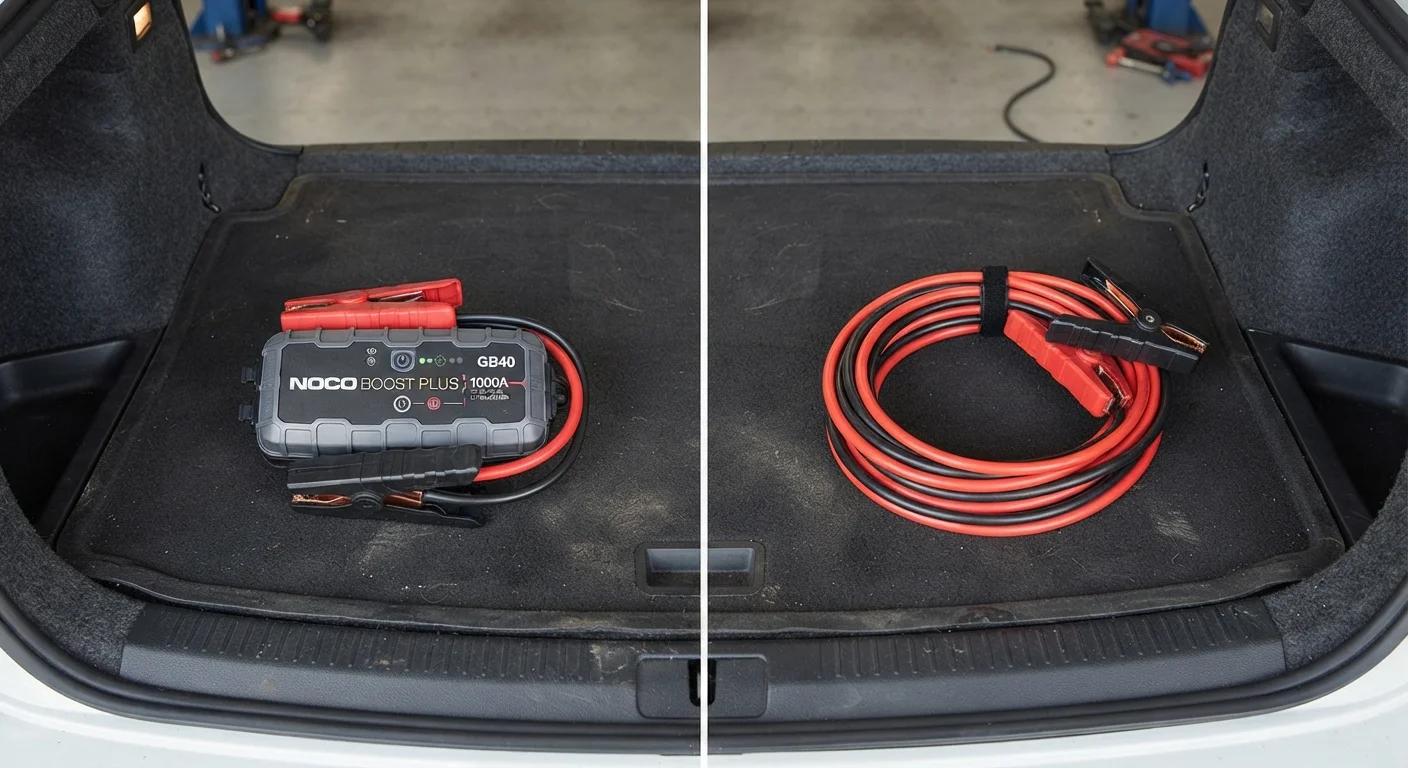
Jumper cables are passive conductors - typically 10- to 20-foot insulated copper or aluminum cables with spring-loaded clamps at each end. They transfer current from a running donor vehicle's battery directly to the dead battery. The donor car's alternator and battery together provide the energy to start the disabled vehicle. Correct clamp sequence (positive to dead, positive to donor, negative to donor, negative to unpainted ground on dead vehicle) is important to avoid sparks near the battery.
Portable jump starters are compact lithium-ion (or, in older models, lead-acid) battery packs with integrated boost circuitry. They store enough charge to deliver high bursts of current - measured in peak amps or cranking amps - to turn over an engine. Most modern lithium units are roughly the size of a thick paperback book. They connect the same way as cables but need no donor vehicle. They do, however, need to be kept charged between uses - lithium packs self-discharge slowly but will eventually reach a point where they can't deliver enough current.
For a deeper look at managing onboard power for all your road-trip devices, see our guide to vehicle power outlets and inverters.
| Criterion | Portable Jump Starter | Jumper Cables |
|---|---|---|
| Requires donor vehicle | No | Yes |
| Ongoing maintenance | Recharge every 2-3 months | None |
| Typical cost range | Higher (lithium units vary widely) | Lower (simple copper cable) |
| Storage size | Compact but bulkier than cables | Slim, coils flat in a bag |
| Cold-weather reliability | Reduced capacity below freezing | Unaffected by temperature |
| Works with large engines | Depends on unit's peak amp rating | Yes, if donor battery is healthy |
| Additional device charging | Often yes (USB ports on many units) | No |
| Failure risk over time | Battery degradation, connector corrosion | Insulation cracking, clamp corrosion |
Key Trade-offs: Reliability, Storage, and Real-World Use
Neither tool is universally superior - each has failure modes worth knowing about before you're in a parking lot at midnight.
Jump Starter Considerations
- Charge maintenance: A jump starter that hasn't been topped off in six or more months may lack the voltage to start your engine. Build a habit of checking and recharging every two to three months.
- Temperature sensitivity: Lithium cells lose capacity in extreme cold. Some units are rated for operation down to -4°F (-20°C), but real-world output drops noticeably below freezing.
- Clamp quality matters: Cheap clamp contacts corrode and can fail to make a clean connection. Look for solid copper clamps rather than plated steel when evaluating any unit.
Jumper Cable Considerations
- Gauge is critical: Cables rated at 4-gauge or lower (thicker wire) handle high-draw starts more safely. Thin 10-gauge cables sold as budget options can overheat.
- Donor dependency: You need a second vehicle. In a remote area, a national forest campground, or late at night, that may not be realistic.
- No upkeep needed: Cables stored in a bag will work just as well in five years as they do today, assuming the insulation hasn't cracked from UV exposure.
~20%
Lithium capacity loss at 32°F (0°C)
Lithium-ion cells commonly experience around 20% capacity reduction at freezing temperatures, with steeper losses below that threshold, per general electrochemical research on lithium battery performance.
4-gauge
Recommended minimum cable gauge for most passenger vehicles
Automotive electrical guides consistently cite 4-gauge as the practical minimum for safe, low-resistance jump starts on standard passenger cars and light trucks.
If your vehicle has a lithium auxiliary or house battery - common in camper vans and RVs - consult our overview of RV battery types and their maintenance needs before using any jump-starting method near those systems.
A Note on High-Voltage EV Systems
Jumper cables and portable jump starters are designed for conventional 12V starting batteries only. Battery-electric vehicles do have a small 12V auxiliary battery for accessories, which can sometimes be jump-started in the traditional way - but procedures vary significantly by manufacturer. Never attempt to jump-start or connect cables to a high-voltage EV traction battery. Always check your owner's manual and, when in doubt, contact roadside assistance.
Matching the Tool to Your Driving Profile
The decision ultimately comes down to three factors: how often you drive solo, how far from populated areas you regularly travel, and how much kit you're willing to maintain.
Solo highway drivers and road-trippers cover the most ground with a jump starter. Being stranded on an interstate with no nearby exits is precisely the scenario cables can't solve alone. Carrying a charged unit eliminates the variable of whether the next driver to pass will stop and whether their vehicle can serve as a donor.
Urban commuters and drivers who rarely venture far from populated areas get solid value from a quality set of cables. Roadside assistance programs, which many insurance policies and some vehicle warranties include, also cover jump starts - meaning cables serve as a true backup of last resort rather than a first-line tool.
For those interested in how powertrain type affects what emergency equipment you should carry, our EV vs hybrid powertrain comparison covers the key differences. Note that neither jumper cables nor standard portable jump starters are appropriate for jump-starting the high-voltage traction battery in a battery-electric vehicle - always consult your owner's manual.
A practical middle ground for frequent road-trippers: carry both. A quality set of cables takes up minimal space and costs little, while a charged jump starter handles the solo-breakdown scenario. Together they cover nearly every realistic dead-battery situation a conventional-vehicle driver is likely to face.