
Why Battery Chemistry Shapes Your Maintenance Routine
Your RV's house battery bank is the backbone of off-grid comfort - powering lights, fans, refrigerators, and charging ports whenever you're away from shore power. Yet many owners treat all batteries the same, applying identical charging routines and storage habits regardless of what's actually under the hood. That mistake shortens battery life and can leave you without power mid-trip.
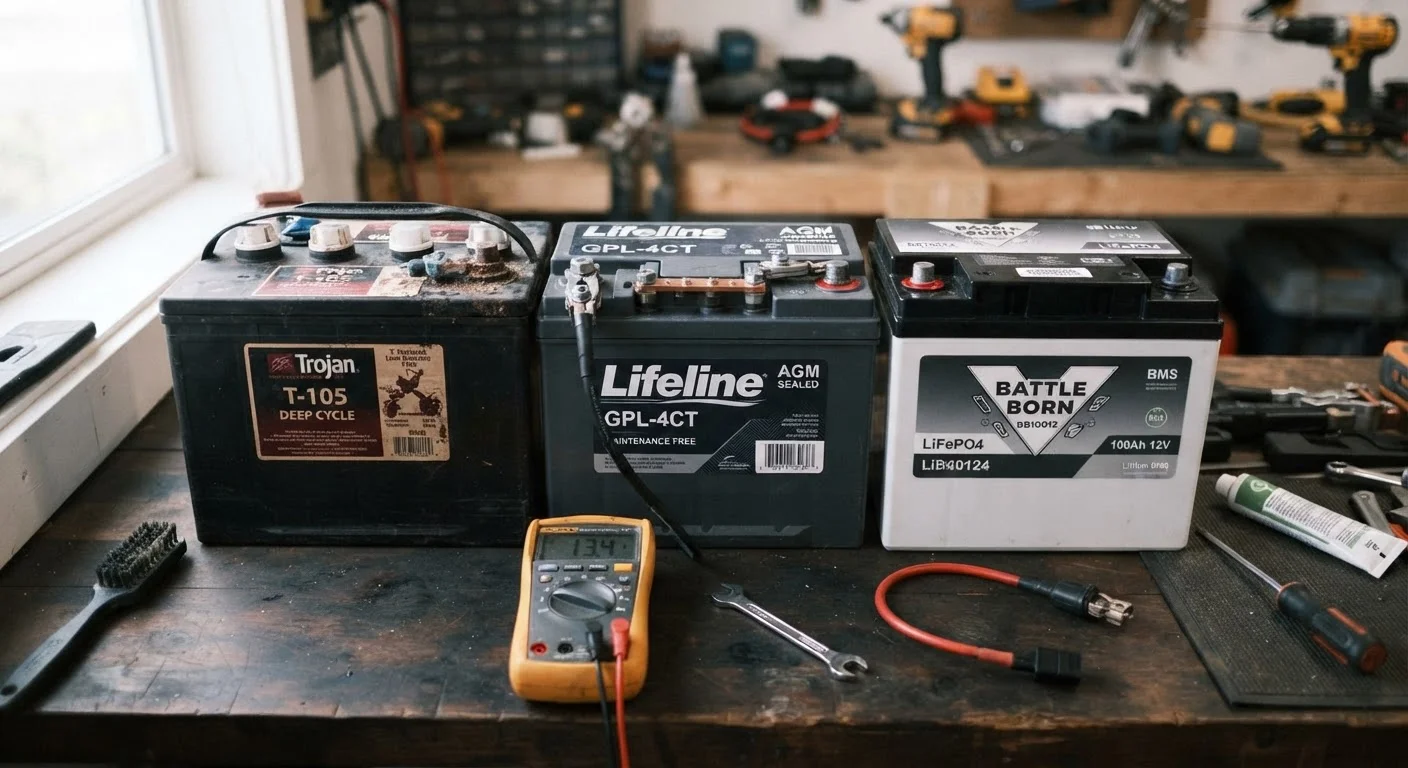
The three battery chemistries most common in RV house banks - flooded lead-acid (FLA), absorbed glass mat (AGM), and lithium iron phosphate (LiFePO4) - each have distinct charge characteristics, depth-of-discharge tolerances, and maintenance requirements. Understanding those differences is the foundation of smart RV upkeep. For a broader look at how battery degradation unfolds over time, the battery degradation data from EVs and hybrids offers useful context on capacity loss patterns that apply across chemistries.
Flooded Lead-Acid: High Maintenance, Low Cost
Flooded lead-acid batteries remain the most widely used RV house battery due to their low upfront cost and widespread availability. Internally, lead plates sit submerged in a liquid electrolyte solution - a design that works reliably but requires active management.
What Maintenance Demands
- Water top-offs: Electrolyte levels drop during normal cycling. Check cells every 2-4 weeks during active use and refill with distilled water only - never tap water - to the manufacturer's fill line.
- Equalization charging: Performed every 30-90 days, this controlled overcharge mixes stratified electrolyte and dissolves sulfate buildup on the plates. Use only a charger with a dedicated equalization mode.
- Terminal cleaning: Corrosion accumulates at posts. Clean with a baking soda and water solution, rinse, dry, and apply a corrosion-inhibiting spray.
- Ventilation: FLA batteries off-gas hydrogen during charging - install them in a vented compartment only.
Depth of discharge matters significantly: repeatedly draining below 50% accelerates plate sulfation and shrinks usable life. Keep discharge shallow and recharge promptly.
Use a Hydrometer to Monitor FLA Health
A battery hydrometer measures the specific gravity of your flooded battery's electrolyte, giving you an accurate read on each cell's state of charge and overall health. Readings that vary significantly between cells signal a weak or failing cell before it causes a failure on the road. Hydrometers are inexpensive and widely available at auto parts stores - keep one in your RV toolkit if you run flooded lead-acid batteries.
AGM: Sealed Convenience With Specific Charging Needs
Absorbed glass mat batteries suspend electrolyte in a fiberglass mat between the plates. The sealed construction eliminates water maintenance and off-gassing, making AGM a popular upgrade for owners who want reliability without the hands-on routine of flooded batteries.
What Maintenance Demands
- Charger compatibility: AGM batteries require a charger programmed specifically for AGM chemistry. A standard flooded-battery charger running at too high a voltage will overcharge and permanently damage the cells - this is the single most common AGM failure point.
- Avoid deep discharge: Like FLA, AGM batteries degrade when repeatedly drained below 50%. Unlike FLA, they cannot be recovered with equalization once sulfation sets in.
- Temperature awareness: Charge acceptance drops in cold temperatures. If camping in freezing conditions, allow batteries to warm before applying a full charge cycle.
- Storage charge: Store at or above 50% state of charge and connect a smart maintainer if the RV will sit for more than a month.
For more on the habits that quietly shorten any battery's life, see battery health habits that accelerate degradation.
| Flooded Lead-Acid | AGM | Lithium (LiFePO4) | |
|---|---|---|---|
| Upfront Cost | Lowest | Moderate | Highest |
| Usable Depth of Discharge | ~50% | ~50% | ~80-90% |
| Typical Cycle Life | 300-500 cycles | 400-600 cycles | 2,000-3,500 cycles |
| Water Top-Off Required | Yes - every 2-4 weeks | No - sealed | No - sealed |
| Equalization Charging | Required periodically | Not needed | Never - will damage cells |
| Cold Temperature Charging | Reduced, manageable | Reduced, manageable | Unsafe below 32°F without BMS cutoff |
| Charger Compatibility | Standard multi-stage | AGM-specific profile | Lithium-compatible charger required |
| Ventilation Required | Yes - hydrogen off-gas | No | No |
Lithium (LiFePO4): High Performance, Different Rules
Lithium iron phosphate batteries have reshaped expectations for RV house power. Their usable capacity is roughly double that of lead-acid alternatives at equivalent amp-hour ratings - you can safely draw down to 20% state of charge without long-term damage. Cycle life typically exceeds 2,000-3,000 full cycles, compared to 300-500 for well-maintained FLA.
What Maintenance Demands
- Battery management system (BMS): Every lithium bank requires an integrated BMS that monitors cell voltage, temperature, and current. Verify the BMS is functioning if you experience unexplained shutdowns.
- Charger and converter compatibility: Many older RV converters charge at voltage profiles designed for lead-acid. Lithium requires a lithium-compatible charger or a converter upgrade - confirm compatibility before installation.
- No equalization: Never apply an equalization charge to a lithium battery. It will damage or destroy cells.
- Cold temperature charging: LiFePO4 cannot be safely charged below approximately 32°F (0°C). Many quality units include a low-temperature cutoff in the BMS, but verify this before winter camping.
- Storage flexibility: Lithium self-discharges very slowly (1-3% per month), making long-term storage more forgiving than lead-acid. A partial state of charge around 50% is ideal for extended storage.
If your RV uses a generator to supplement charging, routine generator maintenance directly affects how well any battery bank stays topped off - see maintaining an RV generator properly for service interval guidance.
Never Mix Battery Chemistries in One Bank
Connecting flooded, AGM, and lithium batteries together in a single house bank creates mismatched charge and discharge characteristics that will damage all of them. Each chemistry requires a different charge profile and has different internal resistance - running them in parallel accelerates degradation and can cause overheating or failure. If you're upgrading to lithium, replace the entire bank at once rather than mixing old and new chemistry.
Storage, Charging Systems, and Long-Term Care
Regardless of battery type, the habits surrounding storage and charging have an outsized impact on longevity. Deep discharge during storage is the most common cause of premature failure across all three chemistries. When storing your RV for extended periods, disconnect the battery from the chassis to prevent parasitic draws from slowly draining cells below damaging thresholds. The long-term RV storage guide covers the full range of protective steps worth taking before a seasonal layup.
For any battery type, a smart multi-stage charger - one that moves through bulk, absorption, and float stages automatically - is a worthwhile investment. It removes the guesswork from charging and reduces the risk of both undercharging and overcharging. If you're troubleshooting a battery that drains faster than expected even after servicing, recurring battery drain causes and diagnostics walks through the common culprits including parasitic draw and alternator issues.
This article is for general informational and educational purposes only. Battery installation, system wiring, and any modifications to your RV's electrical system should be performed by or verified by a qualified technician. Always consult your battery and RV manufacturer's documentation before making changes to your power system.