Why Your RV's Roof Material Matters More Than You Think
Water damage is consistently cited as one of the most expensive repair categories for RV owners - and the roof is its primary entry point. The material your roof is made from determines how quickly it degrades, how difficult it is to repair, and how well it holds up across seasons. Understanding the differences between EPDM rubber, fiberglass, and TPO (thermoplastic polyolefin) before damage occurs gives you the diagnostic framework to catch problems early.
For a broader look at how all roof materials age and what warning signs to watch for, see RV Roof Care: What Every Owner Should Know Before Damage Sets In. This comparison focuses specifically on the structural and performance differences between the three dominant materials in today's RV market.
~90%
RV water damage traced to roof or seams
Industry repair professionals commonly attribute the majority of interior water damage in RVs to roof membrane failures or failed seam sealants.
10-20 yrs
Typical EPDM roof lifespan with maintenance
EPDM membranes maintained with regular UV treatment and sealant inspection commonly reach or exceed this range before requiring full replacement.
EPDM Rubber: The Workhorse of RV Roofing
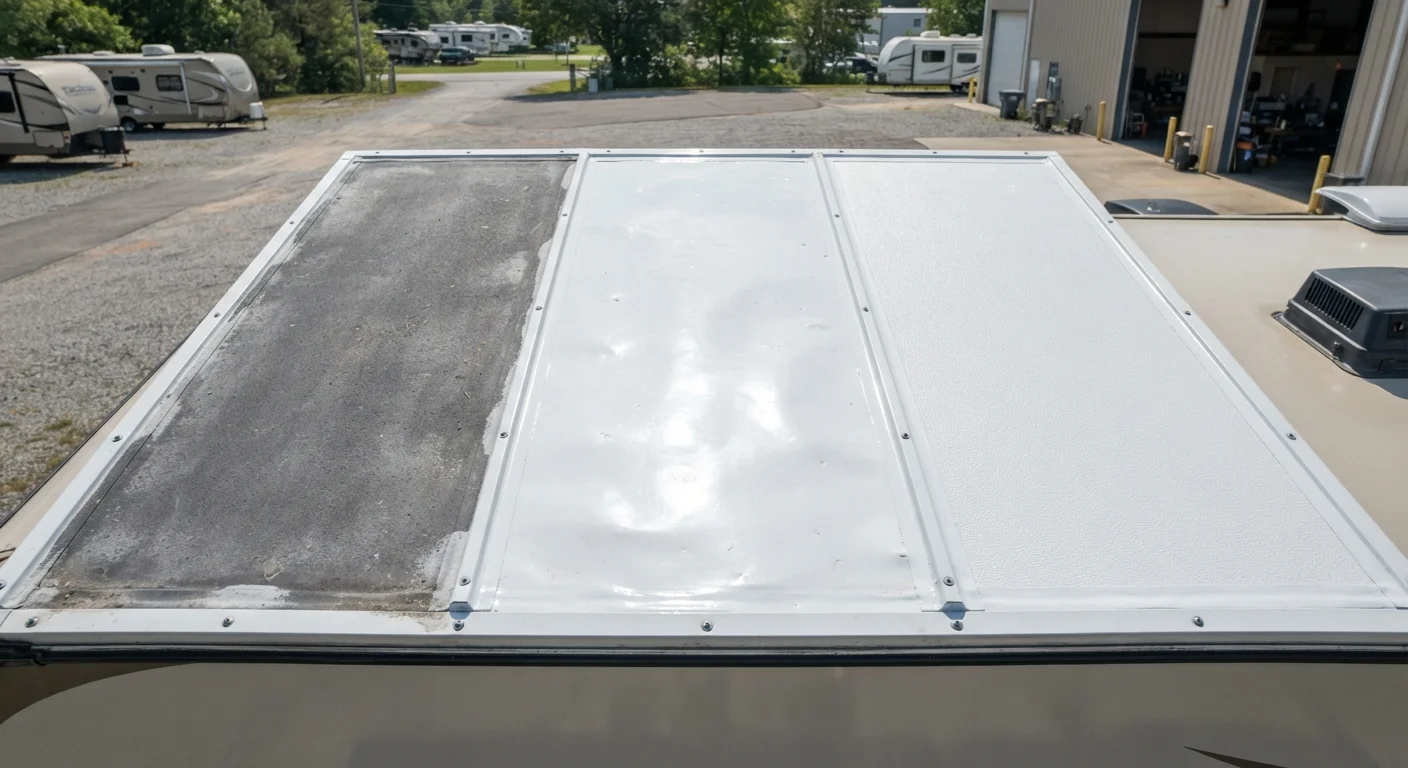
Ethylene propylene diene monomer - universally called EPDM - is a synthetic rubber membrane that has been the standard on Class A, B, and C motorhomes and many travel trailers for decades. It installs as a single large sheet glued to a substrate, which minimizes seam count and reduces leak points in the field.
Strengths
- Low initial cost relative to fiberglass and TPO
- Flexible - handles thermal expansion and contraction without cracking
- DIY-repairable with lap sealant and rubber patches widely available
- Typical service life of 10-20 years with consistent maintenance
Weaknesses
- Absorbs heat, increasing interior cooling loads - relevant if you're comparing roof-mounted vs. portable AC options
- Requires UV protectant treatments every 1-3 years to prevent oxidation and brittleness
- Petroleum-based products (including some slide treatments) can degrade the membrane
- Porous surface attracts black streaking and mildew if left uncleaned
EPDM's Achilles' heel is the lap sealant at seams, vents, and AC penetrations. That sealant dries, shrinks, and cracks - often silently. A twice-annual inspection of every seam is the baseline commitment EPDM ownership demands.
Fiberglass: Rigidity at a Price
Fiberglass roofs are constructed from glass-fiber reinforced panels, often the same material used for RV sidewalls. They are most common on higher-end fifth wheels, toy haulers, and some premium motorhomes. Unlike rubber membranes, fiberglass is a hard surface that can be painted or gelcoated.
Strengths
- Highly resistant to punctures from tree branches, hail, and foot traffic
- Smooth, non-porous surface resists mold and is easier to clean
- Does not require UV-protectant treatment the way rubber does
- Can be waxed and polished like a vehicle body panel
Weaknesses
- More expensive to manufacture and repair than EPDM
- Susceptible to stress cracks as the RV flexes during travel
- Cracks must be addressed promptly - water wicking into the fiberglass laminate causes delamination that spreads invisibly
- Repairs generally require professional application of fiberglass resin and finishing
Fiberglass also transfers more road vibration to roof-mounted equipment. If your rig has a fiberglass roof and you're adding or replacing an air conditioner, verify the mounting flange sealing method matches your surface type. Improper sealing at penetrations is a leading cause of delamination.
Walk Your Roof Safely - and Regularly
Before stepping onto any RV roof, confirm the manufacturer's weight rating and the substrate condition beneath the membrane. Soft spots may indicate water damage to the decking below. Inspect all seams, vent boots, and antenna bases at least twice a year - spring before your first trip and fall before storage. Catching a failed sealant bead early is a $15 fix; missing it can become a $5,000 interior repair.
TPO: The Modern Challenger
Thermoplastic polyolefin is a single-ply roofing membrane that entered the RV market after proving itself in commercial flat-roofing applications. Its key technical distinction from EPDM is that seams are heat-welded rather than glued, creating a molecular bond that is generally stronger and more water-resistant than adhesive lap joints.
Strengths
- White surface reflects solar heat, reducing cooling loads more effectively than EPDM
- Heat-welded seams resist separation better than glued seams over time
- Resistant to UV degradation, mold, algae, and most chemicals
- Lighter weight than fiberglass panels
Weaknesses
- Shorter field history in RV applications than EPDM - long-term performance data is still accumulating
- Seam repairs require a heat-welding tool not typically in DIYers' toolkits
- Can become brittle in extreme cold if the membrane formulation is lower grade
- Fewer experienced RV technicians compared to the large pool familiar with EPDM
TPO is becoming the default membrane on many new-production units, particularly from manufacturers targeting four-season use. Its heat-reflective properties make it a natural complement to roof-mounted air conditioners - a topic explored in our comparison of roof-mounted and portable RV air conditioners.
| EPDM Rubber | Fiberglass | TPO | |
|---|---|---|---|
| Typical Lifespan | 10-20 years | 15-25 years | 15-20 years (field history developing) |
| Upfront Cost | Lower | Higher | Moderate to higher |
| DIY Repairability | High - patches and sealant widely available | Low - resin repair requires skill | Low - heat-welding tool required |
| Heat Reflectivity | Poor - dark surface absorbs heat | Moderate - depends on coating | Good - white surface reflects UV |
| Puncture Resistance | Moderate | High | Moderate |
| Seam Method | Adhesive lap sealant | Panel joints with sealant | Heat-welded seams |
| Primary Failure Mode | Sealant cracking at penetrations | Stress cracks and delamination | Seam separation in cold extremes |
| Maintenance Frequency | Every 1-3 years (UV treatment + sealant) | Annual crack inspection | Annual seam and surface inspection |
Maintenance, Storage, and Long-Term Ownership
Regardless of roof material, long-term condition is heavily influenced by how the RV is stored when not in use. Prolonged UV exposure and standing water accelerate degradation in all three materials - particularly at seams. If you store your rig outdoors, a breathable roof cover adds meaningful protection without trapping moisture beneath it. For a detailed look at storage trade-offs, see Storing Your RV Long-Term: What Protects It and What Quietly Damages It.
Roof material also interacts with your overall maintenance calendar. EPDM owners should budget time in spring and fall for sealant inspection and UV treatment. Fiberglass owners should prioritize crack detection - running a hand across the surface after any significant trip helps catch hairline fractures before they widen. TPO owners should confirm that any repair technician has heat-welding capability before scheduling work.
The roof is just one element of a larger maintenance picture. Keeping your rig road-ready year-round also means attending to tyre condition - practices covered in our guide to extending RV tyre life. And if you're still evaluating which RV class best fits your travel style before making a purchase, Choosing an RV Class: Questions Worth Asking Before You Commit offers a structured framework for that decision.
Never Use Petroleum Products on EPDM
Many common slide-out lubricants and cleaning agents contain petroleum distillates that chemically degrade EPDM rubber, causing it to swell and lose adhesion. Always verify that any product applied near or on an EPDM roof is explicitly labeled safe for rubber membranes. When in doubt, consult your RV manufacturer's recommended product list or a qualified RV service technician.