
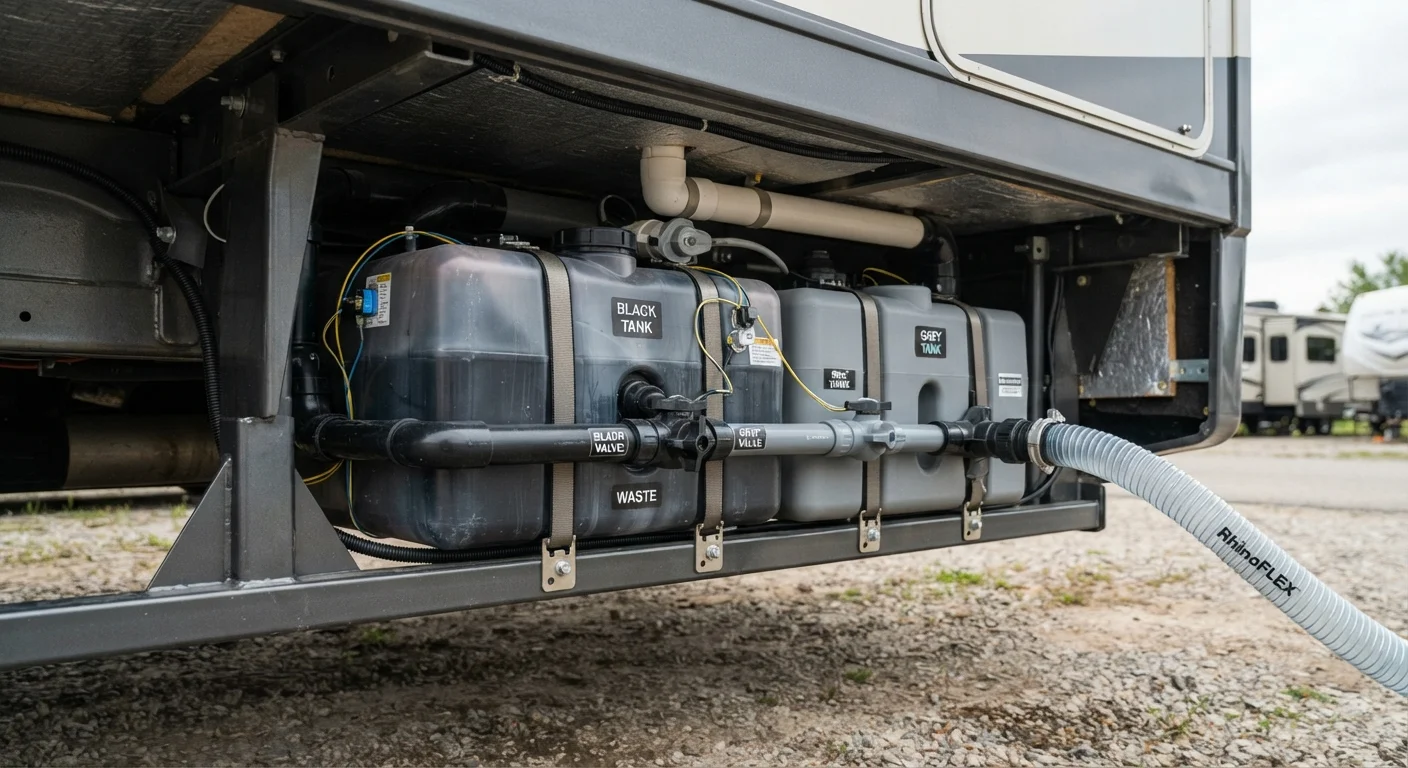
Why Holding Tank Myths Cause Real Damage
RV holding tanks - grey (wastewater from sinks and shower) and black (toilet waste) - are among the most misunderstood systems on any rig. Bad advice circulates freely at campgrounds and online forums, and acting on it leads to genuine consequences: backed-up tanks, persistent odours, failed sensors, and expensive plumbing repairs.
Understanding how these tanks actually work is fundamental to RV life. For a broader look at how all water systems connect, see the complete RV water system guide. The myths below are among the most common - and the most damaging.
Myth
Leaving the black tank valve open at full hookups keeps things clean and odour-free.
Fact
An open valve lets liquid drain continuously, leaving solids to dry and accumulate into a hardened "pyramid" that is extremely difficult to remove.
The black tank needs liquid to keep solid waste in suspension so it can be flushed out effectively. When the valve stays open, water drains away immediately and solids pile up near the valve opening. The resulting compacted mass can block the valve entirely. Close the black tank valve and only open it to dump when the tank is at least two-thirds full - that surge of volume helps flush solids through the drain hose cleanly.
Myth
Grey water is basically clean, so it's fine to dump it anywhere.
Fact
Grey water contains food particles, grease, soap, and bacteria - it is regulated wastewater in most camping environments.
Soap and food residue in grey water can harm vegetation, attract wildlife, and violate Leave No Trace principles as well as specific campground or public land rules. Many state and federal land managers explicitly prohibit surface dumping of grey water. Always use designated dump stations or sewer hookups for both tanks, and check site-specific regulations before assuming grey water disposal is unrestricted.
Myth
Any toilet paper is fine to use in an RV - just use less of it.
Fact
Standard residential toilet paper does not break down quickly enough for RV black tanks and can clog lines and sensors.
Residential toilet paper is engineered to hold together when wet - which is the opposite of what you need in a holding tank. RV-rated or "rapid-dissolve" toilet paper breaks apart within seconds in water, verified by a simple glass-of-water test: drop a few sheets in, stir lightly, and they should dissolve almost immediately. Using quantity-reduction as a workaround does not solve the underlying breakdown rate problem.
Myth
Chemical treatments alone keep sensors reading accurately.
Fact
Sensor probes need physical rinsing to clear residue; chemicals treat odour and bacteria but don't scrub probe surfaces.
Level sensors protrude into the tank and become coated with grease and tissue residue over time. Chemical treatments are not formulated to dissolve this coating off hard probe surfaces. A built-in tank-flush system or an aftermarket rinsing wand - used regularly - physically clears the probes. Once coated sensors are cleaned, accurate readings typically return. Combining regular rinsing with appropriate enzymatic or bacterial treatments gives the best long-term results.
Myth
You should dump tanks as soon as possible to avoid odours building up.
Fact
Dumping a nearly empty black tank leaves solids behind and makes odours worse, not better.
Odour in the black tank comes primarily from dried or decomposing solids. A tank that is dumped too early - before it's adequately full - lacks the liquid volume to flush solids completely through the outlet. The general guideline is to wait until the tank is at least two-thirds full before dumping. Adding water deliberately before a dump further improves the flush. After dumping, add several gallons of fresh water and a tank treatment to begin the next cycle correctly.
Sensor Failures and the Chemistry of Tank Treatment
Two of the most frustrating holding tank problems - inaccurate level sensors and persistent odours - share the same root cause: improper maintenance practices justified by myths. Sensors that read "full" on an empty tank are almost always coated with grease, toilet paper residue, or mineral scale. No chemical treatment alone clears that buildup; a dedicated tank-rinse wand or built-in flush system, used regularly, is the only reliable fix.
2-3 gallons
Minimum water to add after each black tank dump
RV industry maintenance guidance consistently recommends priming the black tank with fresh water and treatment after every dump to maintain moisture and bacterial activity.
⅔ full
Recommended fill level before dumping black tank
Plumbing educators and RV service technicians widely cite two-thirds capacity as the threshold that provides enough liquid volume to flush solids effectively through the drain hose.
Tank treatments do serve a real purpose: they control odour and support the bacterial breakdown of solid waste. However, they work best when the tank holds adequate water - another point where myths cause harm. Dumping a near-empty black tank leaves solids behind that dry and harden, compounding sensor and odour problems.
If you're still working out the full scope of hookup options at campgrounds, RV hookup connections explained covers sewer connections and what full-hookup actually means in practice. And if you're newer to tank management generally, why new RVers struggle with water and tank management addresses the most common early mistakes.
Never Mix Bleach With Tank Treatments
Some RVers attempt to sanitise holding tanks with household bleach. Bleach kills the beneficial bacteria that enzyme-based treatments rely on to break down solid waste - using both together defeats the purpose of the treatment. Bleach can also degrade rubber seals and gaskets inside the tank valve assembly. Stick to products formulated specifically for RV holding tanks.
Staying Compliant and Protecting Your Rig Long-Term
Beyond mechanical damage, holding tank myths can create legal exposure. Dumping grey water on the ground - even at dispersed camping sites - is regulated or prohibited in many jurisdictions. Treat grey water as a managed waste stream, not a harmless overflow. Check local regulations before assuming any informal disposal is permitted.
Consistent, myth-free tank maintenance also extends the life of your plumbing seals and dump valves. Seals that sit dry or are exposed to harsh chemicals degrade faster; valves that are left open continuously can seize or fail to seal completely. Routine care - flush, treat, dump at the right fill level, rinse - is straightforward once the misconceptions are cleared away. For related maintenance context across your RV's water system, RV fresh water system maintenance is a practical reference worth bookmarking.
Valve and Seal Failures Require Professional Repair
A black tank valve that won't close completely or a tank fitting that leaks is not a DIY fix to delay. Raw sewage exposure poses a health risk, and continued operation with a compromised seal can damage the RV's subfloor. If you suspect a valve or fitting failure, have a qualified RV service technician inspect and repair the system before your next trip.