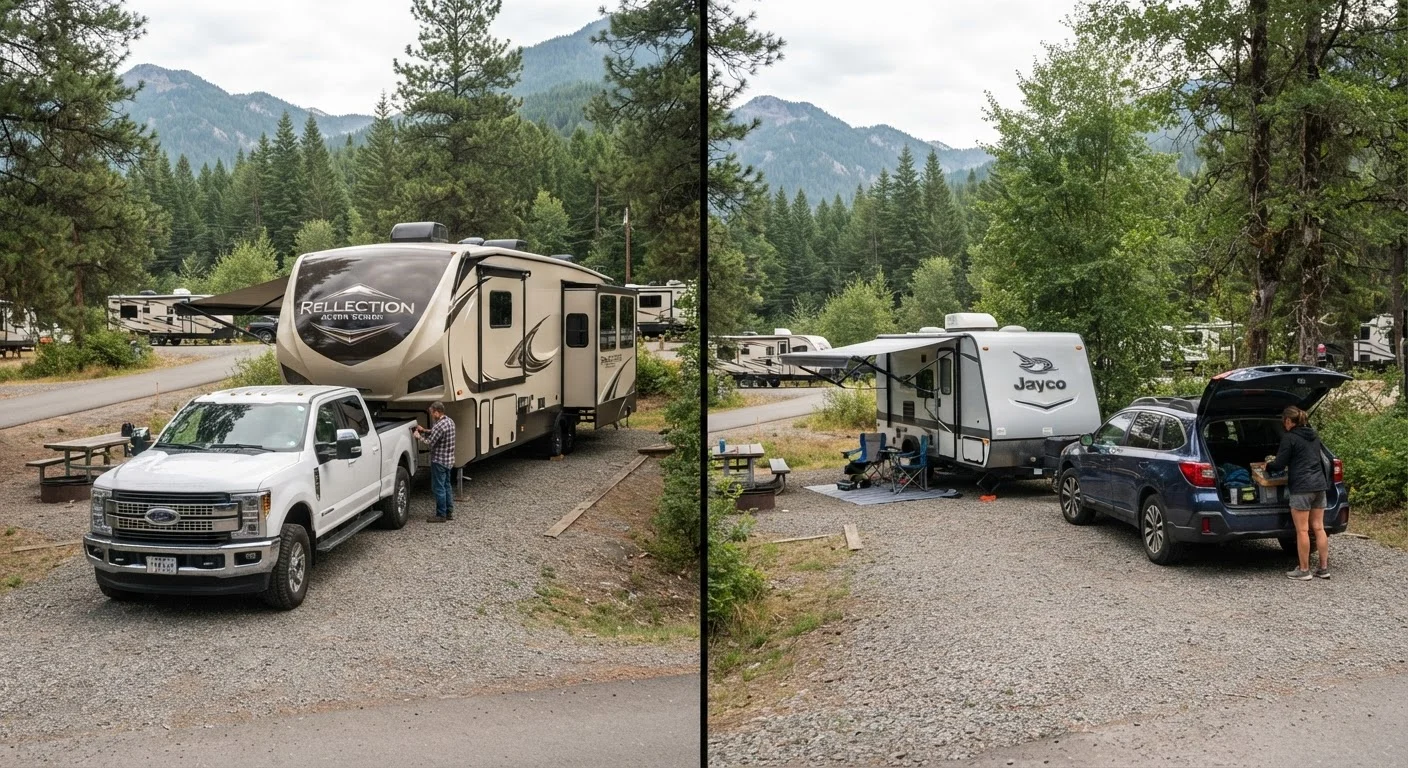
The Hitch: Where These Two Formats Fundamentally Split
The most consequential difference between a fifth wheel and a travel trailer isn't size or price - it's how each connects to its tow vehicle. That connection determines which vehicles can pull them, how they behave on the highway, and what the hitching process looks like every time you move camp.
Travel trailers use a conventional ball-mount hitch, where a coupler on the trailer's A-frame tongue drops over a hitch ball on the tow vehicle's receiver. Nearly any receiver-equipped vehicle - from a mid-size SUV to a three-quarter-ton pickup - can theoretically tow a travel trailer, provided the trailer's gross vehicle weight rating (GVWR) falls within the vehicle's rated towing capacity. Heavier trailers typically require a weight distribution hitch (a system that uses spring bars to redistribute nose-down tongue weight across all axles), along with a sway-control device. See our towing setup walkthrough for a breakdown of those components.
Fifth wheels use a completely different system: a kingpin mounted under the front overhang of the trailer locks into a fifth-wheel hitch - a horseshoe-shaped coupling plate installed in the bed of a pickup truck. This design places the hitch point over the truck's rear axle rather than behind it, which is the root cause of the fifth wheel's superior stability at highway speed. The tradeoff is that a pickup truck with sufficient payload is non-negotiable. Matching a truck to a fifth wheel involves evaluating bed length, pin weight (the downward force on the hitch - typically 15-25% of trailer weight), and the truck's payload rating simultaneously.
| Criterion | Fifth Wheel | Travel Trailer |
|---|---|---|
| Hitch type | Kingpin + fifth-wheel hitch (truck bed) | Ball-mount receiver hitch |
| Required tow vehicle | Heavy-duty pickup (typically 3/4-ton+) | SUV, half-ton, or heavy-duty pickup |
| Typical GVWR range | 12,000-22,000+ lbs. | 2,500-14,000+ lbs. |
| Towing stability | High - hitch over rear axle | Moderate - improved with WDH and sway control |
| Interior floor plan | Bi-level; separate bedroom loft | Single-level throughout |
| Ceiling height | Often 7 ft.+ in main area | Typically 6.5-7 ft. depending on model |
| Hitching ease | Straightforward back-up alignment | Requires precise ball-coupler alignment |
| General price range | Higher entry point | Wider range; lower starting prices |
Living Space: Floor Plans, Headroom, and Practical Comfort
Both formats can deliver comfortable living quarters, but the structural differences in how each is built create meaningfully different interior experiences.
A fifth wheel's defining architectural feature is its bi-level floor plan. Because the front section of the trailer rides over the truck bed, that area sits higher - typically housing a private bedroom, often with a walk-around queen or king bed, separated from the main living area by a short staircase. This separation provides a genuine sense of division between sleeping and living spaces that flat-floor travel trailers typically can't replicate at the same overall length. Ceiling heights in the main body of a fifth wheel commonly reach 7 feet or more, giving a roomier feel than many same-class travel trailers.
Travel trailers, by contrast, are single-level throughout, which has its own practical advantages: no stairs to navigate at night, easier accessibility, and layouts that can work well in compact lengths. A 24-foot travel trailer can pack in a rear bedroom, dinette, and functional kitchen - though the walls and ceiling typically sit lower than a fifth wheel of similar length. Slide-outs (rooms that extend outward when parked) are available on both formats and dramatically expand usable floor space at camp, but they add weight and mechanical complexity.
For a broader look at how these formats sit within the full towable RV landscape, the towable RV category breakdown covers every major class side by side.
15-25%
Pin weight as share of fifth-wheel trailer GVWR
Industry guidance consistently places the kingpin's downward force on the truck bed at 15-25% of the trailer's loaded weight - a key figure for payload calculations.
~2,500 lbs.
Minimum typical pin weight on a standard fifth wheel
Even modestly sized fifth wheels commonly place 2,500 lbs. or more of pin weight on the hitch, quickly consuming a half-ton truck's available payload budget.
7 ft.+
Common interior ceiling height in fifth-wheel main area
Many fifth-wheel floor plans achieve 7-foot or greater ceiling heights in the main living section, contributing to the more residential feel enthusiasts often cite.
Tow Vehicle Requirements and Real-World Considerations
Understanding what each format demands from a tow vehicle is essential before you finalize any RV decision - and this is where many buyers underestimate the full cost picture.
Travel trailers span an enormous weight range: lightweight models start under 3,000 lbs. GVWR, while large luxury trailers can push 14,000 lbs. or more. That range means a capable half-ton pickup or a full-size SUV can handle a broad swath of the travel trailer market. However, towing at or near a vehicle's rated capacity affects braking distance, tire wear, transmission heat, and overall drivetrain longevity. Always verify both the tow rating and the payload rating of any tow vehicle - payload (how much weight the truck can carry, including the tongue weight of the trailer) is frequently the limiting factor that dealers and buyers overlook.
Fifth wheels typically start around 12,000 lbs. GVWR and can exceed 20,000 lbs. for large luxury models. A three-quarter-ton (2500-series) or one-ton (3500-series) pickup is the practical minimum for most fifth wheels. The pin weight alone - often 2,500 to 4,000 lbs. for a typical fifth wheel - will consume most of a half-ton truck's payload budget, making that combination inadvisable for anything but the lightest fifth-wheel units.
If you're still weighing whether a towable RV suits your travel style at all, the motorhome vs. towable comparison provides useful context. And if full-time living is the goal, motorhome vs. fifth wheel for full-time use digs into that specific tradeoff in detail.
Payload vs. Towing Capacity: Know the Difference
Towing capacity (the maximum weight a vehicle can pull) and payload capacity (the maximum weight the vehicle itself can carry, including passengers, cargo, and tongue/pin weight) are separate ratings. A truck may have a high towing rating but a relatively modest payload rating - and exceeding payload is unsafe regardless of towing capacity. Always check both numbers, found on the manufacturer's label inside the driver's door jamb, before matching any trailer to a tow vehicle. Consult a qualified mechanic or the vehicle manufacturer if you have questions about your specific setup.