What Makes an RV "Towable"?
Towable RVs have no engine of their own - they rely entirely on a separate tow vehicle, whether that's a pickup truck, SUV, or heavy-duty diesel. This fundamental distinction separates them from motorhomes and shapes every practical tradeoff: cost, flexibility, living space, and tow vehicle requirements all flow from that single design choice.
For a full breakdown of where towables fit within the broader RV universe, see Motorhome vs. Towable. What follows is a category-by-category reference to the towable formats you'll encounter in the market today.
| Hitch type: Travel Trailer | Ball-mount (rear of tow vehicle) |
| Hitch type: Fifth Wheel | Kingpin plate (truck bed) |
| Lightest towable category | Pop-up / folding camping trailer |
| Garage-equipped format | Toy hauler (travel trailer or fifth wheel body) |
| No wheels of its own | Truck camper (mounts in truck bed) |
| Best living space per foot | Fifth wheel (bi-level floor plan) |
The Major Towable Categories
Conventional Travel Trailers
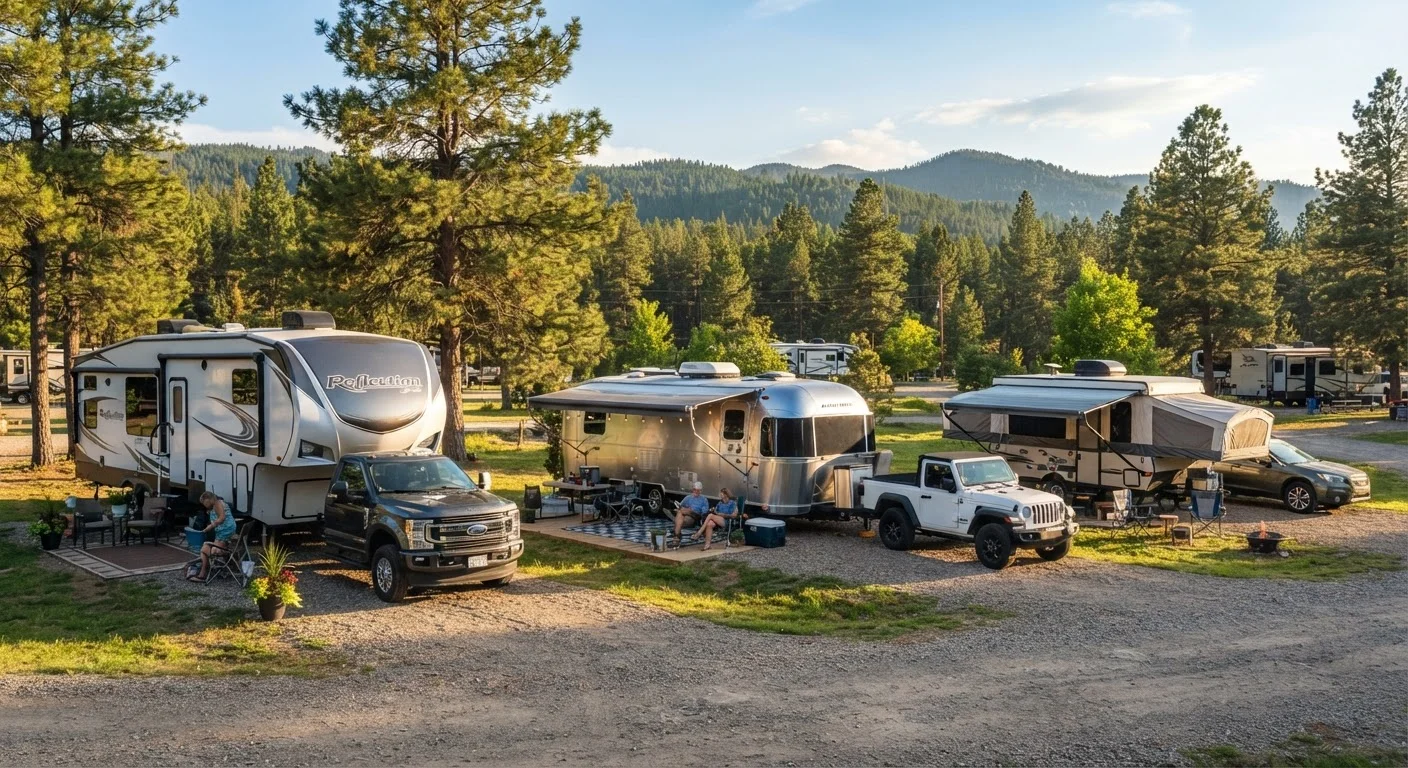
Travel trailers attach to a tow vehicle via a standard ball-mount hitch on the rear bumper or frame. They range from compact single-axle units under 15 feet to large dual-axle models exceeding 35 feet. Floor plans vary widely - dinette, bunkhouse, rear-bedroom, and studio layouts all exist within this category. Because the hitch point sits behind the tow vehicle's rear axle, weight distribution and sway control become important considerations as length and payload increase.
Fifth Wheels
Fifth wheels use a kingpin-and-plate hitch mounted in the bed of a pickup truck, positioning the coupling point over the rear axle rather than behind it. This geometry improves stability and allows taller, bi-level floor plans - typically placing the bedroom in an elevated forward section. Fifth wheels generally offer more living space per foot than comparable travel trailers, but they require a pickup truck and sacrifice bed access. Fifth wheel vs. travel trailer is one of the most common comparisons shoppers face - hitch type, floor space, and tow vehicle compatibility all differ substantially between the two.
Toy Haulers
Toy haulers are travel trailers or fifth wheels built with a rear garage section - a dedicated cargo area with a ramp door - designed to transport motorcycles, ATVs, side-by-sides, kayaks, or other gear alongside living quarters. The garage often converts to sleeping or living space at camp. They exist in both travel trailer and fifth wheel configurations. See how the toy hauler garage format works for a deeper look at layout tradeoffs.
Pop-Up Campers (Folding Camping Trailers)
Pop-up campers, also called folding camping trailers or tent trailers, collapse to a low-profile box for towing and expand at camp via a hand-crank or electric lift system. Canvas or vinyl sides extend outward, creating sleeping bunks. They're the lightest, most aerodynamic towable category - often towable by smaller vehicles - but offer less insulation, weatherproofing, and interior height than hard-sided units.
Truck Campers
Technically not trailered, truck campers slide into or mount onto a pickup truck bed and are secured with tie-downs. They have no wheels of their own and travel as part of the truck. This makes them uniquely maneuverable in terrain where trailers can't go, but they place the camper's weight directly on the truck's payload rating - a critical spec to verify before loading.
Hybrid Trailers
Hybrid trailers combine a hard-sided center section with fold-out canvas ends, splitting the difference between pop-ups and conventional travel trailers. They offer more insulation and structural rigidity than a full pop-up while keeping tow weight and height lower than a hard-sided unit of comparable sleeping capacity.
For definitions of terms like GVWR, dry weight, and payload capacity used across all these categories, consult the RV glossary.
Toy Haulers Cross Category Lines
A toy hauler is not a separate RV class - it's a floor plan variant that can appear in both travel trailer and fifth wheel formats. When comparing toy haulers, verify which base format you're looking at, because hitch requirements, tow vehicle compatibility, and living space characteristics still follow the rules of the underlying category (travel trailer or fifth wheel).
Choosing the Right Category for Your Situation
Category selection is driven by three interconnected variables: what you already tow with (or plan to buy), how you camp, and how much you'll use the RV. A pop-up may be ideal for summer weekend trips with a midsize SUV; a fifth wheel rewards those who want a home-like interior and already own a capable truck. Questions worth asking before committing to an RV class offers a structured checklist for pressure-testing your assumptions before you sign anything.
Tow vehicle capability isn't a variable to estimate loosely. Each category imposes minimum tow ratings, hitch types, and - especially for fifth wheels and large travel trailers - payload and axle-weight requirements. Cross-referencing those specs against your truck or SUV's owner's manual is a necessary step, not an optional one. The Trucks & SUVs hub covers towing capacity across popular platforms if you're evaluating tow vehicles alongside RV categories.
GVWR
Gross Vehicle Weight Rating - the maximum allowable loaded weight of the RV itself, as specified by the manufacturer. Exceeding GVWR is unsafe and may void warranties or insurance coverage.
Kingpin hitch
The coupling system used by fifth wheels, consisting of a steel kingpin on the trailer that locks into a horseshoe-shaped plate (the fifth wheel hitch) mounted in the tow vehicle's bed.
Payload rating
The maximum weight a tow vehicle can carry in its cab and bed. For truck campers and fifth wheels, the camper or hitch weight counts against payload - not just trailer tongue weight.
Dry weight
The weight of an RV as it leaves the factory, before adding water, gear, food, or passengers. Actual loaded weight will always exceed dry weight by a significant margin.
Slide-out
A room section that extends outward from the trailer's sidewall when parked, increasing interior floor space. Slide-outs add weight and require level ground and clearance to operate.
Tongue weight
The downward force a trailer's coupler exerts on the tow vehicle's hitch ball. Proper tongue weight - typically 10-15% of trailer GVWR - is essential for safe towing and sway control.