
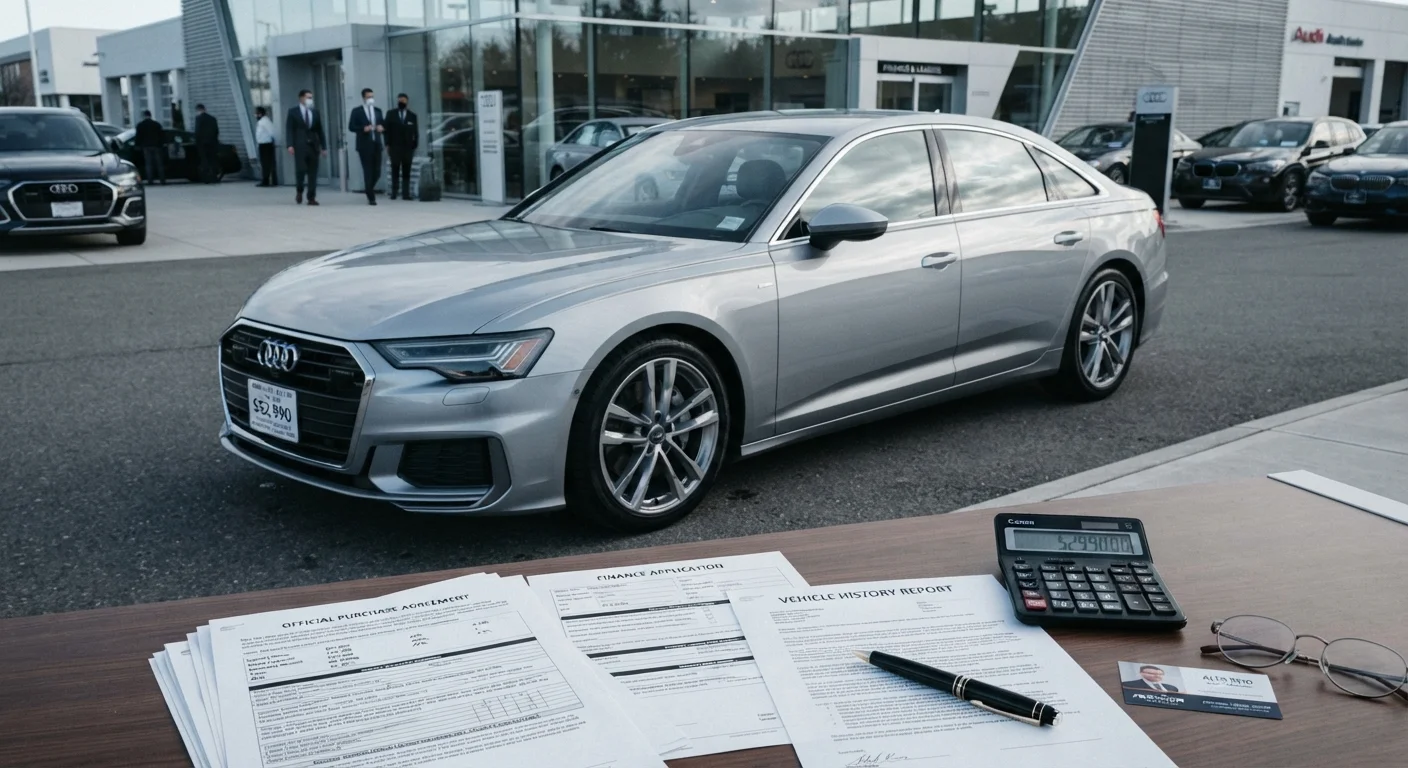
Why the Sticker Price Is Only Part of the Story
A sedan's window sticker answers one question - what the dealer wants today. It doesn't answer what the vehicle will cost you by the time you hand over the keys in year five. Those two numbers can differ by tens of thousands of dollars, and the gap is shaped by factors that vary sharply across sedan categories.
Total cost of ownership encompasses every recurring and one-time expense attached to a vehicle: depreciation, insurance, fuel, scheduled maintenance, tires, unscheduled repairs, registration fees, and financing charges. For sedans specifically, the same dollar figure on two window stickers can mask very different five-year outlays depending on segment, drivetrain, and brand residual-value performance.
40-55%
Share of TCO from depreciation alone
Industry cost-of-ownership models consistently show depreciation is the dominant expense over a standard 5-year, 75,000-mile ownership horizon.
~50%
Typical value lost in first 3 years
Most mainstream sedans shed roughly half their purchase price within the first three years, with the largest single-year drop occurring in year one.
2-3×
Higher servicing cost: luxury vs economy sedans
Proprietary parts, dealer-only diagnostics, and specialty fluids commonly drive luxury segment per-visit maintenance costs to two to three times economy sedan equivalents.
The categories below consistently account for the largest divergence between sedan types - and the ones most buyers underestimate when comparing models.
Depreciation: The Cost You Pay Whether You Notice It or Not
Depreciation is the difference between what you paid and what the market will pay you later. It's not an invoice you receive - which is exactly why buyers routinely underweight it. For most sedans, the first three years strip away 40-50% of purchase price, with the sharpest drop in year one.
Segment matters enormously here. Economy compact sedans from brands with strong reliability reputations tend to hold value better in percentage terms than entry-level near-luxury sedans, despite lower absolute prices. A $35,000 near-luxury sedan that retains 42% of its value after five years costs more in depreciation dollars than a $26,000 economy sedan retaining 55%.
Understanding how depreciation works is foundational before any sedan comparison - it's the single variable most likely to reorder a lineup that looks attractive on sticker price alone.
“Buyers tend to anchor on the monthly payment or the sticker price, but the vehicle's residual value is what determines whether a purchase was truly affordable. Depreciation is the largest cost most drivers never directly see on a bill.”
— Consumer automotive finance research, broadly cited across cost-of-ownership literature, Industry consensus position reflected in TCO modeling methodologies
Insurance, Tires, and Servicing: Where Segments Diverge Most
Insurance premiums are actuarially tied to repair costs, theft rates, and driver profiles associated with each model. Performance-designated sedans - those with turbocharged engines, sport suspension tuning, or track-oriented trims - attract meaningfully higher premiums than their economy or mid-size counterparts, sometimes $800-$1,400 more per year depending on driver history and geography. That spread compounds: over five years, the insurance delta alone can rival several thousand dollars.
Tire costs are frequently overlooked. Economy sedans typically use widely available 16- or 17-inch all-season tires replaceable for $120-$180 per corner. Performance sedans often specify low-profile 18- to 20-inch summer performance tires that can run $220-$400 per corner and wear faster under spirited driving. A single tire replacement cycle on a performance sedan can cost more than two full sets on a compact economy model.
Scheduled maintenance diverges across sedans in both interval frequency and per-visit cost. Brands that use proprietary fluids, direct-injection timing systems requiring walnut blasting, or dealer-only diagnostics create a captive service environment where labor rates are higher and parts prices are less competitive. Economy sedans with conventional engines and widely available parts benefit from competitive independent shop pricing.
Strategies to keep maintenance costs manageable apply across all sedan types - but the baseline you're managing differs substantially by segment.
Request the full service schedule before buying
Ask the dealer or check the owner's manual for the complete maintenance schedule, including fluid types, interval frequencies, and any scheduled replacements like spark plugs or transmission fluid. Pricing those items out at an independent shop - not just the dealer - gives you a realistic annual maintenance budget before you sign anything.
Financing Costs and the Depreciation Trap
Financing charges are a direct function of loan amount, interest rate, and term. Longer terms reduce monthly payments but increase total interest paid and extend the period in which the outstanding balance exceeds the vehicle's depreciated market value. This negative-equity window is particularly consequential for sedans with steep early depreciation curves.
A buyer who finances a fast-depreciating near-luxury sedan over 72 months at a market rate may find themselves $4,000-$8,000 underwater by year three - meaning any trade-in, sale, or total-loss event at that point requires out-of-pocket cash to settle the loan. Economy sedans with stronger residuals and lower purchase prices carry meaningfully lower negative-equity exposure across the same financing structure.
For a broader framework on how rates and terms interact with ownership costs, the rates and terms hub provides foundational context. And if a lower asking price is part of what's drawing you to a specific sedan, this analysis of low asking prices explains how headline figures can obscure downstream cost exposure.
This article provides general vehicle ownership information for educational purposes only and does not constitute financial, tax, or professional advice. Ownership costs vary by individual circumstances, location, and market conditions. Consult a qualified financial professional for guidance specific to your situation.