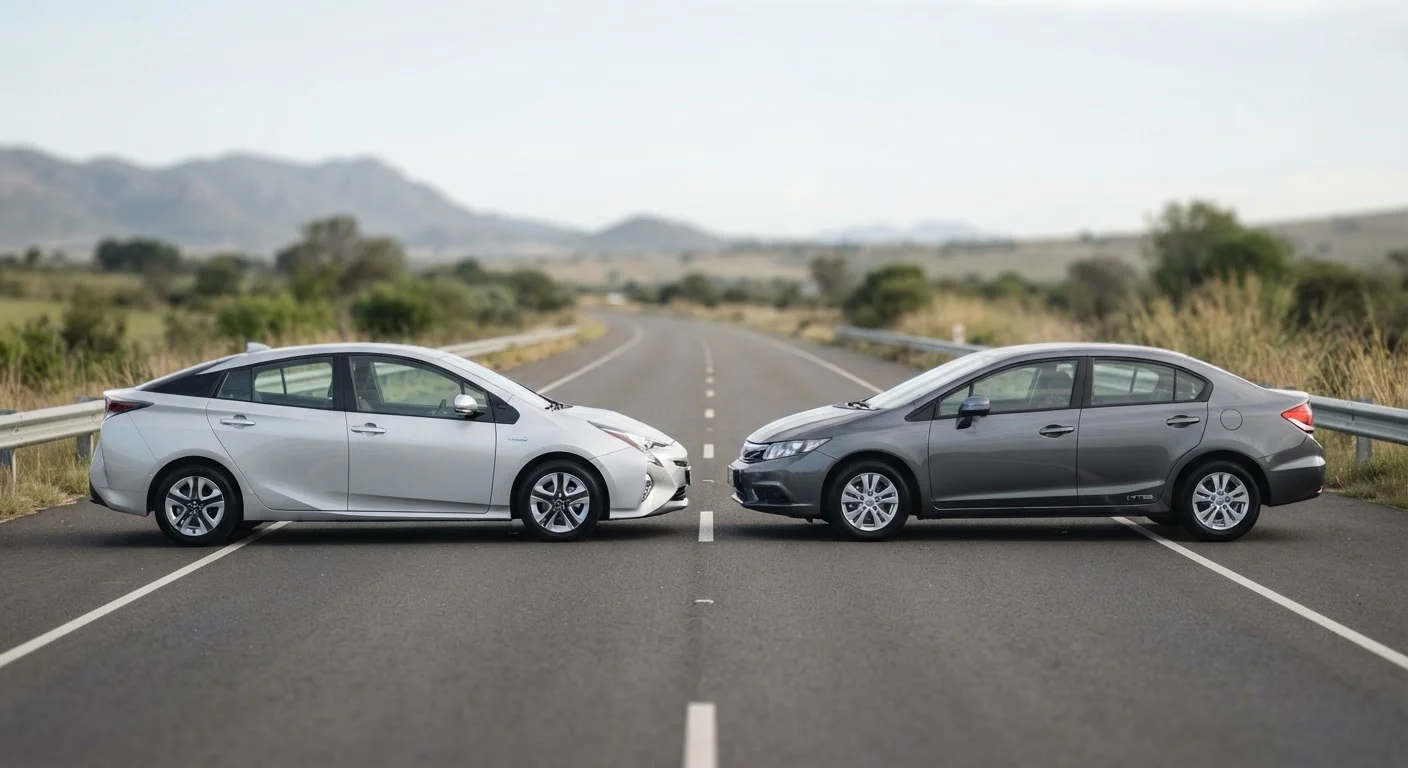

How Each Powertrain Actually Works
Understanding the core mechanical difference between a PHEV and an HEV clarifies every downstream trade-off. For a plain-language breakdown of all electrified powertrain labels, see the hybrid and EV terminology glossary.
A conventional hybrid (HEV) pairs a gasoline engine with a small electric motor and a modest battery pack - typically 1-2 kWh of usable capacity. The system charges itself exclusively through regenerative braking (converting kinetic energy during deceleration into electricity) and by capturing excess engine output. The driver never plugs in. The electric motor assists the engine during acceleration, enables the engine to shut off at low speeds, and improves overall thermal efficiency. Net result: meaningfully better fuel economy than a comparable gasoline-only vehicle, with no behavior change required.
A plug-in hybrid (PHEV) uses a fundamentally larger battery - commonly 8-20 kWh of usable capacity - paired with a more powerful electric motor. That battery can be recharged from an external power source (a standard 120V outlet or a Level 2 240V charger), enabling a genuine electric-only driving mode for a defined range before the gasoline engine engages. When battery charge is depleted, the vehicle operates much like a conventional hybrid, continuing to use regenerative braking to recover incremental charge.
| Criterion | Plug-In Hybrid (PHEV) | Conventional Hybrid (HEV) |
|---|---|---|
| Battery size (usable) | ~8-20 kWh | ~1-2 kWh |
| Electric-only range | ~20-50 miles typical | None (brief low-speed assist only) |
| External charging required | Optional but necessary for EV benefit | Never - self-charging only |
| Typical upfront cost premium | Higher vs. gasoline equivalent | Moderate vs. gasoline equivalent |
| Federal tax credit eligibility (US) | Many models qualify | Generally ineligible |
| Fuel economy (charge-depleted mode) | Similar to or below HEV | Consistently optimized |
| Infrastructure dependency | Charger access improves value | None - gas station only |
| Best driving condition | Short daily trips with regular charging | Mixed or high-mileage driving |
Range, Efficiency, and Real-World Fuel Use
The efficiency calculus for each powertrain diverges sharply depending on how and where the vehicle is driven.
HEVs deliver consistent efficiency gains in virtually all conditions. Stop-and-go urban traffic - where regenerative braking opportunities are frequent - tends to show the largest fuel economy improvements over gasoline alternatives. Highway driving at steady speeds reduces the hybrid system's contribution somewhat, but most modern HEVs still return respectable highway figures. Because the battery is always managed automatically, fuel economy is predictable and consistent.
PHEVs are more nuanced. In charge-depleting mode (operating on stored battery electricity), energy costs per mile can be dramatically lower than gasoline - particularly if the vehicle is charged on off-peak electricity rates. However, once the battery is exhausted and the vehicle enters charge-sustaining mode, efficiency often trails a purpose-built HEV of similar size, because PHEVs carry the added weight of a larger battery without the same optimized hybrid calibration. Drivers who rarely charge their PHEVs effectively operate a heavier, less-efficient car than an equivalent HEV.
~20-50 mi
Typical PHEV electric-only range
EPA all-electric range ratings for PHEVs sold in the US generally fall within this band, varying by battery size and vehicle class.
8-10 yrs
Federal minimum hybrid battery warranty
US federal regulations require automakers to warranty hybrid and PHEV battery systems for at least 8 years or 100,000 miles.
Up to $7,500
Maximum federal PHEV tax credit (US)
Under the Inflation Reduction Act, qualifying PHEVs may be eligible for clean vehicle credits - eligibility depends on vehicle price, battery size, and buyer income limits.
For a structured methodology to evaluate these trade-offs across your specific driving profile, the range, efficiency, and cost comparison framework provides a practical starting point.
Total Cost of Ownership: Upfront Price, Incentives, and Running Costs
Neither powertrain is universally less expensive to own - the math depends on individual usage patterns, local electricity rates, and available incentives.
Purchase price: PHEVs command a notable premium over equivalent HEVs, reflecting the cost of larger battery packs and more complex charging systems. That gap has narrowed somewhat as battery costs have declined, but it remains real.
Incentives: Many PHEVs qualify for the federal clean vehicle tax credit under current US tax law (up to $7,500 depending on vehicle price, buyer income, and battery capacity thresholds). Conventional hybrids generally do not qualify. Eligibility rules are complex and subject to change - consult a qualified tax professional before factoring incentives into a purchase decision.
Running costs: A PHEV driven primarily on electricity can substantially cut per-mile energy costs versus gasoline. An HEV reduces fuel costs more modestly but consistently. Both powertrains typically share similar scheduled maintenance profiles for their gasoline components; the electric drive systems require minimal routine service. Battery longevity remains a legitimate long-term cost variable for both types, though most manufacturers warrant hybrid and PHEV battery packs for 8-10 years or 100,000 miles under federal minimum standards.
Your driving pattern is the deciding variable. The commuter vs. long-distance driver powertrain guide explores how trip length and frequency shift the cost equation.
Charging Access Shapes PHEV Value Significantly
A PHEV's economic case rests on regular charging. Drivers without access to home, workplace, or public charging who rely primarily on gasoline will see fewer fuel savings than the window sticker implies. If charging infrastructure is limited in your area, an HEV's self-sufficient design may deliver more consistent real-world value. Consider your realistic charging access before using electric-range estimates as a decision input.