Why Powertrain Labels Matter
Walk any dealership lot or scan any automotive listing and you'll encounter a thicket of acronyms: MHEV, HEV, PHEV, BEV, FCEV. Each label describes a fundamentally different relationship between an internal-combustion engine, an electric motor, and a battery - and that relationship determines how you refuel, what you pay over time, and how the vehicle performs on your specific routes.
This glossary cuts through the marketing language and defines each term in comparable, apples-to-apples terms. For a broader look at how these powertrains stack up in real-world ownership, see EV vs Hybrid: Which Powertrain Actually Fits Your Driving Life?.
| Mild Hybrid plug required | No |
| Full Hybrid plug required | No |
| PHEV plug required | Yes (optional for operation) |
| BEV plug required | Yes (mandatory) |
| Typical PHEV all-electric range | 20-50 miles (Varies by model; EPA-rated) |
| Common BEV battery warranty | 8 years / 100,000 miles (U.S. federal minimum for EV battery warranty) |
The Four Core Powertrain Types Defined
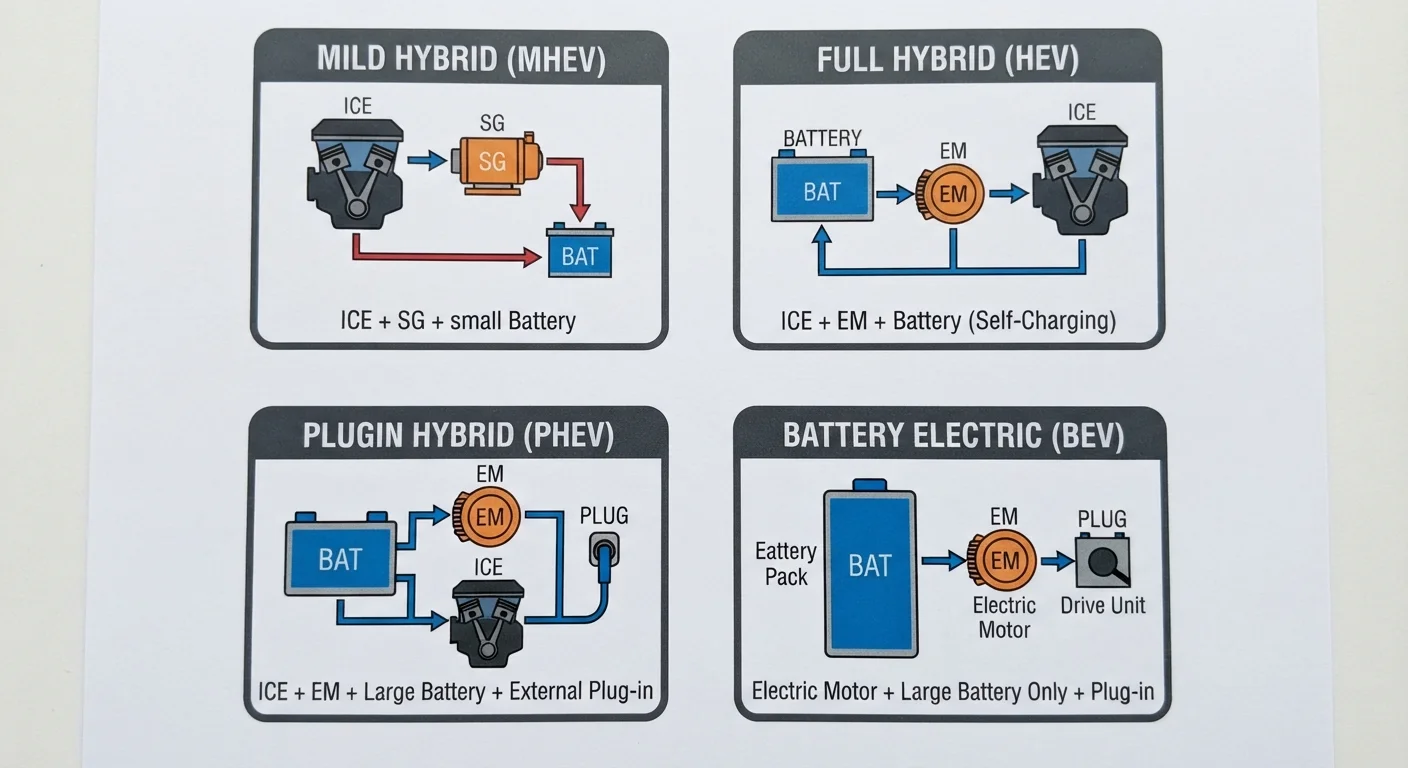
Mild Hybrid (MHEV)
A vehicle with a small electric motor and low-voltage battery (typically 48V) that assists the internal-combustion engine during acceleration and captures energy during deceleration. The electric motor cannot drive the wheels independently - the engine must always be running. The primary benefit is modest fuel-economy improvement with minimal system complexity.
Full Hybrid (HEV)
A vehicle that pairs an internal-combustion engine with a larger electric motor and battery capable of propelling the car at low speeds entirely on electricity. The battery is recharged through regenerative braking and the engine - never from a wall outlet. No external charging is required.
Plug-In Hybrid (PHEV)
A hybrid that adds a larger battery pack charged via an external power source (Level 1 or Level 2 outlet), enabling meaningful all-electric range for daily driving. When that range is depleted, the vehicle operates as a conventional hybrid. PHEVs combine full self-sufficiency for long trips with low running costs for short commutes when charged regularly.
Battery Electric Vehicle (BEV)
A vehicle powered exclusively by one or more electric motors drawing energy from a large onboard battery pack. There is no internal-combustion engine. Range and charging speed are the two critical performance variables; the vehicle must be charged at home or at a public charging station.
Regenerative Braking
A system that converts kinetic energy back into electrical energy when the vehicle decelerates, feeding it back into the battery. It extends range in EVs and hybrids and reduces wear on friction brakes.
All-Electric Range (AER)
The distance a PHEV or BEV can travel on battery power alone before the combustion engine engages (for PHEVs) or before the vehicle requires recharging (for BEVs). AER is typically measured under EPA test cycles.
kWh (Kilowatt-Hour)
The unit used to express battery capacity in electrified vehicles. A higher kWh generally corresponds to greater electric range. It is also the billing unit used by utilities, so local electricity rates directly affect per-mile charging costs.
MPGe (Miles Per Gallon Equivalent)
An EPA efficiency metric that translates the energy content of electricity into gasoline-equivalent terms, allowing BEVs and PHEVs to be compared with conventional fuel-economy ratings on a common scale.
How They Compare on Range and Efficiency
Mild hybrids deliver the smallest efficiency gain - typically 5-15% improvement in fuel economy over a comparable non-hybrid - because the electric motor cannot propel the vehicle independently. Full hybrids improve on that by enabling low-speed electric-only operation, which is especially effective in stop-and-go urban driving where regenerative braking can continuously recapture energy.
PHEVs offer a dual-mode advantage: a usable all-electric range (commonly 20-50 miles depending on the model) that covers most daily commutes without burning fuel, plus a conventional hybrid powertrain for longer trips. Drivers who charge consistently can see dramatically lower fuel costs; those who rarely plug in may find they're carrying battery weight without capturing the benefit. For a clear breakdown of what charging infrastructure looks like in practice, see EV Charging Levels Explained: AC, DC, and What the Numbers Mean.
BEVs eliminate fuel costs entirely for daily driving but require deliberate planning around public fast-charging infrastructure for longer routes. The total-cost calculus depends heavily on local electricity rates, available home charging, and annual mileage. The Electrified Vehicle Landscape: A Comprehensive Introduction for New Shoppers walks through those ownership cost factors in full detail.
5-15%
Mild hybrid fuel economy gain over standard ICE
General industry estimate based on 48V MHEV system efficiency contributions; varies by vehicle and drive cycle.
20-50 mi
Typical PHEV all-electric range
EPA-rated AER across commonly available plug-in hybrid models in the U.S. market.
Total Cost of Ownership: Key Variables by Powertrain
Purchase price is only one dimension. Fuel or electricity costs, scheduled maintenance intervals, battery warranty terms, and potential federal or state incentive eligibility all shift the total-cost picture significantly across powertrain types.
- Mild Hybrid (MHEV): Lowest purchase premium over a conventional vehicle. Maintenance is close to standard ICE intervals. No charging infrastructure required.
- Full Hybrid (HEV): Moderate price premium. Brakes and engine components may last longer due to regenerative braking and reduced engine load. No plug required.
- Plug-In Hybrid (PHEV): Higher upfront cost; may qualify for federal tax credits (eligibility varies by model, MSRP cap, and buyer income - consult a tax professional for your situation). Two fuel sources means two sets of costs to manage.
- Battery Electric (BEV): Typically higher purchase price offset by lower per-mile energy costs and reduced mechanical maintenance (no oil changes, fewer brake replacements). Long-term battery health is a key variable; most manufacturers offer 8-year/100,000-mile battery warranties.
Financing terms also affect the true cost of any electrified vehicle. Understanding how interest rates and loan length interact with a higher sticker price is essential - the Rates & Terms hub covers those mechanics in detail. For questions about specific powertrain components and their service intervals, the Parts Explained hub is a useful companion reference.
Federal Incentive Eligibility Changes Frequently
U.S. federal tax credits for BEVs and PHEVs are subject to income caps, vehicle MSRP limits, and assembly-origin rules that have changed in recent years. Eligibility is not automatic and depends on your individual tax liability. Always verify current rules with a qualified tax professional or the IRS before factoring an incentive into your purchase budget.
This article is for general informational purposes only and does not constitute financial, tax, or legal advice. Incentive eligibility and tax credit rules change; consult a qualified tax professional regarding your specific situation.