
What Lenders Actually Pull When You Apply
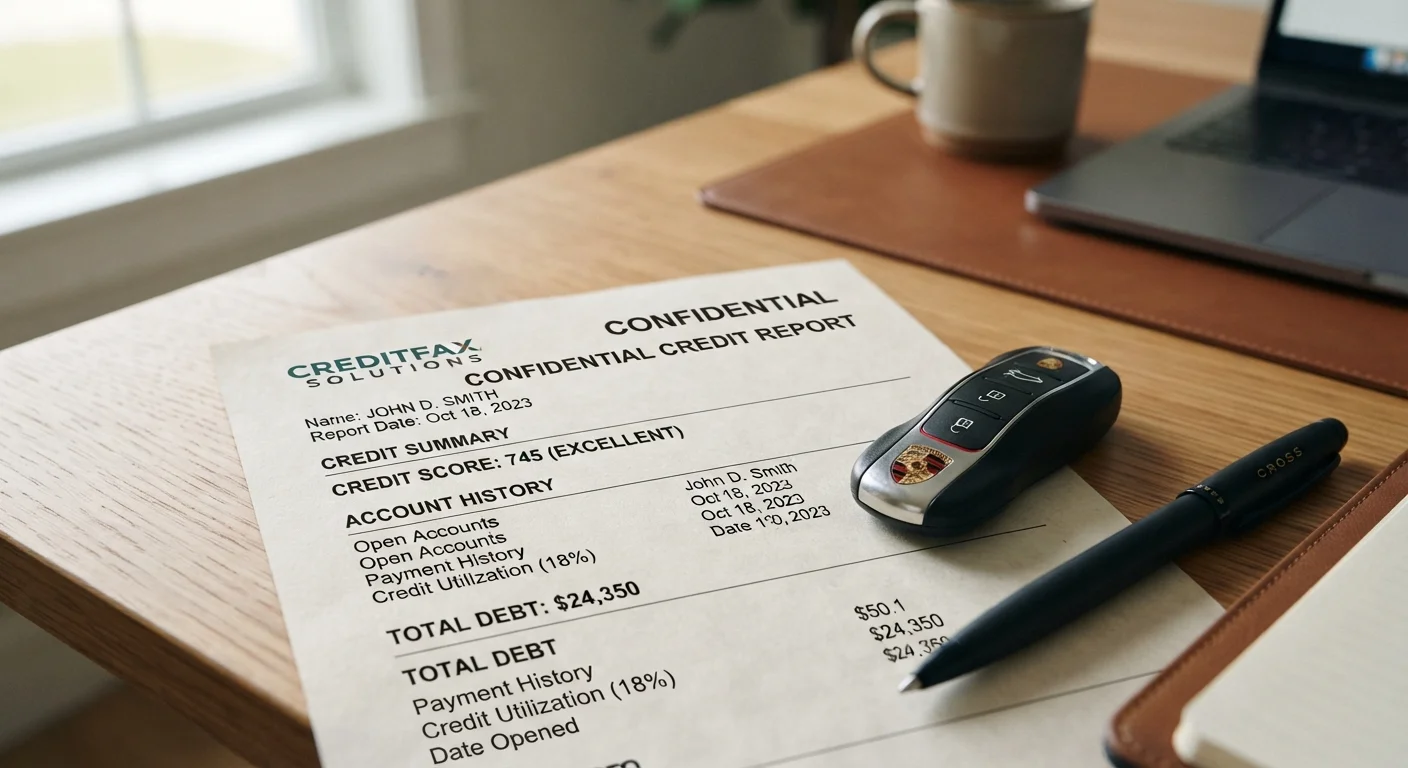
Submitting a car loan application triggers a hard inquiry - the lender requests your full credit report from one or more of the three major bureaus: Equifax, Experian, and TransUnion. The report they receive is a detailed financial profile, not just a score. It lists every open and closed credit account, your payment history on each, current balances, credit limits, derogatory marks, public records, and recent inquiries.
Lenders then apply a scoring model to generate a numeric risk assessment, but experienced underwriters also read the underlying data manually on borderline applications. This means a strong explanatory pattern - such as a single late payment during a documented hardship, followed by two years of clean history - can sometimes influence a decision that a raw score alone would not. For a broader picture of how credit shapes every stage of the financing process, see our comprehensive auto financing guide.
Which Bureau Does Your Lender Use?
Not all lenders pull from the same bureau, and your report can differ slightly across Equifax, Experian, and TransUnion - particularly if a creditor only reports to one or two of the three. Some lenders pull all three; others pull one. It's worth reviewing your reports at all three bureaus before applying, since an error at just one could affect the report your lender happens to pull.
The Five Data Points Lenders Weight Most
Auto lenders prioritize specific elements of your report when assessing risk. Understanding each one clarifies where preparation pays off.
- Payment history: The single largest factor. Any 30-, 60-, or 90-day late payments, charge-offs, repossessions, or accounts sent to collections will draw immediate attention. Recency matters: a late payment from 18 months ago is more damaging than one from five years ago.
- Prior auto loan performance: Because most auto lenders use FICO Auto Score variants, your history with vehicle loans is weighted above other debt types. A repossession, even a voluntary one, is treated as a serious negative.
- Credit utilization: This is the ratio of your revolving balances (primarily credit cards) to your total credit limits. Utilization above 30% can signal financial stress; above 50% raises underwriting concern.
- Length and depth of credit history: Longer account histories and a mix of installment loans alongside revolving credit tend to support stronger scores. Thin credit files - those with few accounts and limited history - present a different challenge than low scores.
- Recent inquiries and new accounts: Several new credit accounts opened in a short period can signal financial strain. For rate-shopping specifics, see our article on hard vs. soft inquiries.
For a deeper breakdown of how each of these factors is calculated, our article on the five factors that shape your credit score walks through the mechanics in detail.
35%
Weight of payment history in FICO scoring
According to FICO's published scoring model breakdown, payment history accounts for the largest single share of a standard FICO score.
30%
Weight of amounts owed (utilization) in FICO scoring
FICO's model documentation identifies credit utilization as the second-largest scoring factor, making balance management critical before applying.
45 days
Rate-shopping window under newer FICO models
FICO Score 8 and later models treat multiple auto loan inquiries within a 45-day window as a single inquiry for scoring purposes.
What the Score Doesn't Capture - And Why It Still Matters
Your credit report score is a snapshot, not the whole story. Lenders layer additional data on top of it: your debt-to-income ratio (calculated from reported debts plus income verified separately), the loan-to-value ratio of the vehicle you're financing (see LTV and why lenders watch it closely), and down payment size.
A borrower with a 700 score and 20% down financing a used vehicle worth well above the loan amount presents a materially different risk profile than a 700-score borrower financing a new vehicle at 110% of its sticker price. The score is the starting point, not the final verdict.
Check for Report Errors Before You Apply
Under the Fair Credit Reporting Act, you're entitled to dispute inaccurate information on your credit report, and bureaus are required to investigate. Common errors include accounts that belong to someone else, incorrect late payment dates, and balances that haven't been updated after payoff. Resolving even one significant error before applying can meaningfully shift your rate tier.
Before applying, it's worth reviewing your own reports for errors - inaccurate derogatory marks or accounts that don't belong to you can unfairly suppress your score. Our credit readiness checklist outlines exactly what to review. And if you've encountered myths about how credit scores work, separating those myths from the facts can help clarify what actually moves the needle.
This article provides general financial information for educational purposes only and does not constitute personalized financial or credit advice. Consult a qualified financial professional regarding your individual circumstances.