Why Eras Matter More Than Models
Ask a seasoned collector why a particular car matters, and the answer almost never starts with a specification sheet. It starts with a moment in American life - a cultural flashpoint that made certain vehicles feel significant enough to save. The hobby of classic car collecting is, at its core, an act of historical curation, and the eras that shaped the market are as important to understand as the machines themselves.
This isn't merely about nostalgia. Auction results consistently demonstrate that vehicles tied to culturally resonant periods command premiums over technically similar but contextually unremarkable counterparts. Understanding why a specific era shifted what Americans collected helps enthusiasts read the market intelligently and appreciate what they're actually stewarding. For a comprehensive look at what classic ownership involves across all dimensions, see The Full Spectrum of Classic Car Ownership.
The Postwar Chrome Era (1948-1957)
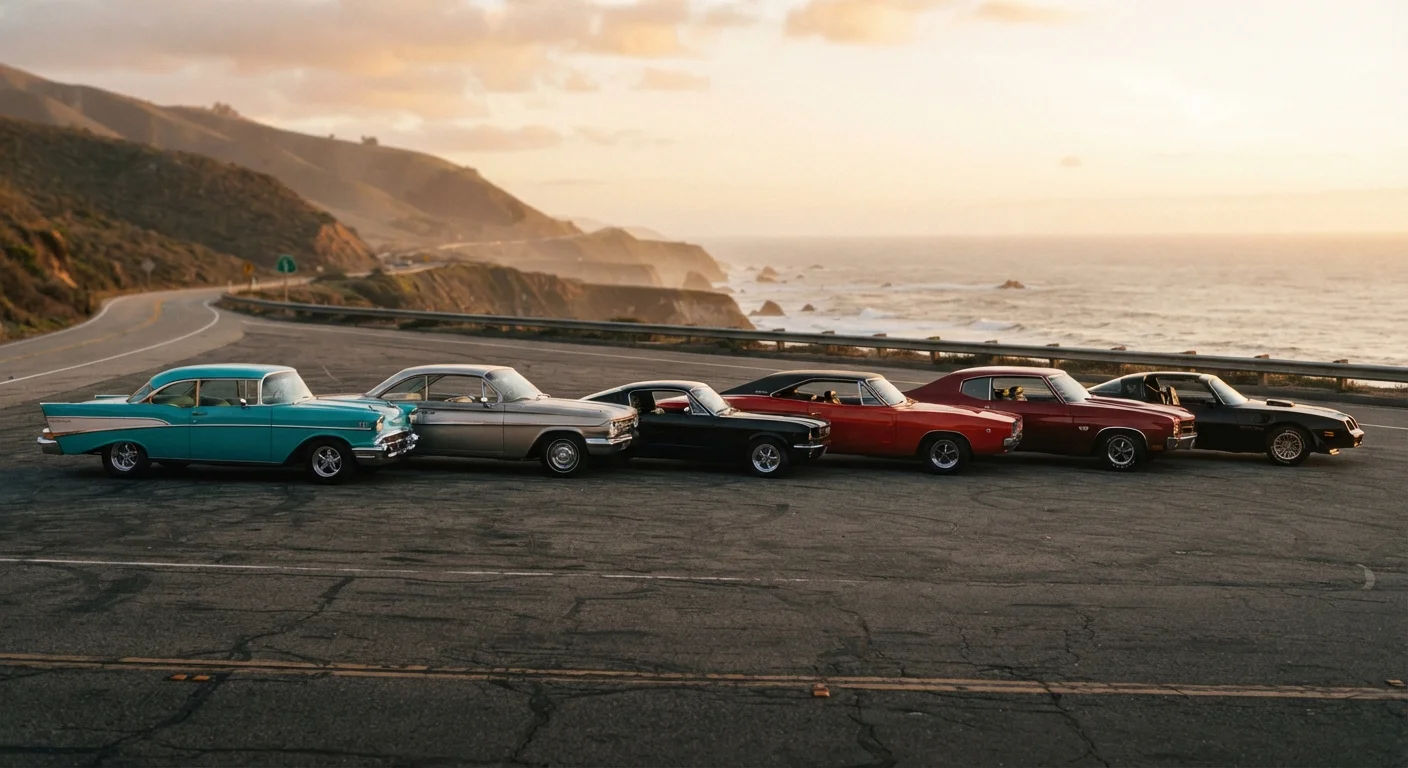
American manufacturing emerged from World War II with immense industrial capacity and a civilian market hungry for expression. The vehicles of this period - exuberant, chrome-laden, and deliberately theatrical - became the first objects of systematic collector reverence. Tri-Five Chevrolets, early Fords, and the first generation of Chrysler's forward-look styling weren't just transportation; they were declarations of postwar confidence. Their desirability in the collector market traces directly to that emotional weight.
Postwar chrome wasn't excess - it was a cultural exhale after years of wartime scarcity.
The Sports Car Awakening (1953-1962)
Returning GIs exposed to European sports cars - MGs, Jaguars, Alfa Romeos - created an appetite that Detroit scrambled to address. The early Corvette, the Thunderbird's two-seat original, and the emergence of dedicated sports car racing culture fundamentally expanded what Americans considered collectible beyond domestic full-size iron. This era also legitimized the idea that driving engagement, not just presence, was worth preserving. For context on pre-modern vehicle categories that preceded this shift, see early motoring's forgotten vehicle classes.
The sports car awakening proved Americans would collect for driving experience, not just visual drama.
The Muscle Car Decade (1964-1971)
No single era has shaped the American collector market more profoundly than the high-compression years bracketed roughly by the GTO's introduction and the emissions-driven detuning of the early 1970s. Big-block engines, youth marketing, and street racing culture converged to produce vehicles that felt genuinely consequential to the teenagers who coveted them - and those teenagers became the collectors who drove auction values to historic highs decades later. For a detailed cultural map of this period, the American Muscle Car Era timeline is essential reading.
The muscle era created the collector market's most durable demand - fueled by generational memory.
The Pony Car Phenomenon (1964-1973)
Distinct from pure muscle, the pony car segment - defined by the Mustang's April 1964 introduction and the competitors it spawned - democratized performance imagery. These were vehicles a secretary or a student could reasonably purchase new, which meant the nostalgia pool attached to them is extraordinarily broad. The Camaro, Firebird, Barracuda, and Javelin each cultivated devoted communities whose documentation efforts have preserved more chassis-level data than nearly any other segment.
Pony cars democratized performance, giving the collector market its widest nostalgia base.
The Malaise Era Reassessment (1973-1983)
For decades, the emissions-strangled, bumper-impacted vehicles of the mid-1970s were dismissed as collector footnotes. That consensus has shifted. A younger generation of enthusiasts - those who grew up riding in Malaise-era station wagons and personal luxury coupes - has begun engaging seriously with these vehicles on their own terms. The cultural reassessment is incomplete but real, and it illustrates a reliable pattern: each generation eventually finds value in the machines it knew firsthand.
Every dismissed era eventually finds its collectors - the Malaise years are no exception.
The Fox-Body and Emissions-Recovery Era (1979-1993)
The Fox-platform Mustang, third-generation Camaro and Firebird, and the turbocharged experiments from Dodge and Buick represent an era when American performance engineering recovered its ambition under new constraints. These vehicles are now firmly within the collector market's orbit, with documented low-mileage survivors attracting serious attention. The era also produced a generation of enthusiasts who learned to modify and tune - skills that created the foundation for today's restomod culture.
The Fox-body era forged a generation of hands-on modifiers who now drive the restomod movement.
The Modern Heritage Era (1990s-Present)
The collector market's boundaries continue to expand toward the present. Vehicles like the last air-cooled Porsche 911s, early Dodge Vipers, and first-generation NSXs - along with significant American trucks and SUVs of the 1990s - are transitioning from used cars to recognized collectibles. This era also introduced the internet as an organizing tool for enthusiast communities, fundamentally changing how provenance is documented and how collectors find one another. The Specialty & Niche Vehicles category increasingly reflects these newer-era entrants.
The 1990s generation of collectibles is arriving - and internet-era documentation is changing how provenance works.
The Living Legacy of Collector Culture
These seven eras don't exist in isolation - each one built the audience, the infrastructure, and the institutional knowledge that the next generation inherited. The regional club scene that sustains the hobby today was largely founded by enthusiasts shaped by the postwar and muscle eras, and it continues to evolve as younger collectors bring 1980s and 1990s vehicles into serious consideration.
What makes the American collector car community distinctive is its willingness to argue passionately about which eras produced the vehicles worth preserving - and then organize, document, and advocate for those choices. Collector registries and marque archives do the unglamorous but essential work of ensuring era-specific knowledge survives the generations. The eras may be closed chapters, but their influence on what Americans choose to collect remains very much an open story.
Track Era Context Before Valuing a Vehicle
When evaluating any potential acquisition, research the cultural moment that produced it - not just the mechanical specifications. A vehicle with strong era-specific documentation (original sales materials, period road tests, competition records) often carries greater long-term collector interest than a technically superior but historically undocumented counterpart. Auction catalogs from major houses are a useful, publicly available resource for understanding how era context is currently being priced by serious buyers.