
Why External Storage Makes Sense for Road Trips
When the trunk is full and the back seat is already occupied, external storage is the most practical way to expand capacity without upgrading vehicles. Unlike cabin storage accessories - see our guide on cabin storage accessories - external systems move bulk items completely outside the passenger compartment, freeing interior space for people and everyday-access items.
The three main categories - roof racks, cargo boxes, and hitch carriers - each mount differently, carry different load types effectively, and impose different trade-offs on driving dynamics and fuel consumption. Understanding those differences before you commit prevents expensive mismatches.
One universal rule: always verify your vehicle's roof load rating (found in the owner's manual) and receiver hitch class before sizing any external system. Exceeding published limits affects both safety and warranty coverage.
Roof Racks: Modular and Versatile
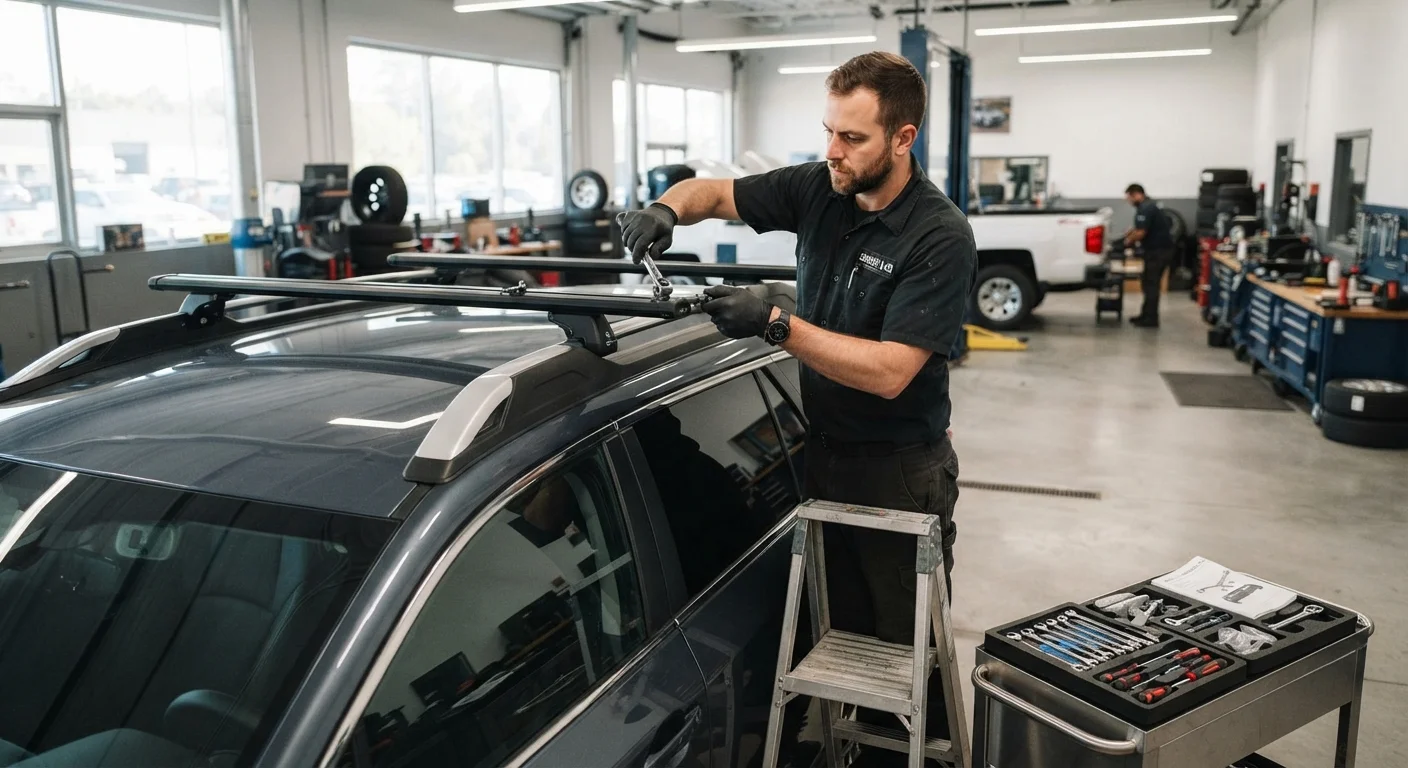
A roof rack is the foundation system for nearly every other roof-mounted accessory. Crossbars mount to factory raised rails, flush rails, or directly to roof gutters depending on vehicle design, then accept specialized carriers for bikes, kayaks, skis, and cargo boxes.
The key advantage is modularity - the same set of crossbars can support different accessory configurations across multiple trips. The trade-offs are real, however. Mounting gear on the roof raises the vehicle's center of gravity, which becomes noticeable in sharp corners and crosswinds, particularly with taller or heavier loads. Aerodynamic drag increases substantially even with an empty rack, contributing to reduced fuel efficiency at highway speeds.
Mark Your Height Before You Forget
Once a cargo box is mounted, note the new total vehicle height on a sticky note attached to your sun visor. Many drivers misjudge clearance in parking structures or at drive-throughs after loading a box. A quick measurement at home prevents a costly collision. Retractable tape measures that clip to a keychain make spot-checking fast and easy.
Roof racks also introduce a height consideration that many drivers underestimate. Parking garages, drive-throughs, and low-clearance bridges all become hazards once a rack and load add 6-12 inches to your roofline. Some drivers affix a reminder tag on the steering wheel or sun visor when the rack is loaded.
For those also planning to carry bikes, our breakdown of roof and hitch bike rack trade-offs covers load ratings and fit in more detail.
Cargo Boxes: Weather Protection and Volume
A hardshell cargo box mounts onto crossbars and provides a lockable, weatherproof enclosure - the most practical solution for soft goods like sleeping bags, clothing, and camping gear that shouldn't get wet or dirty. Boxes range widely in volume (typically 8 to 22 cubic feet) and in profile, with low-profile designs partially offsetting the aerodynamic penalty.
The downsides mirror the roof rack category but are amplified: a loaded cargo box can add 100-200 lbs to the roof, and combined height increases of 12-18 inches are common. Roof load limits become critical here - a vehicle rated for 150 lbs on the roof cannot safely accept a heavy box fully loaded. Weight must be distributed front-to-back across the crossbars according to the box manufacturer's instructions.
| Roof Rack | Cargo Box | Hitch Carrier | |
|---|---|---|---|
| Typical weight capacity | Varies by vehicle (often 100-165 lbs) | Limited by roof rating (100-165 lbs) | 300-500 lbs (hitch class dependent) |
| Weather protection | None (open rack) | High - lockable hardshell enclosure | Low - open platform, exposed to elements |
| Fuel economy impact | Moderate (empty rack still adds drag) | Highest - significant aerodynamic penalty | Lower than roof at speed |
| Height clearance concern | Moderate (crossbars add some height) | High - adds 12-18 inches to roofline | None - load stays at bumper height |
| Load accessibility | Requires reaching overhead | Requires overhead lid access | Easy - waist-height loading |
| Compatibility with towing | Compatible | Compatible | Occupies receiver - no simultaneous towing |
| Modular accessory options | High - accepts many add-on carriers | Low - single-purpose enclosure | Moderate - baskets, bags, ramp options |
Cargo boxes also require reasonable overhead clearance to open the lid, which can be awkward in tight campsites. Dual-sided opening designs help, but they add cost. For a contrasting perspective on how cargo boxes stack up against bed extenders for truck owners specifically, see roof racks, cargo boxes, and bed extenders compared.
Hitch Cargo Carriers: Low and Accessible
A hitch cargo carrier is a platform or basket that slides into a Class II or Class III receiver hitch and is secured with a pin and clip. Because the load sits behind the vehicle at bumper height rather than on the roof, center of gravity remains low and loading or unloading doesn't require reaching overhead.
Platform carriers are typically rated for 300-500 lbs depending on hitch class, making them capable of handling heavier, denser gear that would exceed roof limits. Folding designs allow the platform to drop down when not in use, reducing the vehicle's effective length for parking.
Hitch Carriers and Rear Camera Obstruction
A loaded hitch cargo platform can partially or fully block your rear-view camera and reduce visibility through the rear window. Before a trip, check that your reverse camera still provides a usable image with the carrier loaded. Supplement with extended towing mirrors if blind spots are significant, and consider a hitch-mounted camera extender if available for your vehicle.
From a fuel-economy standpoint, hitch carriers impose less drag than a loaded roof system at highway speeds, though they do increase the vehicle's overall length - a factor worth considering in tight parking lots or when backing up. Rear visibility is another real limitation: a loaded platform can obstruct the rear camera and prevent the hatch from opening fully, so check clearance before loading.
One important restriction: a hitch carrier occupies the receiver, meaning you cannot simultaneously tow a trailer or use a hitch-mount bike rack. If you plan to carry bikes as well, the hitch vs. roof bike rack comparison is worth reviewing to plan your setup holistically.
Fuel Economy Impact Across All Three Systems
All external storage adds aerodynamic drag, but the magnitude varies by system, load, and vehicle shape. Broadly, roof-mounted systems - especially tall cargo boxes - create the largest fuel economy penalty at highway speeds because they interrupt airflow over the roofline. Studies from automotive research organizations have documented roof box drag penalties ranging from roughly 10% to over 25% in fuel consumption depending on vehicle type, speed, and box dimensions, though exact figures vary widely by vehicle and product.
~10-25%
Fuel economy reduction with roof cargo box
Automotive aerodynamics research suggests rooftop cargo boxes can reduce fuel efficiency by roughly 10-25% at highway speeds, depending on box size and vehicle shape.
300-500 lbs
Typical hitch carrier weight rating
Class III hitch receivers generally support hitch cargo carriers rated up to 500 lbs, far exceeding most vehicles' roof load limits.
Hitch carriers generally impose a smaller drag penalty because the load sits in the vehicle's aerodynamic shadow rather than above it, though this advantage diminishes as the platform is loaded with bulky items that extend beyond the vehicle's width.
Practical mitigation: remove racks and carriers when not in use rather than leaving them mounted year-round. An empty roof rack still generates meaningful drag. Pairing smart external storage choices with thoughtful packing - see common boot-packing mistakes for load distribution principles - helps keep total trip costs reasonable.