Why Cabin Organisation Deserves More Than an Afterthought
A disorganised cabin isn't just annoying - loose items shifting under braking, rattling charger cables, and buried-under-junk cup holders are genuine quality-of-life issues on daily drives and long hauls alike. The right storage accessories address these problems without requiring any permanent modifications or significant cost, but picking the wrong ones wastes money and adds clutter rather than reducing it.
The core principle is simple: identify where your specific problem zones are before shopping. A solo commuter in a compact car has entirely different storage needs than a family running errands in a three-row SUV, or a truck owner using the cab for work gear. Vehicle layout matters too - a full-size pickup with a rear bench has very different anchor points and dimensions than a crossover or a hatchback.
For vehicles where cargo space beyond the cabin is also a consideration, the external storage options guide is worth reading alongside this one.
Centre Console Organisers
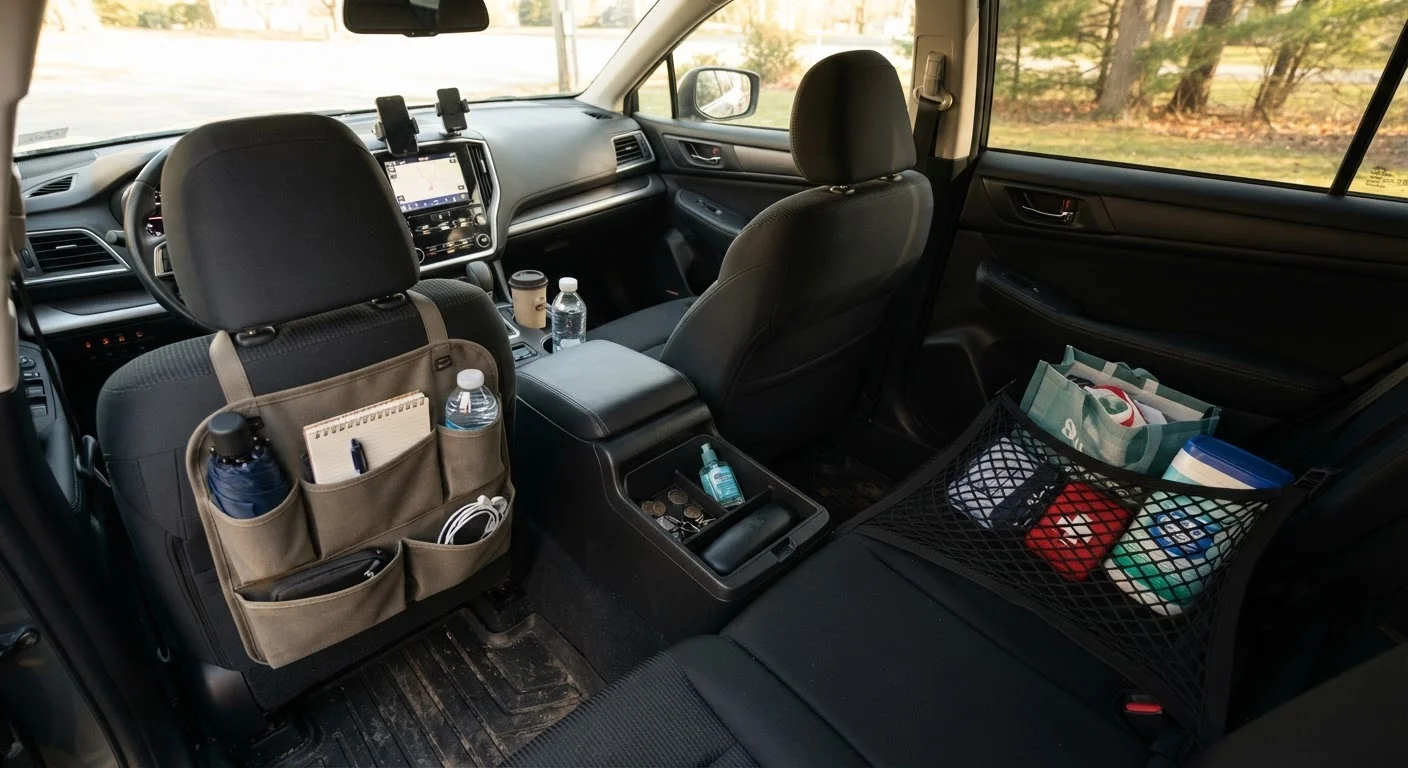
The centre console is the most-reached-for storage zone in most vehicles, and it's usually the first to become a jumble of receipts, chargers, and spare change. A well-fitted console organiser - typically a tray or divider insert that drops into the existing bin - creates dedicated slots for the items you actually reach for: phone, cards, keys, a charging cable.
Fit is everything here. Many organisers are sold as universal, but console dimensions vary significantly between vehicle lines. Measure your console's interior depth and footprint before purchasing. Organiser inserts designed for specific platforms (e.g. full-size truck consoles) generally offer better use of space than generic alternatives.
A console organiser only works if it's dimensioned for your specific vehicle, not just 'universal'.
Seat-Back Organisers and Pockets
Hanging storage attached to the back of front seats is one of the most practical accessories for rear passengers, particularly on longer drives. These pockets typically hold tablets, water bottles, snacks, wipes, and similar items that would otherwise end up on the seat or floor.
Look for organisers with reinforced mounting straps - thin elastic loops lose tension over time and let the whole unit sag. Also consider depth: very deep pockets make items hard to retrieve and can press uncomfortably into front passengers' backs depending on seat travel. Shallow, compartmentalised designs tend to be more functional in practice.
Deep, single-pocket designs look spacious but often make items harder to find and retrieve quickly.
Cargo Nets and Trunk Organisers
In SUVs and hatchbacks, the cargo area is a common catch-all that becomes a sliding hazard at speed. A cargo net tensioned across the width of the load floor keeps bags, groceries, and loose gear from migrating forward under braking. Many vehicles include factory anchor points specifically for this purpose - check your owner's manual before assuming none exist.
Rigid cargo organisers (collapsible cubes or compartmented bins) go a step further by physically separating categories of gear. These work especially well for repetitive loads - a recurring set of tools, sports equipment, or emergency supplies - where you want items in the same place every time. Collapsible versions stow flat when not needed, which preserves usable cargo space.
Factory anchor points for cargo nets are often overlooked - check your owner's manual before buying new hardware.
Truck Cab and Bed-Side Storage
Truck owners face a distinct challenge: the cab often doubles as a mobile office or job-site gear room. Under-seat storage systems designed for extended or crew cabs can dramatically expand usable space by converting the under-rear-seat area - often wasted - into an organised compartment for tools, first-aid kits, or recovery gear.
For the bed, soft roll-up tool bags or hard-sided organiser cases that mount to the truck's bed rails keep frequently accessed items separated from loose cargo. These are particularly useful when the bed is shared between work gear and recreational equipment. For a broader look at truck cargo solutions, the hauling gear guide covers bed extenders and rack-mounted options in detail.
Under-rear-seat storage systems convert often-wasted truck cab space into a dedicated, organised compartment.
Visor and A-Pillar Organisers
Sun visor organisers are a niche product, but they address a real problem: documents like registration, insurance cards, and garage passes that need to be accessible but shouldn't occupy console or glove box space. A slim visor pocket keeps these items flat, protected, and within arm's reach without adding bulk to the dashboard area.
Some drivers also use small magnetic or clip-mount trays attached near the A-pillar or dash edge for coins, a parking fob, or a small notepad. These work best in vehicles where dashboard real estate is limited. The trade-off is that any item mounted at eye level or in the forward field of vision needs to be positioned carefully to avoid becoming a visual distraction while driving.
Visor organisers keep critical documents accessible without consuming console or glove box space.
Modular and Magnetic Dash Trays
Small adhesive or weighted trays placed on flat dashboard surfaces are a low-commitment way to corral items that typically end up scattered - a key fob, a garage pass, a chapstick. Magnetic variants hold metal items securely even on rough roads, while silicone non-slip trays work for lightweight items on vehicles with relatively flat dash surfaces.
The main caveat: not every dashboard has a suitable flat zone, and some surfaces - particularly curved, textured, or soft-touch finishes - don't bond well with adhesive trays. Test fitment before committing, and prefer weighted or non-adhesive options where possible to avoid finish damage on removal.
Weighted or non-adhesive tray options help avoid permanent finish damage on textured or soft-touch dashboards.
Getting the Most from Your Chosen Accessories
No accessory solves a disorganisation habit - it just gives clutter a designated home. The most effective cabin setups combine a small number of well-chosen pieces rather than filling every gap with a product. As a rule, if an accessory requires you to move it out of the way to use the thing it was meant to organise, it's working against you.
Start with a cabin audit before buying
Before purchasing any storage accessory, spend ten minutes cataloguing exactly what you carry daily and where it currently ends up. Most cabin clutter problems come down to two or three specific failure points - a junk-drawer console, a cluttered rear floor, or an overloaded cup holder. Targeting those specific zones with one or two well-chosen accessories beats buying a broad assortment that partially addresses everything and fully solves nothing.
If you regularly carry passengers, especially children or pets, layering seat-back organisers with a cargo net in the rear can handle most of the load. The multi-day drive comfort guide and the pet travel safety guide both address how storage choices interact with passenger comfort and safety.
For SUV owners weighing broader accessory decisions, this breakdown of SUV accessories helps separate high-impact purchases from low-utility ones - a useful sanity check before adding more gear to your cart.