Why a Recovery Kit Is Non-Negotiable
Roadside assistance plans are built for paved roads. Once you leave the tarmac, the calculus changes entirely. As our overview of what roadside assistance actually covers makes clear, most plans exclude unpaved terrain - meaning a stuck vehicle on a fire road or a wash is entirely your problem to solve.
That reality makes a recovery kit one of the highest-value investments an off-road enthusiast can carry. The goal isn't to prepare for every conceivable disaster; it's to handle the four or five situations that actually happen with regularity: getting stuck in mud or sand, a flat on a rough surface, loss of tire pressure, or a trail that demands more ground clearance than you currently have.
Know Your Vehicle's Rated Recovery Points
Not every hook, ring, or loop on a vehicle is rated for recovery loads. Using unrated points during a kinetic pull can rip them free, damaging the vehicle and creating a dangerous projectile. Consult your owner's manual or the vehicle manufacturer's documentation to identify which attachment points are rated for recovery use before you need them on the trail.
Understanding the variables that shape off-road capability - approach angles, suspension travel, and locking differentials - will help you anticipate where your specific vehicle is likely to struggle and prioritise your kit accordingly.
Recovery Straps and Shackles
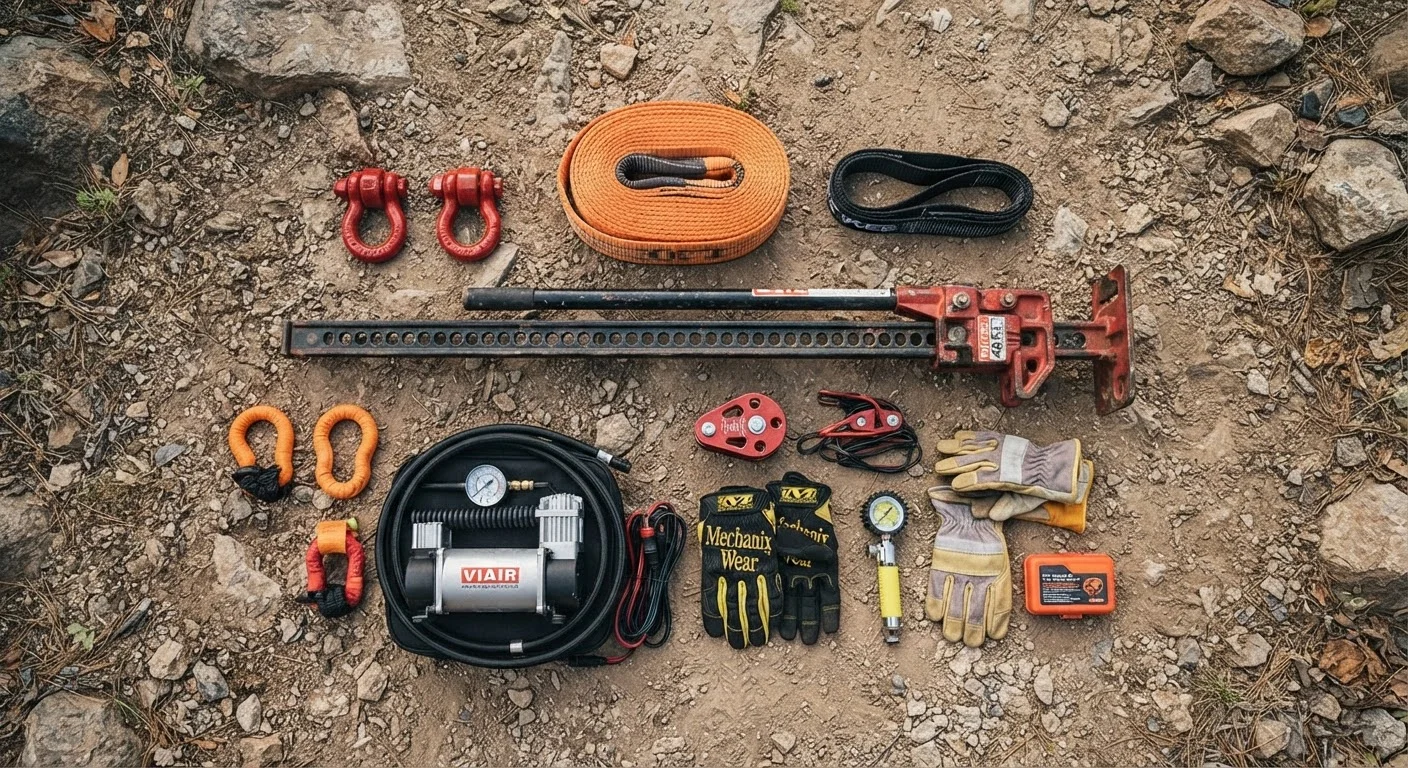
The distinction between a tow strap and a kinetic recovery strap (sometimes called a snatch strap) is critical and frequently misunderstood. Tow straps are designed for moving a vehicle that can roll freely; they have little to no stretch. Kinetic straps are built from nylon webbing that stretches under load, storing energy that is then released to "snatch" a stuck vehicle free. Using a rigid tow strap for a kinetic recovery risks snapping the strap or causing a sudden jolt that damages attachment points.
Shackles - the D-ring or bow-type connectors that link straps to recovery points - must be rated for the weight they'll handle. Soft shackles made from synthetic rope are increasingly popular because they don't become dangerous projectiles if they fail under load. Always recover to manufacturer-rated tow hooks or recovery points, never to a trailer hitch ball or bumper frame rails not designed for lateral loads.
Always attach recovery straps to rated recovery points - not tow balls, bumper edges, or axle housings. A failed attachment under kinetic load can cause serious injury.
Kinetic straps store significant energy during a snatch recovery. Weak or improper anchor points are the most common source of equipment failure and injury in amateur recoveries.
Lay a heavy blanket or recovery damper over the middle of your kinetic strap before pulling. If the strap breaks, it dramatically reduces how far the ends travel.
This is a standard safety practice in organized off-road recovery; the added mass absorbs kinetic energy and limits the "whip" of a snapped strap.
Hi-Lift Jacks and Portable Air Compressors
A hi-lift jack (also called a farm jack) can lift a vehicle significantly higher than a standard scissor or bottle jack, making it useful for freeing a tire that has sunk into soft ground or for winching a vehicle a short distance when used with a strap. However, hi-lift jacks are inherently unstable on uneven or soft surfaces. A base plate - a wide platform that distributes load - is an essential companion item, not an optional add-on. Practice operating the jack at home before you need it on the trail.
A portable 12V air compressor addresses one of the most common off-road strategies: airing down tires to increase the footprint and improve traction on loose surfaces. The compressor lets you reinflate to street pressures before returning to pavement, which is important for handling and tire longevity. Look for units rated to inflate a full-size truck tire in a reasonable time; underpowered compressors can overheat before the job is done.
~30 PSI
Typical street tire pressure before airing down
Many off-road guides suggest airing down to 15-20 PSI on loose surfaces, requiring a compressor to reinflate before returning to pavement.
3-5 min
Target reinflation time per tire for capable compressors
Compressors that take significantly longer risk overheating before completing a full reinflation on a large-format truck or SUV tire.
Traction Boards and Shovels
Traction boards (rigid, textured platforms placed under a spinning tire) allow a single driver to self-recover from sand, mud, or snow without needing a second vehicle. They're reusable, compact enough to strap to a roof rack or bed, and work in scenarios where a kinetic strap has no anchor point. The right roof rack or bed organisation system can make carrying them straightforward without sacrificing interior space.
A folding or collapsible shovel is a low-cost, high-return item. Digging out around a buried tire - clearing the leading edge and creating a ramp - is often the difference between a traction board working and spinning uselessly. A flat-bladed shovel moves more material per stroke than a pointed one in most off-road scenarios.
Test Your Traction Boards Before You Need Them
Practice deploying traction boards in your driveway or a parking lot before heading out. Knowing exactly how to position them under a spinning tire - and how to retrieve them afterward - saves critical time and frustration when you're actually stuck. It also confirms they fit under your vehicle's clearance.
Communication and Navigation Gear
Cell coverage is unreliable across large portions of public land, national forests, and backcountry routes. Two categories of gear fill that gap. Two-way radios (FRS/GMRS) enable communication within a group of vehicles traveling together - valuable for coordinating recoveries or warning the vehicle behind you of a trail hazard. GMRS radios require an FCC license in the US, which covers the licensee's immediate family.
Satellite messengers go further: they allow two-way text communication and, critically, SOS signaling to emergency services from virtually anywhere on Earth. They require a subscription plan but provide a safety net that no radio can match when you're traveling solo or far from populated areas. Download offline maps for your route before departure - a screen showing your cached trail position is far more reliable than hoping for a data signal at a critical junction.
For a broader look at gear that complements trail preparedness, the Road Trip Essentials hub covers additional tools worth considering for extended off-pavement travel.
Packing, Organising, and Knowing Your Limits
A recovery kit that takes ten minutes to unload is a kit that won't get used efficiently under pressure. Consistent packing - same location, same order - means any member of your group can locate gear quickly. Waterproof bags or a dedicated recovery bag keep straps and shackles from becoming a tangled mess. Heavy items like the hi-lift jack should be secured so they don't shift during the approach to the trail.
Weight matters on a vehicle already working hard. Carry what you've trained to use; an unfamiliar piece of gear can create a second problem. If you're new to the aftermarket and recovery gear world, our guide to where enthusiasts usually start with aftermarket accessories provides useful context for building out your setup incrementally.
Finally, a recovery kit does not make any terrain safe - it reduces the consequences of a miscalculation. Traveling with at least one other vehicle, filing a trip plan with someone off-trail, and turning back when conditions exceed your vehicle's capability are habits that no amount of gear can replace.
GMRS Licensing in the United States
General Mobile Radio Service (GMRS) radios require an FCC license to operate legally in the US. As of the current FCC rules, a single license covers the licensee and their immediate family members for ten years. The application process is straightforward and handled through the FCC's online licensing system.
This article is for general informational and educational purposes only. Off-road driving involves inherent risks. Always follow applicable regulations, use recovery gear according to manufacturer instructions, and consult qualified professionals for vehicle modifications or repairs.