Geometry First: Clearance and Angles
The most straightforward off-road variables are geometric - they describe how a vehicle's shape interacts with terrain features before the drivetrain is even engaged.
Ground clearance is measured from the lowest fixed component (often a differential housing or frame rail) to the ground. More clearance means more margin before rocks, ruts, or crests contact the undercarriage. What this figure cannot capture is where along the vehicle's length that clearance is lowest, which is why angles matter equally.
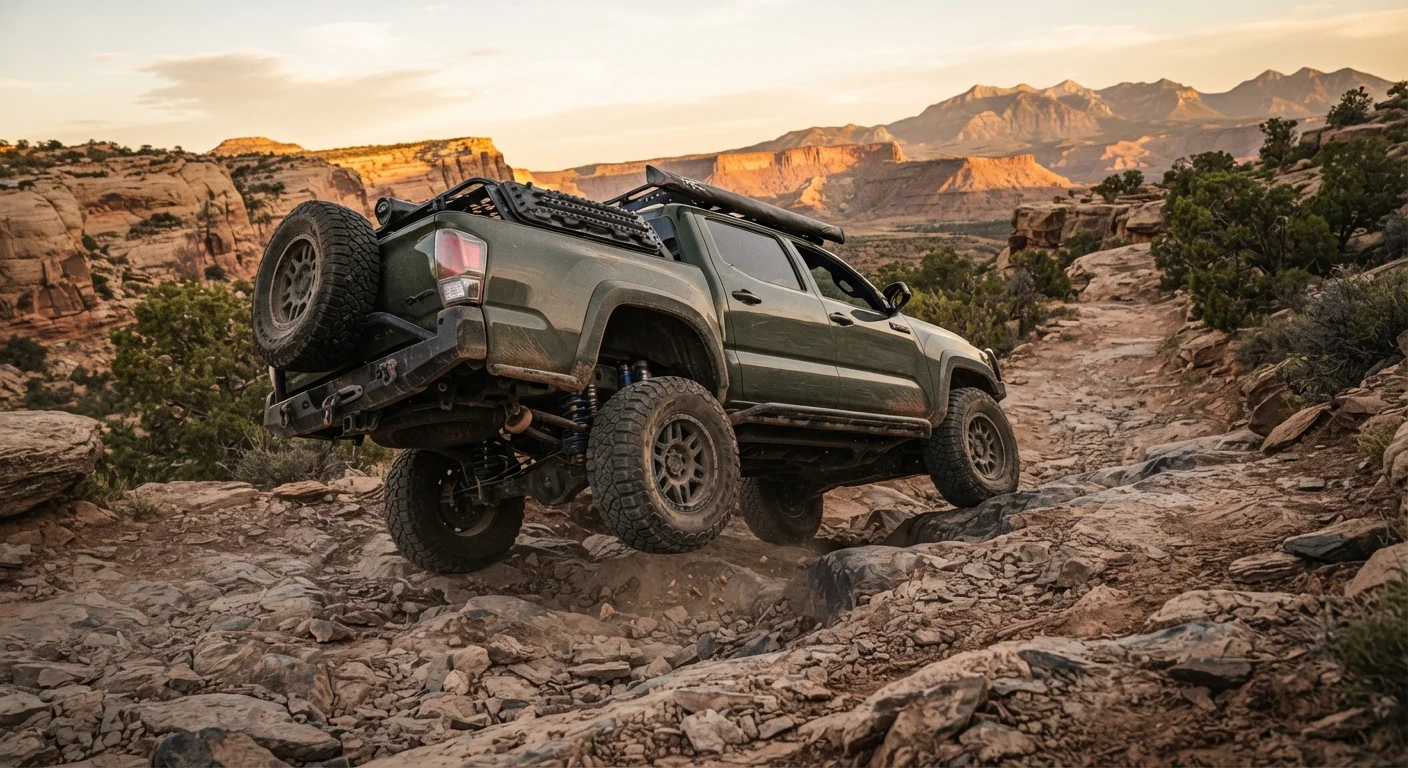
Approach angle is the steepest incline a vehicle can climb from a flat surface without the front bumper or fascia making contact. A shallow approach angle - typical on vehicles with long front overhangs - creates an early collision point before the wheels engage the slope. Departure angle is the equivalent measurement at the rear. A long bed or rear overhang clips terrain on the way down.
Breakover angle describes how sharp a crest the vehicle can pass over without high-centering - the condition where the underside contacts the apex and drive wheels lose ground contact. This angle is directly constrained by wheelbase: longer wheelbases produce shallower breakover angles. It is one reason short-wheelbase vehicles have historically dominated extreme rock-crawling.
These three angles, combined with ground clearance, define the geometric envelope of a vehicle's off-road capability before any mechanical factor is considered. See which specs carry real weight beyond the geometry alone.
Suspension Travel and Axle Articulation
Geometry tells you what terrain a vehicle can enter. Suspension travel determines whether it can maintain traction while navigating it.
Suspension travel is the total distance a wheel can move vertically - both in compression and extension - before reaching the limits of its travel range. On uneven terrain, high suspension travel allows wheels to stay in contact with the ground even as the chassis pitches and rolls significantly. When a wheel loses ground contact, the torque delivered to it becomes useless; any other wheel sharing that axle receives reduced torque as a result (in an open differential configuration).
Axle articulation - sometimes measured as a RAMP score in degrees - is the practical expression of suspension travel: how much the axles can twist relative to each other on irregular surfaces. Solid axle designs, common on traditional body-on-frame trucks and SUVs, generally articulate more freely than independent suspension setups. Independent suspension offers superior on-road handling and comfort but can constrain articulation travel.
Check the Actual Package Contents
Off-road trim names vary widely in what they deliver. Before attributing capability to a badge or package name, review the specific hardware list: skid plate coverage, differential type, suspension tune, and tire rating are the variables that determine real-world performance. A trim labeled 'Trail' or 'Adventure' may or may not include a locking differential - verify before comparing.
For readers interested in how chassis architecture affects both articulation and towing capacity, the body-on-frame vs. unibody breakdown covers the engineering trade-offs in detail.
Traction Management: Differentials and Drive Systems
Suspension keeps tires planted; differentials and drive systems determine where power goes once they are.
A standard open differential splits torque evenly in theory but sends power along the path of least resistance in practice - meaning a wheel with no grip receives torque while the wheel with grip gets little. Limited-slip differentials (LSD) use clutch packs or gear mechanisms to partially resist this bias, improving traction without full lockup. Locking differentials eliminate the bias entirely, forcing both wheels on an axle to turn at the same rate regardless of surface conditions. They are the most effective traction tool in true low-grip or wheel-lift scenarios.
The distinction between 4WD and AWD systems is significant off-road. Part-time 4WD systems with a low-range transfer case multiply torque substantially - useful for crawling at controlled speeds over severe terrain. Most AWD systems, designed primarily for on-road traction management, lack this low-range reduction and are tuned for speed ranges incompatible with technical off-road work. The practical differences between these systems are worth understanding before evaluating any off-road-marketed trim.
~2:1 to 4:1
Typical low-range gear reduction ratio
Part-time 4WD transfer cases commonly offer low-range ratios in this range, multiplying available torque for controlled crawling - a capability absent from most AWD systems.
8-10 in.
Ground clearance range: off-road vs. standard SUVs
Purpose-oriented off-road trims typically clear 9-10+ inches, while standard crossover SUVs often fall in the 6-8 inch range - a gap that becomes significant on rocky or rutted terrain.
30°-45°+
Approach angle range across truck/SUV segment
Factory approach angles vary substantially across the truck and SUV market; shorter front overhangs on dedicated off-road configurations can reach or exceed 45 degrees, versus sub-30 degrees on vehicles prioritizing on-road styling.
Tires, Skid Plates, and the Supporting Hardware
Mechanical systems require physical interfaces to function, and tires are that interface between drivetrain capability and terrain reality. An aggressive all-terrain or mud-terrain tire with reinforced sidewalls delivers substantially more grip on loose, rocky, or muddy surfaces than a highway-all-season tire of the same size. Tread pattern, compound durability, and sidewall strength all contribute - and factory tire specifications on base and mid-level trims frequently prioritize fuel economy and road noise over off-road performance.
Skid plates protect vulnerable underbody components - oil pans, fuel tanks, transfer cases - from impact damage. Their presence (and material quality: steel vs. aluminum vs. composite) directly affects how aggressively a driver can use the available clearance without risking a costly mechanical strike. Many manufacturers reserve full skid plate coverage for dedicated off-road packages.
Electronic aids - hill descent control, crawl control, terrain management modes - can meaningfully assist drivers by modulating throttle and braking on challenging surfaces. They extend capability for less experienced off-road drivers but do not replace the underlying hardware variables covered above. For building out practical trail readiness beyond factory equipment, see the off-road recovery and trail kit guide.
Understanding these variables collectively - rather than relying on trim-level names - gives buyers a clearer framework for comparing what different trucks and SUVs actually deliver on unpaved terrain. For a broader utility-focused evaluation framework, this ownership framework maps use cases to the capabilities that matter.