The Three Charging Levels at a Glance
EV charging in the US is organized into three tiers - Level 1, Level 2, and DC Fast Charging (DCFC) - each defined by the power delivery rate and the infrastructure required. Understanding the distinction isn't just academic: it directly shapes how you plan trips, budget for home installation, and evaluate a vehicle's real-world usability. For a broader context on how charging fits into overall EV ownership, see our comprehensive introduction for new shoppers.
| Level 1 Voltage | 120V AC (US standard household outlet) |
| Level 1 Power Output | ~1.2-1.8 kW (Approximate typical range) |
| Level 2 Voltage | 240V AC (Requires dedicated circuit) |
| Level 2 Power Output | 7.2-19.2 kW (Depends on EVSE and vehicle OBC) |
| DC Fast Charging Output | 50-350 kW (Varies by station and vehicle compatibility) |
| Common DC Connector Standards | CCS, CHAdeMO, NACS (US market; NACS adoption expanding) |
The core variable across all three levels is power output measured in kilowatts (kW). Higher kilowatts translate to more miles of range added per hour of charging. But higher output also demands more from your vehicle's onboard charger, your home electrical system, or the public network infrastructure - trade-offs worth understanding before assuming faster is always better.
Level 1: Standard Outlet, Slow and Steady
Level 1 charging uses a standard 120-volt household outlet - no special equipment required beyond the cord that typically ships with the vehicle. Output sits around 1.2-1.8 kW, adding roughly 3-5 miles of range per hour.
For drivers covering short daily distances - commuters under 40 miles round-trip - Level 1 is functionally adequate when the vehicle charges overnight. However, for anyone with a longer commute or a larger battery pack (60 kWh and above), Level 1 alone often cannot keep pace with daily consumption. It remains the most accessible entry point, requiring zero installation cost.
Level 1 Is Enough for Some Drivers
If your daily driving stays well under 40 miles and you can plug in every night, Level 1 may cover your needs without any installation expense. The math is simple: multiply daily miles driven by your vehicle's energy consumption rate (kWh/mile) and compare against overnight Level 1 output. Drivers with plug-in hybrids (PHEVs) - which carry smaller battery packs - often find Level 1 fully sufficient. See our powertrain glossary for how PHEV battery sizes compare to full BEVs.
Level 2: The Practical Daily-Driver Standard
Level 2 charging operates on 240-volt AC power - the same circuit type used by electric dryers and ranges. Output typically ranges from 7.2 kW to 19.2 kW, adding 20-75 miles of range per hour depending on the charger rating and the vehicle's onboard AC charger capacity.
Home Level 2 installation requires a dedicated 240V circuit and a licensed electrician; hardware and installation costs generally fall between $500-$1,500, though costs vary by location and panel condition. Public Level 2 chargers are common at workplaces, parking garages, and shopping centers. For most EV owners, Level 2 at home is the practical backbone of daily charging. The range and cost comparison framework covers how home charging economics factor into total ownership cost.
~25 miles/hr
Typical Level 2 range added at 7.2 kW
Based on average EV efficiency of approximately 3-4 miles per kWh under Level 2 charging conditions.
20-30 min
Time to add ~100-200 miles via DCFC
Applies to vehicles with high DC acceptance rates at 150 kW+ stations; actual results vary by battery size and SoC.
$500-$1,500
Typical home Level 2 installation cost
Includes EVSE hardware and licensed electrical installation; costs vary significantly by region and panel condition.
DC Fast Charging: Speed for the Road
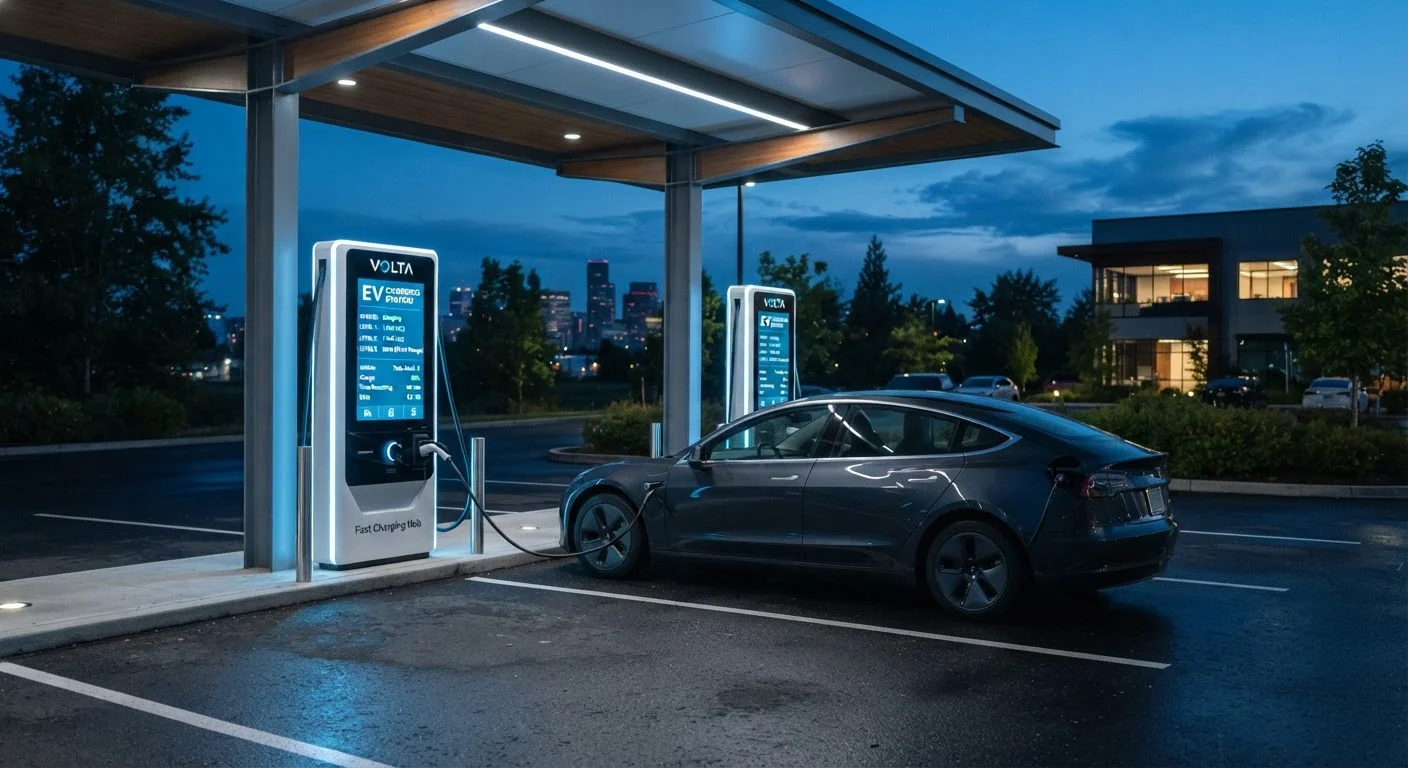
DC Fast Charging bypasses the vehicle's onboard AC charger entirely, delivering direct current straight to the battery. Output ranges from 50 kW at older stations to 350 kW at the most capable current installations. At peak throughput, a compatible vehicle can add 100-200 miles of range in 20-30 minutes.
Not all vehicles support DCFC, and those that do have a maximum accepted charge rate - a vehicle rated for 150 kW won't charge faster at a 350 kW station than at a 150 kW one. Connector standards matter here too: CCS (Combined Charging System) and CHAdeMO have historically dominated, while the NACS (North American Charging Standard, originating from Tesla) has seen growing industry adoption.
Frequent DC fast charging can accelerate battery degradation over time compared to regular AC charging - manufacturers generally recommend DCFC for travel rather than daily use. For a fuller picture of how powertrain type affects charging strategy, see EV vs. Hybrid: Which Powertrain Fits Your Driving Life.
Kilowatt (kW)
A unit of power measuring the rate of energy transfer. In EV charging, higher kW means more range added per hour. Not to be confused with kilowatt-hour (kWh), which measures total energy stored.
Onboard Charger (OBC)
The converter built into the vehicle that transforms incoming AC power into DC for battery storage. Its rated capacity caps how quickly Level 1 and Level 2 charging can proceed, regardless of the charger's output.
DCFC (DC Fast Charging)
A charging method that delivers direct current directly to the battery, bypassing the onboard charger. It enables significantly faster charge rates than AC methods and is primarily used at public highway and commercial stations.
CCS (Combined Charging System)
A widely used DC fast-charging connector standard in North America and Europe that combines AC and DC charging in a single port. It is supported by a broad range of non-Tesla EVs.
NACS (North American Charging Standard)
Originally developed by Tesla, NACS has been adopted by multiple automakers and is expected to become a dominant connector standard across North America.
State of Charge (SoC)
The current battery level expressed as a percentage of total capacity. Charging speed typically slows as SoC approaches 80-100% to protect battery health - this 'tapering' is normal behavior.