How the Two Systems Actually Work
The terms 4WD and AWD are used interchangeably in dealership brochures, but the underlying engineering is meaningfully different.
Four-wheel drive uses a transfer case to mechanically lock the front and rear driveshafts together, splitting torque in a fixed ratio - typically 50/50. Most 4WD systems offer a high-range mode for loose or slippery surfaces and a low-range mode that multiplies torque for extreme conditions. This mechanical coupling is powerful but inflexible: driving a locked 4WD system on dry pavement causes driveline binding - stress buildup in the drivetrain as the front and rear axles try to rotate at different speeds through turns.
All-wheel drive, by contrast, uses a center differential or electronically controlled clutch pack to distribute torque variably between axles and, in more sophisticated setups, between individual wheels. There's no locking action; instead, sensors continuously monitor wheel speed and slip, directing power where grip is available. Most AWD systems operate transparently - the driver does nothing.
Understanding this distinction matters for anyone comparing SUV drivetrains. For a broader look at how vehicle architecture shapes capability, see our article on body-on-frame vs. unibody construction.
| Criterion | Four-Wheel Drive (4WD) | All-Wheel Drive (AWD) |
|---|---|---|
| Engagement | Selectable (manual or auto modes) | Automatic, always active |
| Low-range gearset | Yes - standard feature | Rarely, if ever |
| Torque split | Fixed (often 50/50 locked) | Variable, electronically controlled |
| Pavement use | Not recommended in 4WD lock | Fully pavement-appropriate |
| Typical vehicle type | Body-on-frame trucks and SUVs | Unibody crossovers and SUVs |
| Off-road suitability | High - designed for it | Moderate - surface-level terrain |
| Fuel economy impact | Higher when 4WD engaged | Minimal - rear axle often decouples |
| Driver involvement | Mode selection required | None required |
Real-World Performance Trade-Offs
The performance gap between 4WD and AWD widens as conditions become more extreme. On a snowy city street or rain-slicked highway, a competent AWD system with appropriate tires performs exceptionally well - the electronics react in milliseconds, the transition is imperceptible, and fuel economy is preserved when the rear axle disengages on dry roads.
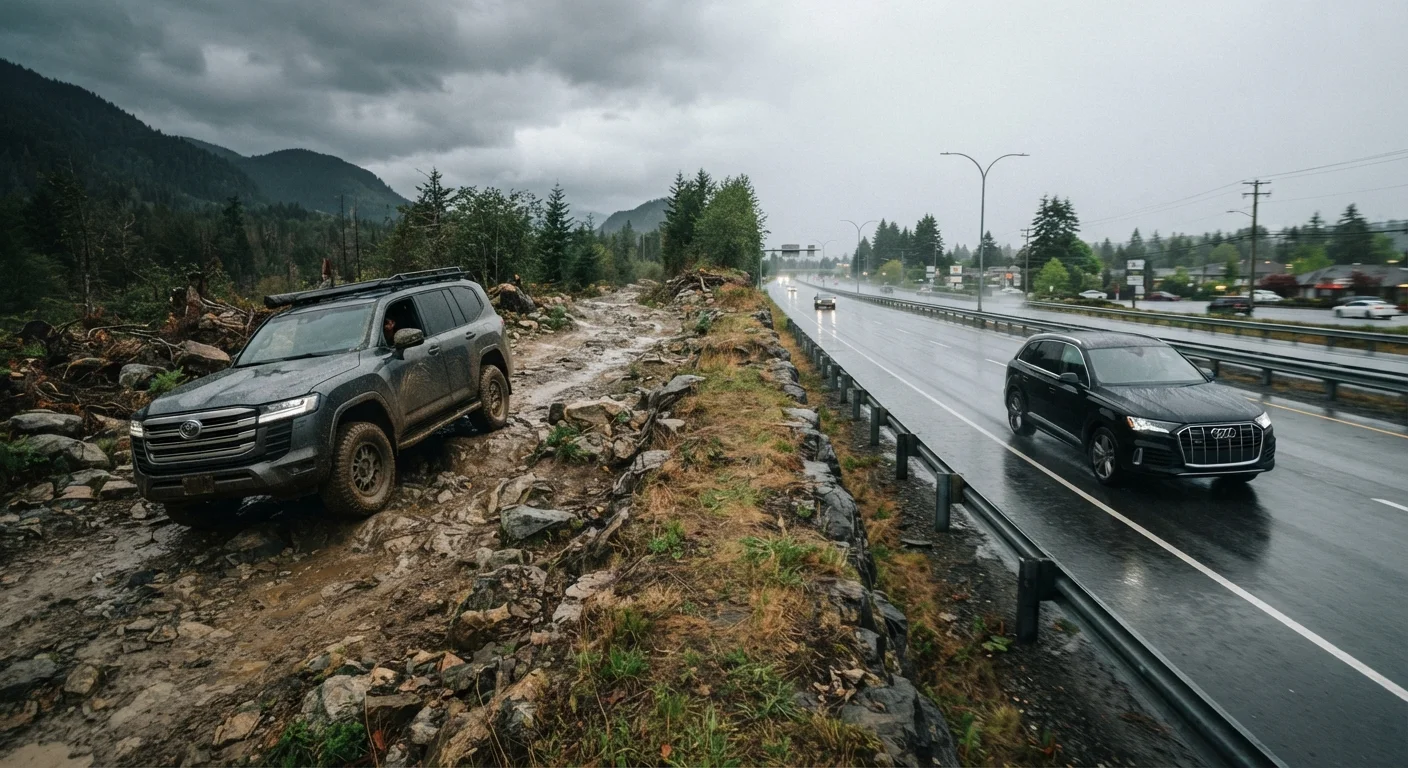
Push further - loose sand, deep mud, steep rocky trails - and AWD's limitations surface. Without a low-range gearset, the transmission cannot multiply torque to the extent that technical terrain demands. Clutch-pack AWD systems can also overheat under sustained slip conditions, something mechanical 4WD handles with more durability.
Conversely, a driver who commutes in 4WD High on dry pavement is accelerating drivetrain wear unnecessarily. 4WD is a tool for specific conditions, not a default driving mode.
~5-10%
Typical AWD fuel economy penalty vs. 2WD equivalent
EPA testing generally shows AWD variants consuming modestly more fuel than their two-wheel-drive counterparts across comparable models.
4:1
Common low-range gear reduction ratio in 4WD systems
A 4:1 low-range ratio quadruples available torque at the wheels, enabling controlled crawl over technical terrain that would stall a standard drivetrain.
For a detailed breakdown of the factors that determine genuine off-road performance beyond just drivetrain type, see what shapes off-road capability in trucks and SUVs.
Where Each System Belongs
The drivetrain choice should follow the buyer's actual use case, not marketing positioning.
4WD makes practical sense for buyers who tow trailers over rough launches, farm or work on unpaved property, or pursue overlanding and trail driving. These vehicles - typically body-on-frame trucks and traditional SUVs - are engineered around the transfer case and benefit from the mechanical simplicity and robustness 4WD provides. If extreme off-road engineering is where your curiosity leads, our piece on purpose-built off-road vehicles shows how far beyond stock 4WD the engineering can go.
AWD suits the majority of SUV buyers who want all-weather confidence without deliberate management. It's the right fit for crossovers, family haulers, and performance SUVs where the emphasis is on road behavior and comfort. The same AWD logic applies in the sedan segment - our comparison of FWD vs. AWD in sedans explores that trade-off in depth.
Part-Time vs. Full-Time 4WD
Not all 4WD systems work the same way. Part-time 4WD (common in trucks) requires the driver to engage and disengage the system manually and should not be used on dry pavement. Full-time 4WD uses a center differential to allow constant use across surfaces. Some systems labeled '4WD' in marketing operate more like AWD in practice - checking the owner's manual for actual operating modes is essential before purchasing.
One variable that applies equally to both systems: tire selection. No drivetrain configuration overrides inadequate grip at the contact patch. All-season tires on an AWD crossover deliver less winter traction than dedicated winter tires on a two-wheel-drive vehicle. That's a factor worth weighing alongside drivetrain type when evaluating all-weather capability.