Engineering Beyond the Factory: Why Stock Isn't Enough
Most factory trucks and SUVs are engineered for a broad market: they must commute efficiently, carry passengers comfortably, pass emissions testing, and comply with federal safety standards. Off-road capability is a feature among many, not the singular design mandate. Purpose-built off-road vehicles invert that priority structure entirely.
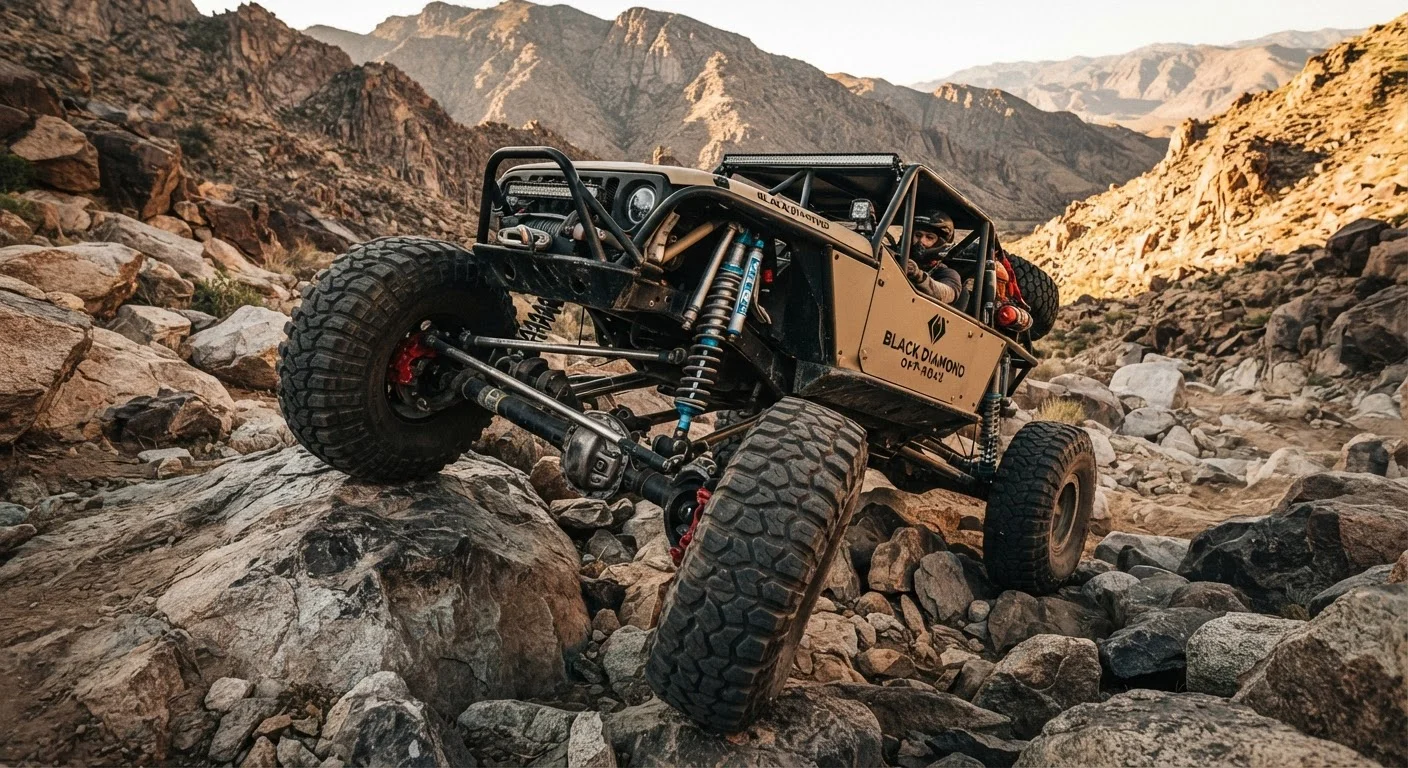
The engineering decisions that define this category - portal axles, flex frames, disconnecting anti-roll bars, and link-and-coil or long-travel independent suspension - exist because each solves a specific physical problem that stock hardware cannot. Understanding those problems clarifies why these machines occupy a distinct collector niche rather than simply representing expensive modifications to conventional 4x4s. For context on what factory trucks already offer, the variables shaping off-road capability explains the baseline from which purpose-built vehicles depart.
Not All 'Lifted' Trucks Are Purpose-Built
A lifted suspension and oversized tires visually resemble purpose-built engineering but do not replicate it. Body lift kits, leveling kits, and aftermarket suspension spacers improve aesthetics and modest trail performance without changing axle type, chassis compliance, or drivetrain torque multiplication. The distinction matters considerably when evaluating a vehicle's genuine capability or collector significance.
Portal Axles: Ground Clearance Through Gearing
A conventional solid axle places the differential and axle shafts at approximately wheel-center height. The lowest point of the axle housing therefore closely tracks the wheel centerline - and anything taller than that clearance will contact the axle before the tire lifts over it. Portal axles solve this problem architecturally rather than by simply lifting the whole vehicle higher.
In a portal setup, each wheel hub contains a separate reduction gearbox. The axle shaft terminates above the wheel centerline, connecting to a small gear cluster that transmits drive downward to the wheel. The physical result is that the axle housing clears terrain the wheels can reach - a substantial mechanical advantage on ledges, boulders, and water crossings. The secondary benefit is torque multiplication at the hub, meaning the differential itself is not required to produce all the low-speed torque needed for extreme obstacles.
Military vehicles - most notably variants of the Mercedes-Benz Unimog and certain NATO platform trucks - pioneered portal axles in production form. Their adoption in civilian purpose-built and expedition vehicles followed because the engineering advantages are unambiguous, not because they are fashionable.
20-40 in.
Typical suspension travel on purpose-built off-road vehicles
Compared to approximately 10-14 inches on most capable factory trucks, according to builder specifications common in the off-road fabrication community.
~4-6 in.
Additional ground clearance portal axles can add
Portal hub geometry raises the axle housing above wheel centerline, with specific gains depending on hub reduction ratio and tire size.
2:1 to 3:1
Typical torque multiplication ratio at portal hubs
Hub reduction gearing in portal axles multiplies torque at the wheel independently of the vehicle's main transfer case ratio.
Flex Frames: When the Chassis Must Yield
Suspension travel determines how far a wheel can move relative to the chassis. But on sufficiently uneven terrain, four wheels at the extremes of even generous suspension travel cannot all maintain ground contact simultaneously - unless the chassis itself can also flex. This is the problem flex frames address.
A flex frame - sometimes called a flexi-frame or articulating chassis - is engineered with deliberate torsional compliance along specific sections of the main rails. Rather than resisting twisting forces rigidly (as a conventional ladder frame or unibody does), the structure allows controlled, predictable flex that effectively extends the vehicle's articulation envelope. Combined with long-travel suspension, this means each wheel can seek its own ground plane across obstacles that would lift a conventional vehicle's opposing diagonal tires clear off the surface entirely.
Chassis flex is not the same as chassis weakness. Purpose-built flex frames incorporate high-strength chromoly or DOM steel tube, precisely triangulated to flex where intended and resist bending or buckling everywhere else. The fabrication complexity is significant, which is part of why these vehicles command specialist collector interest. This stands in contrast to the architecture covered in body-on-frame vs. unibody construction, where rigidity is the design goal.
“The chassis is not just the foundation - in a purpose-built rig, it is an active participant in the suspension system. Allowing it to flex in a controlled way is not a compromise; it is a design feature that took engineers decades to fully exploit.”
— Technical consensus among off-road fabricators, Reflected in fabrication literature and competition vehicle build documentation from the off-road community
Supporting Systems That Complete the Package
Portal axles and flex frames define the category, but they function within a broader engineering system. Long-travel suspension - typically link-and-coil four-link or three-link setups - provides the wheel travel that portal axles and flex frames extend further. Disconnecting anti-roll bars (sway bars) eliminate the lateral stiffness that normally limits suspension droop on the inside tire through a turn or over an obstacle; reconnection restores on-road handling stability.
Locking differentials, whether mechanical or air-actuated, ensure that torque reaches the tire with traction rather than spinning freely at the wheel that has lost contact. Skid plates fabricated from quarter-inch or thicker steel protect the transfer case, fuel tank, and steering components that would otherwise be vulnerable at the clearances these vehicles operate within. Taken together, these systems create capability that is genuinely qualitatively different from a well-optioned production 4x4 - not merely incrementally better.
For those considering how a purpose-built vehicle fits within a broader outdoor use case, overlanding vs. RV camping setups provides useful framing on how off-road capability translates to real-world expedition use. Once a capable rig is in hand, building a recovery and trail kit outlines the accessory layer that makes remote travel genuinely safe.
Inspect Flex-Frame Welds Before Buying
When evaluating a purpose-built vehicle with a custom flex frame, have a qualified welder or fabricator inspect all chassis welds - particularly at gussets, crossmembers, and suspension mounting points - before purchase. Poorly executed welds in these high-stress areas can develop cracks under load that are not visible during a casual inspection. This inspection step is especially important for competition-history vehicles that have seen heavy articulation cycles.