
What Each Architecture Actually Means
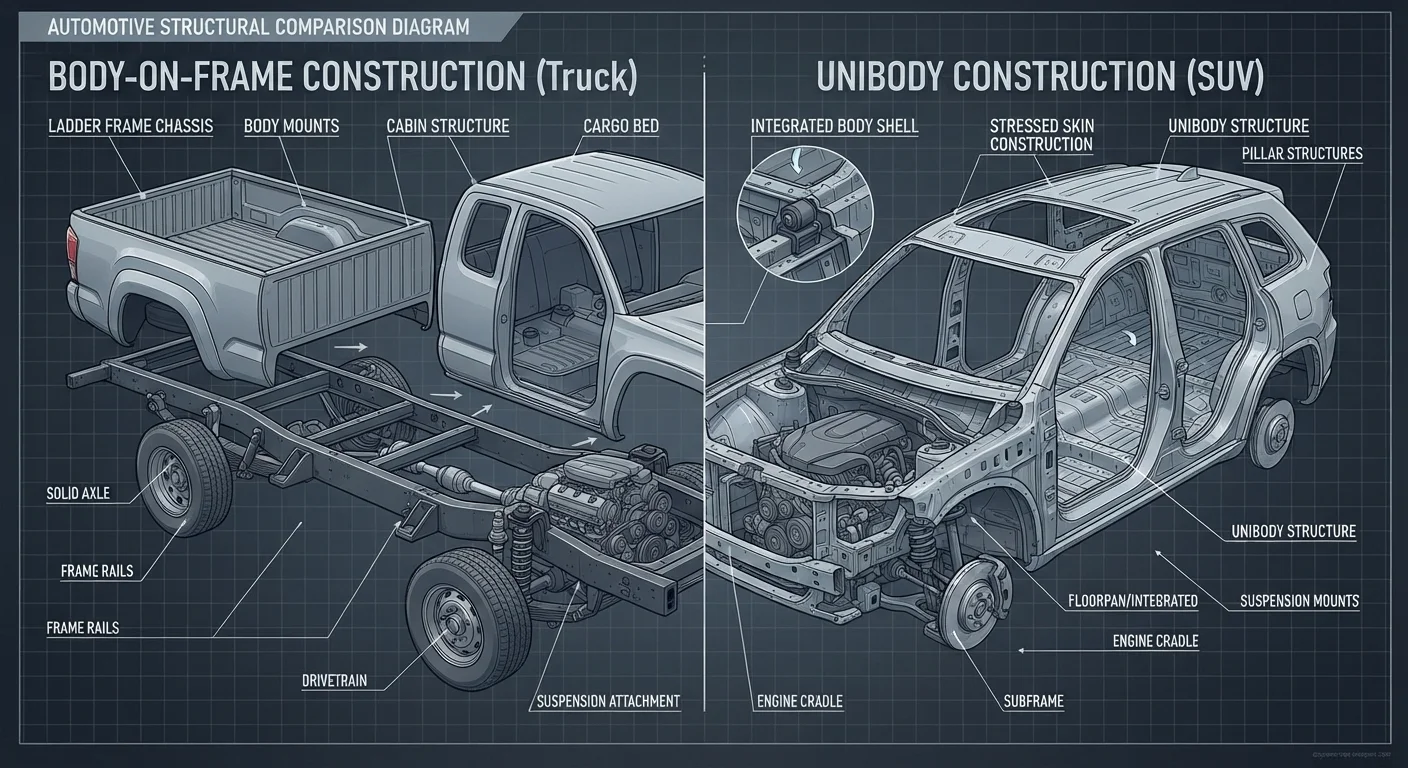
The terms sound technical, but the distinction is straightforward. In a body-on-frame vehicle, two separate systems are bolted together: a rigid ladder frame - two longitudinal rails connected by crossmembers - and a body structure that sits on top of it. The frame carries structural loads; the body handles everything else. Full-size pickup trucks and traditional body-on-frame SUVs like the Ford Expedition and Chevrolet Tahoe are built this way.
In a unibody vehicle (short for unit-body), the frame and body are stamped and welded into a single integrated shell. There is no separate ladder frame. The floor pan, pillars, rocker panels, and roof all contribute to overall rigidity. This is how virtually all passenger cars are built, and it's the dominant approach for crossover SUVs from compact to mid-size categories.
The architectural choice cascades into nearly every performance characteristic that buyers care about: towing capacity, payload, ride quality, handling, fuel economy, and long-term repairability. Understanding which direction those trade-offs run - and why - is the foundation for comparing any truck or SUV honestly.
| Criterion | Body-on-Frame | Unibody |
|---|---|---|
| Construction method | Separate ladder frame + body | Integrated frame-and-body shell |
| Typical tow capacity range | 6,000-20,000+ lbs | 1,500-5,000 lbs |
| Ride quality | More vibration, improved with isolation mounts | Smoother, car-like refinement |
| Handling agility | More body roll, higher COG | Sharper, lower center of gravity |
| Repairability after damage | Frame can be repaired independently | Structural repairs more complex |
| Fuel efficiency | Generally lower (heavier platform) | Generally better (lighter construction) |
| Common vehicle types | Full-size trucks, traditional full-size SUVs | Crossovers, mid-size SUVs, passenger cars |
| Off-road suspension flex | Greater independent body articulation | More limited by integrated structure |
Towing, Payload, and Structural Strength
This is where body-on-frame holds its most durable advantage. A ladder frame is purpose-designed to resist the bending and twisting forces that heavy towing imposes. Engineers can specify frame steel gauge, crossmember placement, and hitch integration points independent of the body. The result: full-size body-on-frame trucks routinely achieve maximum tow ratings above 10,000 lbs when properly configured, and some reach significantly higher.
Unibody structures are engineered to be stiff under normal driving loads, but that stiffness comes from distributed stress management across the entire shell. Add substantial tongue weight from a trailer, and the stress concentrations at the rear hitch area work against the design's assumptions. Tow ratings for unibody crossovers typically range from 1,500 to 5,000 lbs depending on platform and powertrain - adequate for light trailers and small boats, but a hard ceiling for heavier loads.
For a detailed look at how these limits translate to real-world scenarios, see SUV towing realities - the structural architecture behind each class is a primary factor in what crossovers and full-size SUVs can actually handle.
~2x
Tow capacity advantage: body-on-frame vs. unibody SUVs
A typical body-on-frame full-size SUV is rated at roughly twice the maximum tow capacity of a comparably sized unibody three-row crossover.
400-800 lbs
Approximate platform weight difference
Body-on-frame platforms generally add several hundred pounds compared to unibody equivalents of similar size, a factor that directly affects fuel economy and payload math.
10,000+ lbs
Tow rating threshold exclusive to body-on-frame
No production unibody vehicle currently achieves a tow rating above 10,000 lbs; that ceiling remains the domain of ladder-frame trucks and SUVs.
Ride Quality, Handling, and Daily Drivability
Unibody construction wins decisively here. Because the body contributes to overall rigidity, engineers can use lighter, more precisely tuned suspension components and calibrate damping for a car-like ride. There's also less opportunity for the low-frequency shudder and harshness that can transmit through a body-on-frame vehicle's mounting bushings - particularly on older platforms or when towing near rated capacity.
Body-on-frame trucks have improved substantially in this regard over the past two decades, with rubber-isolated cab mounts and independent front suspension becoming standard on most modern full-size trucks. But the physics don't disappear. A separate frame introduces more potential paths for vibration transmission, and the vehicle dynamics of a body-on-frame platform - higher center of gravity, longer wheelbase relative to track width - generally produce more body roll and a less agile feel in corners compared to a comparable unibody crossover.
For buyers whose use case straddles commuting and moderate off-road use, 4WD vs. AWD system design is another architecture-level decision that intersects with this one - body-on-frame trucks more commonly pair with true part-time 4WD, while unibody crossovers almost exclusively use full-time or on-demand AWD.
Off-Road Durability and Repairability
Body-on-frame platforms carry a structural repairability advantage that matters in genuine working or off-road contexts. If frame damage occurs, qualified shops can often repair or section the ladder frame without replacing the entire vehicle structure. Body panels can be swapped without structural consequence. This is why body-on-frame trucks dominate commercial, agricultural, and expedition-use categories where field repairability is a real concern.
Unibody repair after significant structural impact is more complex. Because the shell is load-bearing, damage to any section - even from a moderate collision - can compromise the entire structure's calibrated stiffness. Modern repair techniques and measuring systems address this, but the process is more involved and the threshold for declaring a vehicle a total loss tends to arrive sooner.
Off-road capability variables like suspension travel and approach angles interact with frame type in meaningful ways - body-on-frame designs allow more suspension flex relative to the body, which is why dedicated trail rigs have historically favored this architecture. For the engineering extremes this enables, purpose-built off-road vehicles push frame-based thinking to its logical limit.
Why 'SUV' Doesn't Define Construction
The SUV label covers two fundamentally different construction types. Traditional full-size SUVs like the Chevrolet Tahoe and Ford Expedition share their body-on-frame platform with full-size pickup trucks. Mid-size and compact SUVs - including most three-row crossovers - use unibody construction derived from passenger car platforms. When comparing SUVs, confirm the underlying architecture before assuming capability will be similar.
Matching Architecture to Your Actual Use Case
The practical question isn't which construction method is superior in the abstract - it's which one matches your real workload. If you're comparing two SUVs of similar size with meaningfully different tow ratings, construction architecture is almost certainly a primary reason. A body-on-frame three-row SUV rated to tow 8,000 lbs and a unibody three-row crossover rated to 3,500 lbs are not the same category of vehicle despite appearing comparable on a spec sheet.
For truck buyers weighing platform size against daily practicality, full-size vs. midsize truck trade-offs are worth reviewing - both segments are body-on-frame, but the capability gaps are real. And for a broader framework that maps specific use cases to vehicle categories, truck and SUV ownership for utility provides structured guidance without pushing toward any single recommendation.
Construction architecture is durable, foundational information - it doesn't change with a model-year refresh or an optional package. Understanding it positions you to read between the lines of manufacturer marketing and identify which vehicles are genuinely built for the work you need done.